Manchester
& the Northwest Region of England
Papillon
Graphics'
Virtual Encyclopaedia of Greater Manchester
Including
Bolton, Bury, Manchester, Oldham, Rochdale, Salford, Stockport, Tameside,
Trafford & Wigan
NAVIGATION
Virtual
Hosting by
TheServerBank
The
Ten Boroughs of Greater Manchester
Greater
Manchester
Eight
Boroughs and Two Cities
The geographical divisions of the region give rise to a great
deal of confusion. Outsiders invariably refer to the wider region
of the North West of England as "Manchester". Geographical terms
like "Manchester", "Lancashire" or "Greater Manchester" are
freely interchanged as if they all meant the same thing - much
to the annoyance of the many residents of the 10 towns which
now make up the Greater Metropolitan County of Manchester.
Local
Loyalties No
matter whether the dialect is Oldham, Cheadle, Gatley, Westhoughton,
Macclesfield or Rossendale, outsiders refer to them all as "Mancunian"
or "Lancashire". It is little wonder that the peoples of Salford,
Stockport, Oldham, Rochdale, Tameside, Trafford, Bury, Bolton
and Wigan fiercely defend their right to be called Stopfordians
(natives of Stockport), Ashtonians (natives of Ashton), Mancunians
(natives of Manchester), or Boltonians (etc), and it is right
and proper that they should. Salford, for example, was an important
township when Manchester was little more than a hamlet on Salford's
outskirts - Salfordians grow visibly annoyed at being called
Mancunians.
The Metropolitan
Boroughs of Greater Manchester This characteristic is not unique to North West England,
of course. Manchester is, first and foremost, a city, with a
clear boundary marking where it ends and where Stockport, Salford,
Oldham, or any of the other 10 Metropolitan Boroughs begin.
Manchester is also one of the discreet Boroughs of Greater Manchester
Metropolitan County which was invented in 1974 as an administrative
entity. At that time its new Metropolitan boundaries were created,
comprising 2 cities in their own right (Manchester and Salford),
six towns (formerly County Boroughs - Bury, Bolton, Oldham,
Stockport, Rochdale and Wigan), and 2 newly created boroughs
- Tameside and Trafford. These last two stand out as somewhat
of an oddity as there is no geographical place called Tameside
or Trafford.
The title of "Greater Manchester" is a largely convenient
entity for practical administrative purposes, though all the
10 metropolitan borough towns of which it is comprised have
a real confederation and act as one body in many respects, though
it still remains in many ways chiefly a postal, geographical
and political distinction.
The Metropolitan
Boroughs of Greater Manchester are (in alphabetical order):
Visitors
need to be certain what they mean when making such distinctions,
and tread warily lest local sensibilities are offended by well-meaning
though insensitive gaffs. (The author frequently receives irate
letters and email from individuals defending their god-given right
to belong to Lancashire and not to what they see as a fictitious
and nebulous administrative body as Greater Manchester).
To demonstrate the sensitivity of such terminology, when the boundaries
of Metropolitan Boroughs were created in 1974, there was a proposal
to rename the new Oldham Metropolitan Borough as 'Newham' or 'Milltown'
- the proposal was, needless to say, most heavily defeated on
account of considerable local opposition to it. There was even
a move afoot to name what eventually became Greater Manchester
as 'SELNEC' - (South East Lancashire North East Cheshire). That
too, happily, was booted out of court.
Further, when in 1986 the Greater Manchester Metropolitan County,
along with all other Metropolitan Counties, was formally abolished,
much of its administration infrastructure remained in place (just
to confuse things), and for several years the costly County Hall
built on the corner of Piccadilly gardens stood forlorn and empty.
Hence, fierce arguments take place between two opposing lobbies
- those who maintain that Bolton, Bury, Oldham, etc, are back
in the County of Lancashire, (and that they never really left
it), and those who believe they are now firmly fixed in the County
of Greater Manchester.
Bearing in mind this understandable partisan spirit, it's clear
that we need to distinguish between Manchester (the City), Greater
Manchester (the Metropolitan County) and the County of Lancashire.
We have tried to do this and are most happy for the people of
Wigan, Rochdale and the other townships to consider themselves
in Lancashire, and for Stockport to remain in Cheshire. As to
Trafford, which acquired lands both from Cheshire and Lancashire,
we cannot say. However, Manchester itself is clearly a focal point.
Whatever you decide to call the place, it is unequivocally the
hub of a large county.
Local civic
pride and sensibilities aside, most people throughout the region
naturally look to Manchester as its headquarters. In this website
we have used Manchester as a base, and clearly the large part
of it is devoted to the City and to the townships within its
sphere of influence, but the website also ventures as far north
as Hadrian's Wall,
and the Lake District,
and south to the Staffordshire
Potteries - from Liverpool
and Chester in the West,
and to the Peak District of
Derbyshire in the east. Due to its centrally located position,
Manchester is a good base for wider tourism throughout this
region, an important regional hub, and we have therefore included
places that might reasonably visited by motorcar or public transport
and back in a day trip. (See "Day
Trips From Manchester").
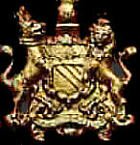
The Arms
of the City of Manchester
The Armorial
Bearings
"Gules, three bendlets enhanced Or; a chief argent, thereon
on waves of the sea a ship under sail proper. On a wreath of
colours, a terrestrial globe semée of bees volant, all proper.
On the dexter side a heraldic antelope argent, attired, and
chain reflexed over the back Or, and on the sinister side a
lion guardant Or, murally crowned Gules; each charged on the
shoulder with a rose of the last. Motto : Concilio Et Labore"".
Explanation
of the Arms
The Shield : red (Gules) with three gold (Or) bands drawn diagonally
across to the right hand side. The white (Argent) top segment
(the Chief), shows a ship at sea in full sail. This is a reference
to the city's trading base and to the Manchester Ship Canal.
Crest : On a multicoloured wreath stands a terrestrial globe,
signifying Manchester's world trade, and covered by a swarm
of flying bees. The bee was adopted in the 19th century as a
symbol of industry - Manchester being the birthplace of the
Industrial Revolution. Supporters : On the left a heraldic antelope
with a chain attached to a gold (Or) collar, representing engineering
industries, and hanging at the shoulder, the red rose of Lancashire,
in which county Manchester once was. On the right a golden lion
stands guardant (facing us), crowned with a red (Gules) castle
(a reference to the Roman fort at Castlefield from which the
city originated). The lion also wears the Lancashire Rose. Motto
: "Consilio et Labore" - loosely translated "wisdom and effort".
Manchester's
Future - What Next?
Positions
are continually shifting, and even as this is being written mechanisms
are in motion to restore the old historic counties of Lancashire
and Cheshire to their former status. The Greater Metropolitan
Counties, (so much disliked for so long by so many), seem doomed
to eventual removal from the popular consciousness. Already new
Unitary Authorities like Blackburn & Darwen, Blackpool, Halton
and Warrington have been created, moving the administrative centres
away from the old County Councils and Metropolitan Counties.
For several years now Ordnance Survey maps and road atlases have
ceased depicting the administrative counties of Greater Manchester
and Merseyside, but show the Unitary Authorities of Southern Lancashire
and North Cheshire instead. This suggests that towns like Blackburn
and Blackpool may no longer be shown as part of the County of
Lancashire. (More confusing than ever) !!
Lancashire
Lancashire is an old historic county which lies mainly to
the north and west of the City of Manchester. Preston is the
County Town and administrative centre of the county (and notLancaster, as
many would, logically, think).
Before regional reorganisation in 1974 there existed the City
of Manchester, surrounded by several "satellite"
County Boroughs - these included Bury, Bolton, Oldham, Rochdale
and Wigan, and were unequivocally located in the County of
Lancashire.
Salford was a city in its own right and therefore already
of independent county status like the City of Manchester itself.
Stockport lay in the County of Cheshire.
Most local residents in these old Lancashire townships still
regarded themselves as Lancastrians and so passionate did
many feel about the loss of "their native county"
that they formed an association called 'Friends of Real Lancashire'.
(See: http://www.forl.co.uk). This movement proudly defends
the historic County Boundaries. They maintain:
"Our
county is called Lancashire, not Cumbria, Greater Manchester,
Merseyside or part of Cheshire."
Thus,
many Boltonians fiercely insist that they live in Lancashire,
not in Greater Manchester, as do many Oldhamers, Wiganers
and Rochdalians!! Even more confusingly, parts of Trafford,
and Stockport used to be within the County of Cheshire. This,
despite the fact that all the residents of these boroughs
still pay a proportion of their Council Tax to Greater Manchester
(for police, fire and transport, services, etc), and not
to Lancashire County Council.
Not everybody agrees with the 'Real Lancashire' viewpoint,
of course, as many will not agree with that expressed by us
here. Readers must decide for themselves what they believe
to be true in this contentious debate.
(See also: Lancashire Main Entry).
Here are
a few sources on the subject:
"The
local Government Act 1972 did not abolish traditional counties,
only administrative ones. Although for local government
purposes some of the historic counties have ceased to be
administrative areas, they continue to exist for other purposes."
(Department of the Environment, 3 September 1991).
"The
new county boundaries are administrative areas and will
not alter the traditional boundaries of counties"
("The Times", 1st April 1974)
"Legislation
enacted for the creation of the administrative county was
for the purpose of local government and did not affect the
geographical boundaries of the County Palatine."
(Duchy of Lancaster Office, 4 March 1996).
We
are indebted to Doreen Ainscough for providing the above
sources.
"We
have received large numbers of representations from people
living in Merseyside and Greater Manchester who still consider
themselves Lancastrians and who would like to see the reinstatement
of the historic county. (Similar views have been expressed
in Barrow and the Furness area of Cumbria which was also part
of Lancashire before 1974.)"
Local Government Commission Draft Recommendations, June 1994.