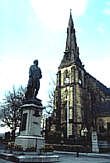
St Mary's Church
and the RobertPeel
Monument

Bury Town Hall

The War Memorial
Gardens

The Peel Tower,
Holcolmbe Hill

Part of the new
market Hall
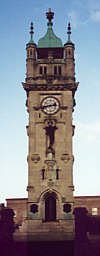
Memorial Clock
Tower
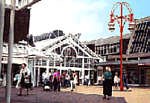
Millgate Shopping
Centre
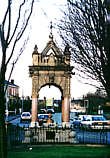
Drinking Fountain,
Manchester Road |
Bury
Bury is known
regionally as a town whose thrice-weekly market, held on Wednesdays,
Fridays and Saturdays, draws crowds of shoppers from far and wide.
Its popularity has also been recently enhanced by the Metrolink
tram/train service which terminates at Bury, and the reopening
of the East Lancashire Light Railway
which runs daily from Bury (Bolton Street) to Rawtenstall. The
town is famous also for paper-making, which has declined somewhat
since its heyday, and the notorious Bury Black Pudding, a local
delicacy, served boiling hot and eaten as a takeaway snack (available
at the town's market on market days).
Outside the parish church, at the end of The Rock, stands a monument
to one of Bury's most celebrated men, Sir Robert Peel, Prime Minister,
and founder of the Metropolitan Police Force
Bury
Town Hall is a striking modern (if rather bland) building, set
around with pleasant gardens - it was opened by Her Majesty The
Queen in 1954. In the past decade, much of the town centre has
been developed as a large covered shopping mall - The Millgate
Precinct. Some 5 miles distant on Holcombe Hill overlooking the
borough, stands the monument to Sir
Robert Peel - the austere Peel Tower.
Origins
& History of Bury
The name Bury,
(also earlier known as "Buri" and "Byri")
comes from a Saxon word, probably meaning "a stronghold". In ancient
times the whole area was almost certainly covered in woodland,
marsh and moorland and was probably inhabited by nomadic herdsmen.
A Bronze Age funeral barrow has been located at Whitelow Hill
in nearby Ramsbottom. Several ceramic urns were unearthed here
and are now on display in the Bury Museum.
The Romans are believed to have arrived in Bury around 78 AD and
Agricola, the Governor of Britain built roads out from his new
fortress as Mamuciam (the origin of Manchester), one of which,
Watling Street, crossed the Borough through Prestwich across the
River Irwell at Radcliffe and continuing on through Affetside
towards to Ribchester.
Parts of the road are still visible today particularly around
Affetside. It has been suggested that the village of Ainsworth
may be near to or the site of Roman Coccium as the place has always
been known by the nickname "Cockey Moor".
During medieval times most of Bury was held by the the De Montbegons,
Lords of the Manor of Tottington. This barony had been granted
to Roger De Poitou at the end of the 11th century. By the 14th
century, the manor had passed into the possession of the Pilkington
family until 1485 when the lands of Sir Thomas Pilkington were
forfeited because of his allegiance to Richard III.
Later, under a new king, Henry, the lands were granted to one
of his staunchest supporters, Thomas, Lord Stanley, who for his
services was created Earl of Derby. The Stanley family have been
Lords of the Manor ever since. In the south of the area most of
the land was acquired by purchase of Lord Grey de Winton and his
successor, the Earl of Wilton, is still the present owner.
In the Middle Ages the "Black Death" led to a shortage of labour.
Land previously ploughed fell into decay. Large areas were turned
into pastures and sheep were reared. It was at this time that
Bury appears to have become a centre for wool and woollen cloth.
Little had changed in Bury until the beginning of the 18th century,
when a revolution took place in the textile world. John Kay, born
at Walmersley in Bury, developed the so-called "Flying Shuttle"
and revolutionised cotton weaving, hastening the progress of weaving
as a fully mechanised industrial process.
During the Industrial Revolution the town of Bury grew at an astonishing
rate. In 1791 called the Manchester, Bolton and Bury Canal Company
was formed, and thereafter coal was brought to the town by narrowboat
directly from Worsley through the Bridgewater Canal and Castlefield
Basin in Manchester. Little of the original canal is still in
existence, but happily, the Manchester Bolton and Bury Canal Society
are systematically restoring the navigation around Radcliffe.
Canal trips are now possible once more.
The area has always had a military connection with the Lancashire
Fusiliers Regiment (later "The Fusiliers") based at their
headquarters on Bolton Road. Since their founding 300 years ago
they have many battle honours including Gallipoli in the Great
War, winning six VCs.
Paper manufacturing has been a major industry in the area since
the last century and until relatively recent times had brought
much wealth and prosperity to the town. Today there remain no
more than a handful of the mills which once placed Bury among
the most important paper making centres in Europe.Large paper
manufacturing companies like Bibby and Baron, Ramsbottom's Trinity
Paper Mills, and the East Lancashire Paper Mills, produced much
of the nation's paper requirement until quite recent times. Sadly,
East Lancs paper Mill, the last remaining in Radcliffe, closed
down in 2001. Much of the world's paper-making machinery was also
manufactured in Bury. Courses on paper-making are still run at
Bury College. Today, many of its surviving mills concentrate on
processing recycled fibres, and the town is regaining some of
its past pre-eminence in paper manufacture, with the Fort Sterling
factory at Ramsbottom having recently invested £70 million in
paper-making processing.
See Also:
|