Bolton,
Greater Manchester & the Northwest of England
Papillon
Graphics' Virtual Encyclopaedia of Greater Manchester
Including
Bolton, Bury, Manchester, Oldham, Rochdale, Salford, Stockport, Tameside,
Trafford & Wigan
NAVIGATION Virtual
Hosting by
TheServerBank
Photos
by Gary Burns
Visit www.boltoninfo.net
for all kinds of information about Bolton.
News, events, what's on, help, advice, youth, forums, etc.
Take
a look now
The
Town & Borough of Bolton
In the Greater Manchester Metropolitan County
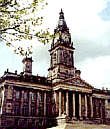
Bolton Town Hall
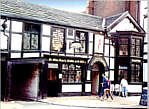
The Old Man &
Scythe Inn
Plaque marking
the last place of abode before the execution of James Stanley, Earl
of Derby
The township
of Bolton has developed over the centuries from a small village
settlement set in the moors of Lancashire to a major modern township.
Situated about 15 miles to the north-west of Manchester city centre,
along the M60 & M61 motorways and the A666. It was considered
important enough to be attacked three times during the course
of the English Civil War. However, Bolton is best known for its
industrial heritage, its inventiveness and its cotton manufacturing
and thereby to the establishment of Bolton as one of many Lancashire's
mill towns that led the way in the Industrial Revolution. Effectively,
Bolton became a boom town in the 19th century, as its population
grew from around 17000 in 1800 to 10 times that number by 1900.
Cotton was
always the dominant local product, though there were other industries
that flourished in the locality - trades such as engineering,
the building of the railways which fostered all late 19th century
industry, as well as the now extinct local mining industry.
Bolton
Origins
After the
Norman Conquest of Britain, Bolton was given by William the
Conqueror in 1067 to Roger de Pitou, whose family, the Montgomerys,
held it until 1200 when it passed by marriage to the Earl of
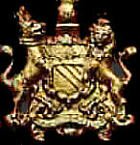
Derby. The coat of arms shows an arrow (or "bolt") through a
crown. The arrow may have referred to the key role which Bolton
archers are said to have played in the defeat of the Scots at
Flodden Field in 1513. The crown itself represents the wooden
stockade which surrounded the Saxon village - known as a "tun"
or "ton" (the origin of the word town) - hence "bolt-tun".
In
1251, William de Ferrers obtained a Royal Charter from king
Henry III for a market and fair to be held in Bolton. By 1253,
Bolton had been granted another Charter making it a free borough
and a market town. It still boasts one of the largest and finest
shopping centres of any of the towns around Manchester - from
the new shopping complex at Knowsley Street to the big Market
Hall, and the excellent fish and vegetable markets at Moor Lane.
Bolton
during the Civil War
In the 17th
century, Bolton was a Puritan stronghold and sided with the
Parliamentarian cause against the Royalists. It is said that
the Civil War began in Preston, the first battle was in Manchester,
but at Bolton the fight was bloodier and at its most intense.
Bolton suffered three attacks during the Civil War, led by James
Stanley, the Earl of Derby and Prince Rupert. Bolton
finally fell to the Royalists in 1644 when their forces entered
the town and carried out the only massacre of the Civil Wars.
After the war, when the Royalist cause was lost, Derby was tried
and sentenced for the massacre. Ye Olde Man & Scythe pub, (pictured
above left) is the place where James, the seventh Earl of Derby
stayed the night before his execution on Churchgate in 1651.
A cross outside the pub bears plaques which relate stories of
Bolton through the ages.
Bolton-le-Moors
Until the
19th century, Bolton was properly known as "Bolton-le-Moors"
and the Parish Church of St Peters is still officially called
"St. Peter's, Bolton-le-Moors". Before 1830, the town was run
by 2 authorities, Great Bolton with 40 representatives, and
Little Bolton with 30, the two separated by the River Croal.
Locally, the trustees for Great Bolton were known as the "Forty
Thieves". Its wealth was built on textiles; Flemish émigré
weavers settled in Bolton around 1337 and introduced spinning
and weaving to the area, as well as bringing clogs, which were
absorbed into the local culture. Cotton spinning and weaving
was a large concern, employing over 15,000 men and 21,000 women
by 1911. By
1929 Bolton had 216 cotton mills and 26 bleaching and dyeing
works. Sadly the 20th century decline in the Lancashire cotton
industry took a heavy toll on Bolton's workforce - by the 1980s
it had fallen to around 2,500 men and women.
Bolton's
Eight Townships
Bolton Borough
is made up of eight towns: Farnworth, Kearsley, Blackrod, Little
Lever, Westhoughton, Horwich, South Turton and Bolton. Presently
it has a population of around 261,000 and covers an area of
some 54 square miles - 93,000 people presently work in the borough.
Graham
Shorrocks: "A Grammar of the Dialect of the Bolton Area.
Part I". Introduction, Phonology. Bamberger Beiträge
zur Englischen Sprachwissenschaft (University of Bamberg Studies
in English Linguistics) 41. Frankfurt am Main, Berlin, Bern,
New York, Paris, Vienna: Peter Lang, Europäischer Verlag
der Wissenschaften, 1998. ISSN 0721–281X; ISBN 3–631–33066–9;
US-ISBN 0–8204–3565–1.
Graham
Shorrocks: "A Grammar of the Dialect of the Bolton Area.
Part II". Morphology and Syntax. Bamberger Beiträge
zur Englischen Sprachwissenschaft (University of Bamberg Studies
in English Linguistics) 42. Frankfurt am Main, Berlin, Bern,
New York, Paris, Vienna: Peter Lang, Europäischer Verlag
der Wissenschaften, 1999. ISSN 0721–281X; ISBN 3–631–34661–1;
US-ISBN 0–8204–4323–9.