|
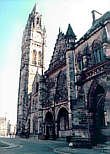
Rochdale Town Hall
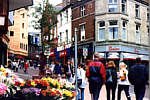
Yorkshire Street
- shopping centre

A motorway welcome
to Rochdale
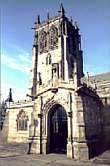
Parish Church
of St Chad

The original
Rochdale Pioneers Co-operative
|
Rochdale

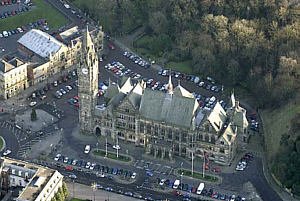
Rochdale and the Pennine Hills
Aerial Photo
Courtesy of www.webbaviation.co.uk
© 2005
CLICK ON IMAGE TO ENLARGE
Rochdale is
probably best known as the birthplace of the singer, Gracie
Fields, and of its former Liberal MP, Sir
Cyril Smith, known locally as "Big Cyril", who still lives
in the town. It
is also the birthplace of the Co-operative Movement.
The
present Metropolitan Borough was formed out of six independent
local authorities in the early 1970s - Heywood, Littleborough,
Middleton, Milnrow, Rochdale and Wardle - and stretches from the
north-eastern side of Manchester to the Pennines and the borders
of South Yorkshire. Rochdale
is the main town and is the administrative and commercial centre
of the borough.
Rochdale
was a major weaving district, and the upper floors of cottages
in towns like Wardle, Littleborough and Milnrow still bear evidence
of Weaver's windows, where cotton, and earlier wool, was woven.
History
of Rochdale
Rochdale appears
in the Domesday Book under the name of Recedham Manor, and was
part of the Salford Hundred. Ownership of the manor belonged to
the Crown in 1399, and continued so until it was purchased by
John Byron in 1638. It was eventually sold by the poet Lord Byron
in 1823, when it passed to the Dearden family, who still hold
the title. In earlier medieval times, Rochdale had been an important
market town, with weekly markets held from the 13th century, and
an annual fair. The market was held outside the parish church,
and had a long-standing "Orator's Corner". The
local reformer and Rochdale MP, John
Bright spoke here on Anti-Corn Law Reform.
By Tudor times
it had already become an important area for the manufacture of
woollen cloth. The present St Chad's parish church was built in
1194, on the site of an earlier church which dates from 769 AD.
It was not until 1891 that the town stocks were removed from near
the church gates. By the eighteenth century, as steam power took
over in the new textile mills, the many fast-flowing streams which
ran down from the neighbouring Pennine Hills made Rochdale, and
its six towns, very strategically placed to develop textile production
into a fully mechanised and productive industry.
Most
of the mills have now gone. Yet there survive many vestiges of
its mechanisms, its millponds, water channels and converted mill
buildings. The Cheesden Valley, a pleasant country walking trail,
high above Heywood still has industrial remains of this era, and
the Ellenroad Steam
Engine, near Milnrow has been restored to a fully working
condition.
The
industrial wealth of Rochdale, and its growing importance as an
industrial and political entity, resulted in the town being grant
Municipal Borough status in 1856, upon which the council immediately
sought to build a fine new Town Hall (pictured top left) as a
matter of civic pride. Suitable land was purchased alongside the
River Roch, and a competition to design a new town hall was announced.
The foundation stone of the winning design, by William Henry Crossland
of Leeds, was laid on 31st March 1866 and the building was completed
in September 1871 at a total cost of £160,000. It is a grand,
imposing and elegant building, which dominates the approach to
the town from Manchester. Its two main features are the porte-cochère,
an entrance porch large enough to receive and shelter horse-drawn
carriages, and its bell tower, a campanile-type structure, separated
from the main building.
Later,
the River Roch was paved over, and still runs beneath the town
centre, in order that trams could be routed into the town. Trams
ran until November 1932.
See
Also:
|