|
NAVIGATION









































Virtual
Hosting by

TheServerBank
Photos
by John Moss
|
 |
 |
The
Town & Borough of Rochdale
In the Greater Manchester Metropolitan County
|
|
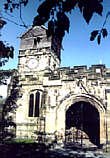
St Leonards Parish Church, Middleton
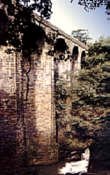
Healey Dell Viaduct
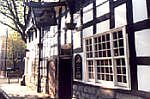
The Old Boar's
Head Inn Middleton
|
Rochdale
One of Rochdale's
oldest buildings is the present Lloyd's Bank in Lord Square. It
originated in 1705. It is believed that this was the site of the
original Rochdale settlement, and stands on part of the original
market square. Originally called Union Buildings, it was the headquarters
of Jacobite rebels in 1745. It was subsequently an inn, and then
in the late-19th century it became shops and offices. Lloyd's
Bank Limited took possession in 1930.
St Chad's
Parish Church, Rochdale
Standing on
Sparrow Hill, St Chad's overlooks the town centre - it is Rochdale's
oldest building and originated in Saxon times. The tower dates
from 1190 and parts of the churchyard wall are pre-1066. In the
churchyard lie buried John
Collier (also known as Tim Bobbin). The church represents
many different styles and periods of architectural building, although
it was sorely neglected in the early 19th century, and considerable
restoration was carried out in 1873, as well the addition of the
topmost section of tower, carried out by Crossland, the designer
of Rochdale Town Hall.
St Leonard's
Parish Church, Middleton
This is a
Grade 1 Listed building, being of both architectural and historical
importance. Its tower dates from 1412, and much of its stonework
comes from earl 12th century Norman origins.
|
A school
existed here since 1412, founded by Thomas Langley, Bishop of
Durham and Chancellor of England. The school survives as Queen
Elizabeth's Senior High School, it being the oldest founded
school in Greater Manchester. A great deal of extension and
improvement was done by Lord Richard Assheton as thanksgiving
for his delivery at the Battle of Flodden in 1513, and there
is a Flodden Stained Glass Window bearing the names of Middleton
archers who fought there. Around the year 1700 a wooden steeple
was built on top of the tower and in 1714 a set of 5 bells were
installed, later to be increased to eight, and these regularly
rang the curfew until 1939, and still do so on special occasions.
Modern Rochdale
Although
modern Rochdale still has its fair share of industrial and commercial
development, the major part of the borough is open countryside,
or within view of it. To the north and east, the landscape is
dominated by Pennine moorlands, while the south and west abounds
in pleasant river valleys, farmland and woodlands.
The
whole Metropolitan Borough lies in the wide valley created by
the Rivers Roch, Beal and Irk. The Rochdale Canal runs through
the borough on its trans-Pennine route from Manchester to Huddersfield
and beyond. Open Air and Leisure facilities are wide and varied,
from the 155 acre Country Park at Hollingworth Lake to the Cheesden
Valley which once ran 15 watermills and is now a conservation
area. Fine country walks can be found around the Naden and Greenbooth
Reservoirs, there is a Nature Reserve at the Ashworth Valley
and Healey Dell, as well as the Piethorne Valley with its great
walking opportunities and views.
Rochdale
also has 8 Golf Courses within its border, 5 Swimming Pools,
3 Sports Halls, and 28 Parks and Recreational Areas. Its professional
Rugby Club, Rochdale Hornets, and Rochdale Association Football
Club both play at the Spotland Stadium in Sandy Lane.
Rochdale
Local Heroes
The town
also claims some prominent and celebrated sons and daughters
- the pop star Lisa Stansfield who was born and still lives
in the town; radio and TV personalities Andy and Liz Kershaw
were brought up in the borough; actress Julie Goodyear, who
played Bet Gilroy in "Coronation Street" lives in Heywood; comedian
songwriter Mike
Harding was brought up and has a home in Middleton.
Historic and celebrated figures from the past have included
Samuel
Bamford, born in Middleton; Edgar Wood the noted
architect who lived and worked in Middleton; John
Bright the famous political radical was born in Rochdale;
Norman Evans, the great stage and radio comic hailed from Rochdale,
and was discovered by Gracie
Fields when he performed at the Rochdale Hippodrome; Lord
Byron, the English Romantic poet, became a resident of Hopwood
Hall in Rochdale in 1808 when he inherited the estate.
Middleton
Middleton
in the second largest settlement in the Borough. People born
and brought up in Middleton can claim the traditional title
of "Moonraker". This refers to the legendary poachers who, at
the approach of the local Constabulary, threw their booty in
a pond and began raking the reflection of the moon in water,
in the hope of recovering the green cheese. Many of the buildings
reflect the influence of one of the towns most famous sons,
the architect Edgar Wood. These are complemented by attractions
such as St Leonard's Parish Church, which has on eof the three
remaining wooden church towers in the country, and Ye Olde Boar's
Head Inn on Long Street, which, according to legend, has a secret
tunnel that links the inn with the Parish Church. Other famous
residents of Middleton were Cardinal Thomas Langley and the
writer Samuel Bamford.
For more about Middleton, visit www.middleton-online.co.uk
Heywood
Midway between
Rochdale and Bury lies Heywood, which together with nearby villages
of Heap Bridge, Hopwood and Hooley Bridge, accounts for some
15% of the Borough's population. Heywood is surrounded by agricultural
land, but is also a thriving and convenient centre for industry
and distribution, being close to the M60, M62 and M66 motorways.
The origins of Heywood date back to the 13th Century, but the
area owes much of its character to the father of Sir Robert
Peel, the originator of Britain's first police force, who created
the textile town from a greenfield site.
For more about Heywood, visit www.heywood.org.uk
Littleborough
Littleborough,
on the Pennine edge is one of the larger townships of Rochdale
and has a history of both wool and cotton weaving. In the 15th
Century Littleborough was only important because it stood at
the junction of two ancient routes - the road over Blackstone
Edge and the packhorse route climbing out of the valley to the
Reddyshore Scout Gate and Todmorden. However, the coming of
the Rochdale Canal (1794-1804) and the trans-Pennine railway
changed that and by 1860 a small town was growing where the
road and canal met.
Milnrow
Milnrow
is a minor literary shrine to the Lancashire dialect satirst
John Collier), and is
a residential area full of character and variety. The village
has its own shops, churches and pubs, and the magnificent Hollingworth
Lake Country Park is on the doorstep.
To find out more, visit www.milnrow.co.uk
See
Also:
|
|