|
Salford's Shopping
City Precinct
Inside Salford
Shopping City
Above and below:
Salford Quays
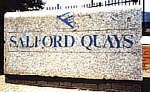
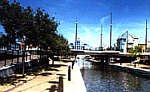

University of
Salford
|
Salford -
the Older Town

Salford showing the University
Aerial Photograph
Image Courtesy of www.webbaviation.co.uk
© 2005
CLICK ON IMAGE TO ENLARGE
It
is only since very recent times that Salford could begin to be
thought of as a tourist venue, for it's 19th and early 20th century
history has been dogged by poverty and industrial squalor and
images created by the likes of its most celebrated artist, L.S.
Lowry. However, after considerable slum clearance and redevelopment,
Salford has become a place which the tourist should visit as it
has a great deal to offer. Salford is much older than its more
internationally celebrated neighbour, the City of Manchester.
The
Salford Hundred
According
to the Anglo-Saxon Chronicle of 919 AD, Salford had been part
of the kingdom of Northumbria, until had been conquered by Edward
the Elder, king of the West Saxons. The Manor (or Hundred) of
Salford contained all the lands "between the Ribble and the Mersey",
contained 9 large parishes, and came under the diocese of Lichfield
in matters ecclesiastical. Salford was also mentioned in the 1086
Domesday Book of William the Conqueror. It makes reference to
Salford as being "held by Rogier de Poitou" (aka. Poitevin). The
so-called Salford "Hundreds" (an Anglo-Saxon word meaning "district"),
included most of modern Manchester, as far as Heaton Mersey in
the south, Bolton and Bury to the north, Oldham and Rochdale to
the east, and Warrington and Wigan to the west.
Salford
- the Willow Ford
Salford's
name is a corruption of 2 ancient words: "Sal" or "Sahl",
(from the Latin "salix" meaning sallow - the old word for
willow), and "ford". Hence, it could be translated as the willow
ford. It was, for many centuries, the only place to cross the
River Irwell for many miles in either direction. The willow tree-lined
the banks of the Irwell separated Salford from Manchester for
many centuries, and the original river crossing stood where the
Victoria Bridge is located today, near the corner of Blackfriars
and Deansgate. Extensive stretches of the banks of the Irwell
in Salford are still lined with willow today.
In the early 13th century, Salford had already emerged as a small
town, with an annual rent of 23 shillings (£1.15). On 4th June
1228, Henry III granted Salford a weekly market on Wednesdays,
and an annual 3 day fair on "the eve, day and morrow" of the Nativity
of St Mary, that is 7th-9th September. The fair continued right
up to 1851 when it was abolished after shopkeepers complained
of noise and nuisance.
The
Manor of Salford
By
1230, the town was granted a charter by the Earl of Chester, then
Lord of the Manor, creating the town a free borough, and countersigned
by the famous Simon de Montefort. By 1399, the land had come into
the inheritance of Henry Bolingbroke, who ascended to the throne
of England as Henry IV, thus creating the Royal Manor of Salford,
with the monarch as Lord of the Manor, a status which Her Majesty
the Queen holds to this day.
See
also :
More
Salford follows >
|