|
|
Manchester
& the Northwest Region of England
 

Papillon
Graphics' Virtual Encyclopaedia of Greater Manchester
Including
Bolton, Bury, Manchester, Oldham, Rochdale, Salford, Stockport, Tameside,
Trafford & Wigan
|
|
NAVIGATION









































Virtual
Hosting by

TheServerBank
|
 |
 |
The
City of Salford
in the Greater
Manchester Metropolitan County
|
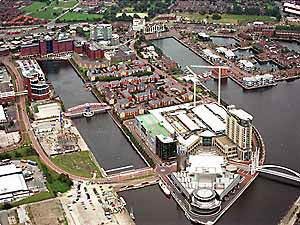
Salford Quays
Aerial Photograph
Image courtesy of www.webbaviation.co.uk
© 2005
CLICK
ON IMAGE TO ENLARGE
Salford
in the Domesday Book
The
earliest mention of the Salford Hundred occurs in William the
Conqueror's great survey, the Domesday Book, made for in 1086.
It was recorded that King Edward the Confessor had held the Manor,
(or Hundred), in 1066 when it was mostly forest land, divided
into 21 berewicks (or sub-manors) each held for the King by a
thegn.
William
granted the land to Roger de Poitou who parcelled it out to his
own followers. By 1086 the hundred was again in the King's hands
and was held intermittently by the monarch over the next three
centuries. Roger de Poitou also created the (lesser) Manor of
Manchester which has ever since been separate in matters of Local
Government from Salford. To this day Salfordians proudly boast
being the oldest of the two cities, and object volubly to being
called "Mancunians".
Local
Government in Salford
The
Salford Charter also granted the right to elect its own "Reeve"
and to hold its own Law Courts (the "Laghemot"). This charter
remained the basis of Salford's local government until the Police
Commissioners Act of 1791.During
Tudor and Stuart times, Salford was assessed for taxation as a
parish of Manchester and in 1655 paid the sum of £12-8s-1d (£12.40).
By this time, the Manor of Salford included Broughton, Pendleton
and Kersall - the latter being granted rights to a monastery,
known as St Leonard's Cell, which by 1660 had passed into the
hands of the Byrom Family, and the celebrated John Byrom, who
wrote the hymn "Christians Awake".
Also, the fact that the administrative headquarters and centre
of Salford local government is actually in nearby Swinton is locally
very controversial, and the city centre of Salford is nowadays
little more than a shadow of its former self, with most of its
redevelopment having taken place out of town - in Salford Quays,
or outlying districts like Swinton and Worsley.
Salford
during the Civil Wars
Unlike
Manchester, during the Civil War, Salford was Royalist. The siege
of Manchester which started the Civil War was launched from Salford.
Salford was also devoutly Jacobite and supported the Pretender
to the Throne of England, Charles Edward Stuart (Bonnie Prince
Charlie), whom they hosted on his ride through the area in November
of the 1745 Rebellion. Blessed by the Reverend John Clayton, a
friend of John Wesley, he left for his campaign in the South,
only to return defeated 9 days later. Two local men, Tom Syddall
and Thomas Deacon, who had joined the Manchester Regiment to help
Charles Stuart fight in the Rebellion, were captured and beheaded
- their heads brought back and displayed on the Exchange in Manchester.
Salford
in the 18th Century
By
the early 18th century, contemporary maps show Salford as still
largely rural, with the major road networks already in place.
By 1750 the town was to change dramatically - possibly the most
drastic transformation of any town in England, as factories (largely
spinning, weaving, dyeing and bleaching) took over the fields,
so that nowadays only their names survive to indicate where they
were. Salford's growth at this time was marked by some degree
of industrialisation. Cloth was manufactured, silk weaving was
done in the locality, as were dyeing, fulling, and bleaching.
The population had reached 7,000 by the end of the 18th century.
By
the end of the 18th century the canals were in place - the Bridgewater
from Worsley, and the Leeds and Liverpool canal. The River Irwell
had been made navigable all the way to Liverpool.
Salford
in the 19th Century
In
the 19th century, the effects of the industrial revolution on
Salford was phenomenal. Factories replaced homeworkers and the
resident population, which was just 12000 in 1812, increased by
1840 to 70244, and by the end of the century to 220000. This rapid
increase, probably the greatest in the whole of Britain, was reflected
in the vast areas of poor quality housing that were built throughout
the Victorian period when overcrowding created real social problems.
Houses
were crowded together at as many as 80 to the acre. Trade continued
to boom, and with the construction of the Manchester Ship Canal
and the docks at Salford, the city became an industrial meeting
point for all major routes and was receiving raw materials for
the whole north west of England, as well as being the main distribution
point for manufactured goods being exported out. The fate of Salford
during the Industrial Revolution was not an enviable one. Most
of the worst effects and excesses of over-industrialisation and
human exploitation were to be found there.
It
was not all quite so black - there were some real improvements
made to the social and material fabric of late Victorian society.
For Example, the first Public Libraries Act was introduced in
1850. Salford had, a year previously, already established a library,
museum and art gallery, the first municipal authority in Great
Britain to do so.
Modern
Salford
Since
the 1960s, Salford has gradually restored itself of the grubby
smoky town images of the post-war period. Today it boasts many
delightful aspects, from the elegance of ancient Worsley, to the
formal civic grandeur of the Crescent, where the Art Gallery and
the University of Salford now stand.
In
the last decades, with the abandonment of the great docks, many
acres of dock wasteland have been redeveloped as the Salford Quays
project. Waterway frontages have been attractively revamped, trees
planted, .... and attractive new waterside dwellings have been
introduced into a hitherto undesirable area, making it now a much
sought-after place to live, as well as having major new cultural
developments like the Lowry and the Imperial War Museum.
Historic Places of Salford
Salford
has a great history. Peel Park, now Salford Art Gallery, was owned
by Sir Robert Peel, a local of Bury, Prime Minister and founder
of the Metropolitan Police Force. Ordsall Hall, near Salford Quays,
was once the home of Sir John Radclyffe, who was given the privilege
by king Edward III of escorting his bride to be, the Belgian Princess
Phillipa to England. Near MacDonalds (Fast food & hamburgers)
in Acton Square stands the house of William Harvey, founder of
the Vegetarian Society. Not far away stands Joule House, named
after James Prescott Joule, the world famous 19th century physicist,
who lived there for several years. In one of the houses on The
Crescent lived Thomas Worthington, one of the great architects
of the region.
Nowadays
Salford boasts some fifty public parks and gardens, and has at
last thrown off its unfortunate image of the "Smoky Old Town".
See
Also: Salford
Hotels, B&B & Guesthouses
|
|