Stockport,
Manchester & Northwest England
Papillon
Graphics' Virtual Encyclopaedia of Greater Manchester
Including
Bolton, Bury, Manchester, Oldham, Rochdale, Salford, Stockport, Tameside,
Trafford & Wigan
NAVIGATION Virtual
Hosting by
TheServerBank
Photos
by John Moss
Stockport
in the Greater
Manchester Metropolitan County
Located
on the River Mersey about 7 miles South-east of Manchester city
centre, Stockport is an attractive old town with a long history.
Oddly, two alternative explanations seem to exist for the origin
of the name of Stockport. One has it that, as a Saxon village,
it was given the name "Stockport", which means " the market place
at the hamlet " In fact, it has had a market there since well
before it was officially granted in 1260 AD.
Strangely,
though both Cheadle and Bramhall (which now exist within the Metropolitan
Borough of Stockport) were referenced in the Domesday Book of
1086, Stockport itself received no mention.
Alternative
authorities have it that here is sufficient evidence to support
the argument that there had existed a fortified stronghold in
the vicinity since ancient British times, and that even Agricola
had recognised its strategical advantages and fortified Stockport
to guard the passage of the Mersey. The town's name, then, could
have been derived from two alternative Saxon words: "stoc"
- a stockaded place or castle; and "port" - a wood.
Literally, a castle in a wood. Either explanation is plausible
and possible.
Norman
Stockport
The
Normans also fortified the site and the castle they built was
rebuilt and adapted over the centuries until it was finally demolished
in the year 1775. Well authenticated tradition carries the history
of Stockport back to early Norman times, and it was the second
Sir Robert de Stokeport, a successor of one of the barons created
by Hugh Lupus d'Avranche, nephew of King William the Conqueror,
who obtained the Charter of Freedom for the town around the middle
of the thirteenth century, whilst the third Sir Robert de Stokeport
obtained a grant of a weekly market and a yearly fair. This Charter
was one of the first granted in the district and was so exceedingly
comprehensive that it remained in force for more than six hundred
years.
Stockport
Charter and a Fair
By
1172 a castle stood in Castle Yard, where the present market place
now is and it withstood a siege by Henry II. In 1220 the town
was granted a Charter of Freedom - a 1530 Latin copy of the Charter
can be seen in the Town Hall. This provided for a code of local
government, as well as the market and an annual fair. By 1327
it was held by the de Spencer family. After more than 2 centuries,
accounts describe the castle as in a decayed and disused state,
and it remained so until some rebuilding during the Civil Wars
in the 17th century, when some defensive restorations were carried
out. However, by the end of this war the castle lay once again
in ruins.
The
Municipal Corporation
of Stockport
The
Manorial system of local government came to an end with the establishment
of Municipal Local Government by the Municipal Corporations Act
of 1825. Under this Act, Stockport was included in the list of
towns to be divided into seven wards, with a Council consisting
of 14 Aldermen and 42 Councillors.
In
1888, the town was raised to the status of a County Borough. Since
its early incorporation Stockport had considered building for
itself a town hall to reflect its new dignity and civic pride,
and permissions were obtained to erect a town hall and proper
public offices within the borough.
t
was not until 1893, however, that a definite proposal was made
to erect the town hall on the site of the old National School
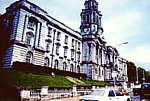
in Wellington Road South. The design of this magnificent edifice
was placed in the hands of Sir Brumwell Thomas (renowned contemporary
architect of Belfast City Hall) .