Manchester
& the Northwest Region of England
Papillon
Graphics' Virtual Encyclopaedia of Greater Manchester
Including
Bolton, Bury, Manchester, Oldham, Rochdale, Salford, Stockport, Tameside,
Trafford & Wigan
NAVIGATION
Virtual Hosting by
TheServerBank
Photos
by John Moss
Stockport
in the Greater
Manchester Metropolitan County
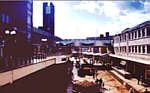
Merseyway Shopping
Precinct
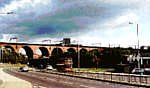
Stockport's celebrated
railway viaduct
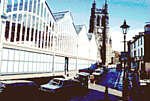
Stockport covered
Market Hall with St Mary's Church in the background
Stockport
- the Market Place
In
1775, the Lord of the Manor, George Warren, levelled the site
and planned to build a muslin factory although the plan failed,
and the site was used for many years to store market goods and
ales for the local inns. The market place site has also served
as a place for public executions, the pillory and stocks, and
was a place of public proclamation. It was here that local history
maintains that the last wife to be sold in England was purchased.
The
Stockport Museum contains many local artefacts and objects of
local significance, including the unique "Scold's Bridle" - a
crude metal cage with mouthpiece which enclosed the head , fitted
on gossiping and nagging wives!! Offenders were chained up on
public display in the Market Place. Also on display local geology
and archaeology exhibits, and its award winning "On One Round
Hill" Exhibition depicting the town from Stone Age to the Present.
The
Castle Yard witnessed Stockport's first balloon ascent in 1827,
and by 1841 the building was taken down and served as a cattle
market for many years. Overlooking the Market Place stands St.
Mary's Parish Church. Its chancel dates from the 14th century,
but earlier churches stood on this site, the earliest known being
in 1150 AD. The nave and tower had to be rebuilt in 1813, reputedly
after prolonged and overzealous bell-ringing to celebrate Lord
Nelson's victory at Trafalgar had weakened the structure! Stockport
became a Borough in 1835.
Stockport
Market Hall
By
the middle of the 19th century, the present iron and steel market
hall was erected, and has been a place of trade ever since, people
travelling in from many miles around. The Building has been recently
renovated and restored at a cost of £500,000. Stockport has a
long history of industry - from the 16th century cultivation of
hemp and rope manufacture. By the 18th century it boasted one
of the country's first mechanised silk mills. But perhaps Stockport's
best known industry was in the manufacture of hats, a trade which
still survives today. Stockport has an excellent shopping centre.
Merseyway
Shopping Precinct
The
Merseyway Shopping Precinct is a large area which was built on
massive supporting stilts directly over the River Mersey, which
still runs below ground down to Liverpool some 40 miles away.
The precinct has all the major department stores and banking facilities,
with ample side street and rooftop parking. Alternatively, one
may stroll along the old streets of the original town, such as
Underbank (pictured bottom right), with its steep warren-like
cobblestoned alleys up to the market place above, and Great Underbank,
with its old buildings like Underbank Hall. Now serving as a branch
of NatWest Bank, it was originally built in the late 15th century
and is an excellent example of a half-timbered building (see picture
on previous page).
Stockport
Viaduct
Stockport
is one of the most distinctive boroughs in Greater Manchester.
It has many well known landmarks like the huge brick railway viaduct,
built in 1840, which dominates the western approaches to the town,
and featured as a background to many of the paintings of L.S.Lowry.
Beneath it runs the town bypass, and the M60 Orbital Motorway
on its way to Tameside, Sheffield and east Manchester. Built in
the 19th century to carry the main line from Manchester to Birmingham
and London, it consists of 27 arches, contains over 11 million
bricks and spans one-third of a mile. It is illuminated at night
and makes an impressive approach to the town centre. Stockport
is nowadays a pleasant de-industrialised borough, (unlike the
description by Frederick Engels in 1844 when he called the town
"one of the dustiest, smokiest holes" ), and areas like Cheadle,
Hazel Grove, Heaton Moor, Marple and Bramhall are popular and
much sought after residential areas. The red sandstone cliffs
dominate the landscape to the town's northern edge. These 250
million year old edifices provided the town with air raid shelters
during World War II, and tours of the shelters are operated to
this day, showing the preserved 1938 shelters with beds and warden's
quarters.
Stockport
Tunnel Shelter Tours
These
are available by advance booking (Telephone: 0161-474 4460). These
cliffs, and the sluices which were cut into them, provided water
for the introduction of steam power in the late 18th and early
19th centuries.
Stockport
Town Hall
The
Town Hall was the pride of local burghers when it was opened by
the Prince of Wales in 1908. Built in white limestone with its
distinctive tiered clock tower, it was (and still is) fondly known
as "the wedding cake". It was designed by Brummel Thomas, who
had earlier designed a town hall for the city of Belfast. The
interior is richly decorated with marble and has grand wrought
iron balustraded double staircases. Besides council chambers,
offices and a mayoral suite, there is a great hall, known as The
Ballroom, which hosts public functions and is also available for
hire for private parties and functions, as well as being used
for its regular midweek Tea Dances.
Mersey
Square, Stockport
Mersey
Square, the visitor's first view of the town centre, also covers
the Mersey (hence its name), and dates back to medieval times,
when bear-baiting was held in the "Bear Pit" - the site still
remains in a vestigial state, but is now a small public garden.
The square also housed the Old Fire Station, demolished in the
1960s, a fate shared by many old buildings during that pre-conservation
era, to make way for the Merseyway shopping development.