|
Medieval
Manchester & the Middle Ages
The Salford
Hundred
Very little
is known about Manchester during the Middle Ages, and it was
by no means an important town as it had been during Roman
times. Few Englishmen would have even heard of the place, though
Salford would have been
well known as would Wigan,
Preston and Lancaster.
After the Norman Conquest of 1066, Manchester was a mere district
of Salford, and the so-called Salford Hundred was a large Manor,
covering all the lands between the River Ribble (Preston) in
the north, and the River Mersey (at Stockport)
in the south. The Salford Hundred and the barony of Manchester
were in the ownership of the descendants of Rogier de Poitevin,
a gift from William the Conqueror for services rendered in the
invasion of Britain.
After
the Black Death Plague in the late 14th century, the town began
to grow as the textile industry began around the Cathedral area.
In Hanging Ditch, (the remnants of a walkway between the Cathedral
and the Corn Exchange - now 'The Triangle'), evidence of fulling
and tanning industries has been found.
Early
Textile Production in Manchester - Flemish Weavers
By
1322 there is mention of a fulling mill in old town records, and
Hanging Ditch is thought to have been named after the manner in
which fullers hung their cloth out to drain and dry over the ditch
which was the River Irk (now culvetted over behind the present
day Mitre Hotel). The Mill is referred to as being in "Meal
Gate" (modern Long Millgate, near Victoria Station and Chetham's
School).
Later,
Flemish weavers moved to the area, fleeing from religious persecution
in the Low Countries and brought with them new skills, linen,
lace and bleaching. The district of Whitefield, now in the Borough
of Bury, is thought to have been named because of Flemish
occupation of the area and the manner in which they laid out their
bleached cloth over the fields on either side of the main Manchester-Bury
Road - hence the 'white fields' (now Whitefield).
A Castle
and Collegiate Church in Manchester
Few
would know that Manchester once had a castle! It once stood on
the spot now occupied by Chetham's
School, and its defensive potential can still be seen from
Hunts Bank near Victoria
Station and the MEN Arena. It was unlikely to have been more
than a wooden palisade on top of a raised natural embankment.
The Gresleys, descendants of Poitevin, built their fortified Manor
House here, remnants of which can still be seen in the raised
stone walling from Hunts Bank.
So, medieval Manchester grew up around the collegiate church,
now the cathedral, then the Parish Church of St Mary. At one end
was Long Millgate, the main entrance into the town from the North
(as it still is today), the Market Place (now long since gone)
whose place was later marked by Market Stead Lane (contemporary
Market Street), and Deansgate, from the South and the main road
to Chester and Liverpool
to the west.
Manchester
as a Market Town
By
the thirteenth century, Manchester had become a market town and
had applied for and been granted the right to hold an annual fair
in 1223, and the town had grown sufficiently to be granted a charter
in 1301. In 1368, a stone bridge was erected over the River Irwell
to connect Manchester directly to the City
of Salford - the first record of any permanent bridge over
the Irwell. The annual fair was held at Acresfield, then open
land adjacent to the town, now St Ann's Square. By this time a
regular Saturday market was being held, and people came from all
over the region to buy their wares and provisions.
Manchester
as a Baronial Borough
Manchester
became a Baronial Borough (thereby an independent self-governing
entity) in 1301, still ruled by the Lord of the Manor, but with
an appointed "boroughreeve" (or Mayor) who handled day-to-day
administration of the borough. Manchester was to change very little
thereafter until the 16th century.
Ironically, though the town of Manchester was neither important
nor wealthy, the medieval parish was extremely well off, owning
vast tracts of land, some 60 square miles, stretching from Prestwich
(Prestwich-cum-Oldham as it was then) to the north, Ashton-under-Lyne
and the River Tame to the east, Urmston in the west and Stockport
in the South (practically the whole of contemporary Greater Manchester).
When Thomas de la Warre
was made Lord of the Manor in 1421, their was sufficient revenue
(from rents and leaseholds on the lands which he and the church
owned) to build his magnificent collegiate church and his own
manor house (now Chetham's School). After the dissolution and
the Reformation the lands reverted to the crown and were administered
by John Dee for Queen
Elizabeth I.
Manchester
in early Tudor Times
In
1485 the Wars of the Roses began between the Houses of Lancaster
(signified by the Red Rose), and of York (signified by a White
Rose). Oddly, though these wars were going on all around, because
of its relative obscurity, Manchester avoided any part in the
conflict, and no blood was spilled on Manor soil throughout the
whole conflict. Incidentally, when Henry VII acceded to the throne
he united the red and white roses of the protagonists to form
the combined red and white Tudor Rose. Henry VII, Richard of Yorks
successor passed via Warrington through Manchester on a visit
to his mother - the first reigning monarch every to visit Manchester!
Between the end of the 15th century and the beginning of the 17th
century, Manchester was to develop from a small provincial township
to a major industrial and commercial hub, pivotal in the county
of Lancashire.
|
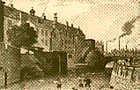
Chethams' Library
from the Irwell - an old print

Long Millgate in the 1870s - little changed since medieval times.
Books
about Medieval Manchester
|