Manchester
Main Line Railway Stations in the Northwest Region of England
Papillon
Graphics' Virtual Encyclopaedia of Greater Manchester
Including
Bolton, Bury, Manchester, Oldham, Rochdale, Salford, Stockport, Tameside,
Trafford & Wigan
NAVIGATION
Virtual
Hosting by
TheServerBank
Photos
by John Moss
Manchester
Railway Stations
The Old MS&LR
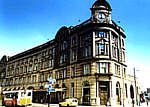
London Warehouse at Piccadilly
Piccadilly
Rail Station
National
Rail Enquiries National Rail Enquiries: 08457 48 49 50
Rail Enquiries from overseas (International rates apply): +44(0)20
7278 5240
Rail Enquiries Textphone: 0845 60 50 600
Welsh language: 0845 60 40 500
National
Rail Journey Planner
Website: www.nationalrail.co.uk.
Most
rail passengers arriving at Manchester will discover that Piccadilly
Station is their first taste of the city of Manchester. Its original
iron sheds with their decorative cast iron columns was built in
the 1880s, as part of the former London Road Station, as the road
from which you enter the Station Approach is the old London Road.
It was the terminus of the Manchester and Birmingham railway line,
and the old station dated from 1842.
The
original station was named London Road Station, and only changed
its name to Piccadilly in relatively recent years.
In
its day it was a major achievement, as it made travel to London
direct by rail a possibility in a travel time of nine and a half
hours. Today it takes just over two and a half hours. But in the
1840s, the alternative was to travel by stagecoach, and this was
a 24 hour journey.
The
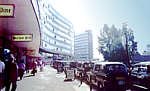
present station buildings and tower were completed in 1969, with
a new station approach and a massive area facelift - the serpentine
glass and steel of Gateway House (architects Richard Seifhart
and Partners) following the curve of the drive to the station.
The
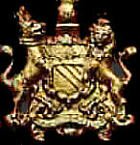
original 1842 Railway Crest still adorns the entrance. All but
one of the many classic warehouses and goods stores which served
the station were demolished in this mid-1960s refurbishment. The
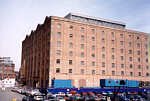
sole surviving warehouse is the MS&LR seven storey London Warehouse
of 1876, still standing behind Gateway House.
A
ten storey office block also dominates the station's frontage.
Piccadilly Station serves all destinations south for both inter-city
and local routes. Also behind Gateway House are the station Car
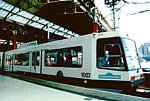
Parks. The station also serves as a terminus for the Metrolink
Rapid Transit Tram, which connects Piccadilly with Victoria
Station.
STATION
APPROACH, (off Corporation Street),
Manchester
Originally a small single storey single platform building built
in 1844 on Hunts Bank to serve the Manchester
& Leeds trans-Pennine railway, by the 1880s Victoria Station had
come to dominate the Long Millgate area and was one of the biggest
passenger stations in Britain.
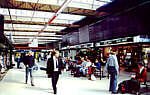
The original
700 foot long iron and glass train sheds still survive intact,
thanks to sturdy design and construction by George Stephenson.
The present
Edwardian building facade was built on in 1902 by architect William
Dawes. It has a 160 yard facade, which still carries an iron and
glass canopy bearing the names of the original destinations which
it served. These were severely damaged by the
IRA bomb which was exploded nearby in 1996. Fortunately, the
glasswork has now been fully restored to its former glory.
Immediately
adjoining the station used to stand the Exchange Station, which
boasted the longest passenger platform in the world - but - severely
damaged by wartime bombings, it was closed in 1969, and now survives
largely as an unprepossessing carpark opposite the Cathedral.
Further redevelopment
of Victoria Station took place in 1992 on the basis of a £35
million grant to upgrade the old station and to link it to the
newly constructed Nynex Arena (now the Manchester Evening News
Arena) adjacent to it on Hunts bank. This grant was to form part
of the Govenment's commitment in support of Manchester's abortive
bid to host the 2000 Olympics in the city.
Nowadays,
largely serving destinations north and east of Manchester, it
is the main terminus for the new Nynex Arena, and a major interface
where the Metrolink train joins the streets of Manchester as an
urban tramway. Also a major rail-bus interchange, the station
is linked directly to Piccadilly Station by Metrolink.
Liverpool
Road Station ranks as one of, if not the most important railway
stations in Britain. Manchester can be said to have been the place
where the Railway Age began. It was the service established between
Liverpool and Manchester which first demonstrated the feasibility
of rail as a viable public transport system. Opened to the public
on 15th September 1830, it marked the terminus of the newly created
line which ran from Liverpool to Manchester, and it is now part
of the Museum of Science and Industry.
The Liverpool
& Manchester Railway came to the city when Joseph Cowlishaw,
a Manchester corn merchant, Joseph Saunders, also a corn merchant,
from Liverpool, and a wealthy estate agent and surveyor named
William James formed a company, surveyed the likely route and
proposed the building of the railway line.
George Stephenson
was employed to construct this new feat of engineering. In 1825,
the proposal was submitted to Parliament and rejected; the next
year, despite strong opposition from some quarters, leading engineers
George and John Rennie were brought in to re-survey the proposal,
and as a result the Bill was successfully passed and work began
on constructing the line.
The station
building and the warehouse opposite date from the earliest days
of railway history. It was to this station that the Rainhill Trials
to choose a locomotive to pull passenger coaches between Liverpool
and Manchester arrived.
George Stephenson's
ubiquitous "Rocket" being the winner. The rail link, together
with the canal system, was instrumental in the growth of Manchester's
industrial base in the 19th century.
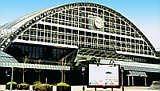
Resurrected
after lying derelict for many years, the old Central Station which
originally connected by rail the City of Manchester to Liverpool
was closed in the late 1960s. In its new form - the Greater Manchester
Exhibition Centre (GMEX) was opened by Her Majesty Queen Elizabeth
in 1986, having cost more than £20million in converting it to
one of England's finest exhibition centres.
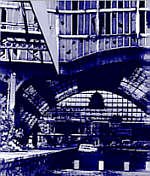
At over 10,000
square metres it is also one of the country's largest, the whole
space being open without interior supporting pillars, its vast
vaulted roof held up by sheer engineering ingenuity and simple
geometry. The hall can seat over 9000 people. There are an additional
2,250 square metres of surrounding land adjacent to the main hall
for temporary buildings and exhibitions, with onsite parking for
over 1,500 cars. Regular exhibitions are held there - everything
from Aquatic to Computer Fairs, Caravans and Home Exhibitions.
It also frequently
hosts musical and performance events, having already added Luciano
Pavarotti, Simply Red and a Torville & Dean Ice Spectacular to
its repertoire. The conversion of the old Central Station into
its present form is typical of the kind of urban renewal and inner
city transformations which the City of Manchester Council and
the Central Manchester Development Corporation have undertaken
over the past decade, much to their credit and to the approval
of the citizens of Manchester.
This is a
major stopping off point for Metrolink Trams, not only for GMEX
itself, but for Castlefield.