Virtual
Hosting by

TheServerBank
Photos
by John & Gloria Moss except aerial photograph

|
 |
 |
Manchester
Libraries
in
the City Centre
|
|
|
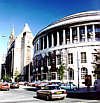
Manchester
Central Library
St
Peters Square, Manchester M2 5PD
Telephone: 0161-234 1900
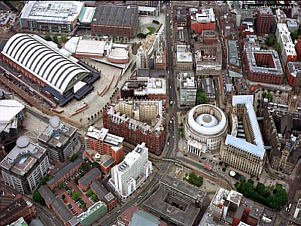 Central Library,
St Peters Square & GMEX
Central Library,
St Peters Square & GMEX
Aerial Photo Courtesy of www.webbaviation.co.uk
© 2005
CLICK
ON IMAGE TO ENLARGE An important
British library, which serves the city and the region, and one
of the largest outside London, it has an extensive collection
of books for lending and for reference, as befits a major university
city. It also houses audio-visual material and exhibitions.
Manchester
had been the first local authority in Britain to introduce a public
lending and reference library, under powers granted by the Public
Libraries & Museums Act of 1850. Lending of books was free, costs
being supported by ratepayers.
The
existing building came as a result of many years searching for
a suitable place to house Manchester's growing collection of books
and printed materials. Amongst these are 30 incunabula - books
printed before 1501. It also houses the Library Theatre, a café,
shop and Local Studies Unit.
It was
designed by London architect E. Vincent Harris, who won the competition
for its design as well as the adjacent Town
Hall Extension (built later). The foundation stone of the
library was laid by Prime Minister Ramsey MacDonald in 1930, and
it was officially opened by King George on 17 July 1934. It is
regarded as one of Harris's most confident and impressive buildings
- a Manchester landmark which dominates St Peter's Square, and
commands an imposing position when approaching from the south
along one of Manchester's busiest thoroughfares, Oxford Street.
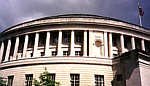
The
building was constructed as an underlying 4 storey high steel
frame, clad in Portland stone, and rising 90 feet, with attic
and storage facilities below ground. It is clearly influenced
by the Pantheon in Rome. Rustication is employed on the two lower
floors to give the whole building a feeling of massiveness and
strength. Above this level are two storeys behind giant Doric
columns
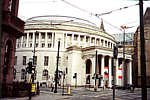
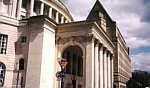
Its southern
front is dominated by an imposing 5 bay portico of Corinthian
columns with rounded arches at each side. On top is a large domed
glass roof covering the central reading room, (similar to that
at the British Museum), but this is hidden from street level by
a higher surrounding lead-covered roof. Harris also designed the
furniture which is in evidence throughout the building. It cost
some £410,000 and the site on which it stands cost £187,800.
It is also
home to an extensive local history collection and a wide range
of specialist materials for visually and hearing impaired people
is available. It also has a Chinese book collection, reflecting
the large ethnic influence in Chinatown which is nearby.
|
|
|
|
|
John Rylands
University Library
150
Deansgate, Manchester M3 3EH.
Tel: 0161- 834 5343/6765
Website: http://rylibweb.man.ac.uk/spcoll/
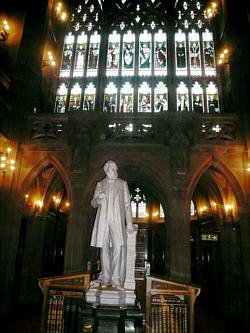
Statue of John
Ryland in his library
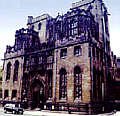
This is a
superb Neo-Gothic building of the 1890s housing one of the finest
collections of rare books and manuscripts in the north of England,
including a copy of the Gutenberg Bible of 1455, and Chaucer's
Canterbury Tales printed by William Caxton in the early
16th Century. The library's international renown lies with its
rare books, many of which were purchased initially by Mrs Rylands;
these include the Spencer Collection of printed books, purchased
for £210,000 in 1892, as well as many valuable manuscripts from
the Biblioteca Lindesiana acquired in 1901 for £155,000.
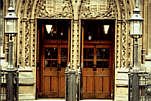
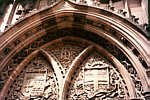
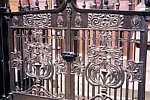
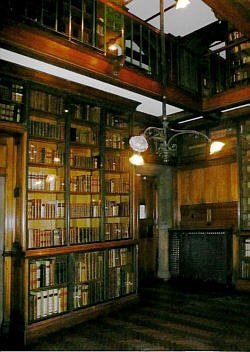
The building has many notable fine architectural features, including
its early Art Nouveau bronze fittings - among them are light switches,
gates and radiator grilles. It was one of Manchester's first electrically
lit buildings, and had air conditioning. Stone for the building
came from Penrith in Cumbria; known as shawk, it varies from grey
to buff and pink. Woodwork is in Polish oak and there are many
fine pieces of detailed carving.
There is a substantial collection of portrait busts of great writers
such as Darwin, Shakespeare and Bacon, as well as symbolic statuary
representing Theology, Science and the Arts. White marble portraits
of John
Rylands and his wife, Enriqueta are to be found at
either end of the Reading Room.
When John Rylands, a Manchester cotton merchant died in 1888,
he left a personal fortune of some £2,750,000, which provided
the finance for building the library, commissioned by his third
wife and widow Enriqueta Augustina.
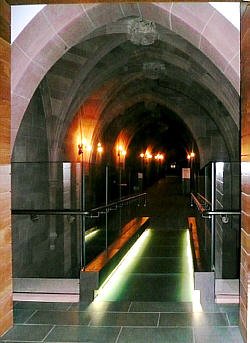
New entrance - from modern into Victorian
The commission
was granted to the architect Basil Champneys (later knighted),
who was to produce a design that would make it one of the finest
libraries in Britain. Champneys also designed all the furnishings
and fittings to maintain the consistent Neo-Gothic style. Taking
10 years to build, the library was opened to the public on New
Year's Day 1900, and it remained an independent public library
until 1972, when it merged with Manchester University Library.
It still boasts that it is the 3rd largest academic library in
the United Kingdom.
Open : Monday-Friday 10.00am-5.30pm. Saturdays 10.00am-1.00pm.
Closed on Sundays. Other times by appointment. Visitors and group
parties are welcome, and guided tours are available by prior arrangement.
There are frequent special exhibitions and imaginative displays
of printed material. Toilets and facilities for the disabled.
Library accessible to serious students by arrangement. Enrolment
as a reader is free. Guided tours are available for groups of
up to 50 people by prior arrangement. Tours last about 1 hour
and there is a small charge of about £1.50 with half price concessions.
Members of Library Staff welcome the opportunity to give outside
illustrated talks on the history and work of the library. Rooms
available for hire for seminars, receptions and private functions.
Bookshop on site with postcards and library publications are on
sale in the entrance hall to the library .
See
Also: Plan of John Rylands
Library
|
 |
Chetham's
Library
Long
Millgate, Manchester.
Telephone: 0161-834 9644 / 7961.
Website: www.chethams.org.uk
In 1655 Chetham's Hospital and Chetham's Library were established
from monies left by Sir
Humphrey Chetham , a wealthy local textile merchant, in his
will at his death in 1653. The term "Hospital" is an interesting
point - it referred to the poor (who in those days were invariably
also the sick - wealthy people had their own private "surgeons").
"Chets", (as it became known) was set up as a charitable free
school to provide education for about 40 boys (girls were not
then regarded as worth educating!!) from poor families, who showed
aptitude to learn.
The site also included a free library - the first free public
library in the world with over 100,000 books, many of them quite
rare, and over half printed before 1850. The public may still
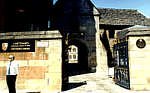
access this library by appointment with the warden. Built in red
sandstone, like the cathedral, it originally formed dormitories
and quarters for cathedral clergy. The buildings, grouped around
a central courtyard with a defensive entrance gate, were typical
of medieval building style.
From 1547, after the reformation, when Henry VIII closed and dissolved
monasteries, the premises were the town dwellings of the Earl
of Derby. The college was refounded in 1557, but by the time of
the outbreak of the Civil Wars, the buildings were in a dilapidated
state. Their purchase by Humphrey Chetham almost certainly saved
them from demolition. He purchased the lot for £400 just prior
to his death.
Chetham's is now a music school for musically gifted young men
and women, and attracts young proteges from all over the north-west
of England. It still largely maintains the original principle
of admitting talented youngsters, and barring none because of
financial hardship. The school is well funded and maintains poorer
pupils. Lunchtime concerts are held every Wednesday in the Baronial
Hall. Concerts can be combined with a guided tour of the school
and library. The library, containing a large collection of books,
specialises in local history material. In this library, Frederick
Engels spent many hours researching for his numerous writings.
|
|

See
Also:
North
West Film Archive
|
The Portico
Library
57
Mosley Street, Manchester 2.
Telephone: 0161-236 6785.
Website: www.theportico.org.uk
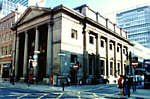
Situated on the corner of Mosley Street and Charlotte Street,
this narrow elegant classical building was designed by Thomas
Harrison of Chester in 1806, at the height of the so-called classical
revival. It was commissioned by the wealthier gentlemen of Manchester,
as a reading room to compete with the one which they had seen
in Liverpool. Not to be outdone by Liverpudlians, they even installed
a wind measuring machine in the building!
The library contains over 25,000 volumes. It is also the home
base of the Manchester Literary and Philosophical Society. Its
imposing pediment dominates the street, rising high on slender
Ionic Columns to create the Portico after which it is known.
Sadly, the ground floor was lost in recent times, due largely
to financial considerations, and the private library now occupies
only the upper floor. The ground floor has become a bar Café.
Until the Public Libraries Act of 1850, this was the only circulating
Library in Manchester. Initially, its 400 shareholders paid an
annual subscription of £2.10s.0d (£2.05) for use of the ground
floor newspaper reading room and the upstairs gallery. This gallery
is supported on iron columns and is topped by a glass dome. Unfortunately,
the building was divided in two at the time of the Second World
War, and the ground floor subsequently became a branch of Lloyds
Bank.
Frequent exhibitions are held, and certain areas are still open
to non-members. Well worth the climb upstairs to see this prize
of early
19th century architecture.
|
 |
Working Class
Movement Library, Salford
Jubilee
House
51 The
Crescent, Salford M5 4WX.
Tel: 0161-736 3601.
Email: enquiries@wcml.org.uk.
Website www.wcml.org.uk.
History of working people is stored here. Extensive archives.
Open to the general public, researchers, students and schoolchildren
- please ring to make an appointment.
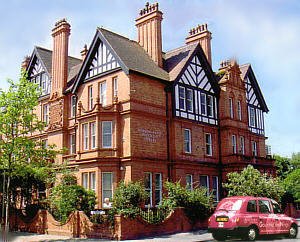
The
Working Class Movement Library began in 1953 and now has a large
archive collection of 50,000 books, pamphlets, manuscripts and
memorabilia related to the development and history of the labour
movement since the late eighteenth century. It is a major educational
resource for the region, and is an independent charitable trust
supported by the City of Salford's Heritage Department. It is
located in Jubilee House on The Crescent (the A6) opposite the
University of Salford. The library welcomes students, researchers
as well as general enquiries.
Material has to be studied on site as materials cannot be borrowed,
but there is a photocopying service. Admission is free. Prior
to visiting the library you must make an appointment, during normal
opening hours. Organised groups are also welcome.
Computerised cataloguing of the archive began in 1996, financed
by a grant from the National Lottery Heritage Fund.
Opening
Hours
Closed all day on Mondays and Saturdays. Sunday opening from 2.00pm
to 5.00pm on alternate weeks - please check. Weekdays open from
10.00am to 5.00pm from Tuesday to Friday with late opening till
7.00pm on Wednesdays.
Friends
of WCML
The Friends of the Working Class Movement Library are devoted
to the support and advancement of the Library's aims including
fund-raising from lectures, Open Days, book sales, and financial
donations, in order to promote the growth of the Library. Membership:
Annual subscription is £5 for employed
and £2 for unemployed members.
Suburban
& Regional Libraries follow >
|
.
..
|