Municipal
& Public Buildings of Manchester
Nineteenth
century Manchester saw the emergence of a new ruling elite - the
self-made businessman and the textile industrialist millionaire.
These nouveaux riches - men with money and influence, eagerly
sought not only economic, but political power. After the Municipal
Charter of 1838, these "city fathers" (as they liked
to be called) were given the opportunity to create a fully fledged
advanced city with all the trappings of a civilised metropolis.
They did it in a grand manner. In 1845 Manchester began to create
public parks; in 1851 an Act of Parliament authorised the introduction
of a half penny rate to create public libraries and museums; later
came free hospitals for the treatment of the poor, the introduction
of underground sewers and various Planning Acts to improve the
living conditions of its people. There was an immense and ever
growing sense of civic pride in the city - nowhere more in evidence
than in Warehouse's exuberant Town Hall, whose floors are decorated
with mosaic bees, symbol of the industry which had created the
wealth to make the modern city possible. What follows are some
of the best examples of Manchester's civic buildings.
The Municipal
Buildings
Manchester
Town Hall Extension
On completion
of the Central Reference Library in St Peter's Square in 1934,
work began immediately on constructing the Town Hall Extension.
Designed by Vincent Harris, as a result of an open competition,
(he had also designed the Library next door), it was to be eight
storeys high and intended to house various growing municipal departments
including gas, electricity, rates, rents, street cleaning, etc,
and a cinema with demonstration rooms beneath ground level. Its
200 foot southern wall was curved to parallel the Library next
door, separated by the Library Walk between. Many authorities
reckon this to be Harris's best work. It also includes a large
council chamber at first floor level. The total cost of the building
was £750,000 and it was opened officially by King George
VI in 1938. A commemoration in the form of a carved inset stone
on the library side at the Mount Street end marks the occasion.
The extension is connected by two covered bridges to the main
Town Hall building. On the Mount Street side is a covered arcade,
and on the opposite side, in St Peter's Square is the official
City of Manchester Visitor Centre (Tourist Information).
Stylistically, the building is Gothic in character, with heavy
masonry, deep pierced ornately carved tracery effects, and a typically
steeply pitched roof,
yet interpreted in a modern style in Darley Dale stone. Internally
it has stained glass windows by George Kruger Gray, which represent
ancient Lancastrian Coats of Arms.
Back
to Top
Victoria
University of Manchester
The University
began life under the name of Owens College, the original quadrangle
block commissioned in 1869, and designed by Alfred
Waterhouse, who had been responsible for many other buildings
in Manchester. After various other name changes, it became the
Victoria University in 1880. (Nowadays, the "Victoria"
is dropped). From then until the outbreak of the Fist World War
it saw considerable expansion, followed by many years of inter-war
stagnation before the boom of the 1960s which saw a revival in
its fortunes and a more-or-less constant expansion since then.
Waterhouse's original building on Oxford Road, still forms the
heart of the main campus, despite many extensions and other buildings
added all around it over subsequent years. Work was not actually
completed until 1902, and was completed by his son, Paul (as the
Refuge Assurance
Building had been). It was built in the then fashionable modern
Gothic style. The later phase of building included the addition
of the Museum and the Beyer Laboratories from 1883-87. Later,
Paul Waterhouse completed the Christie Library between 1895 and
1898, and the Whitworth Hall, completed in 1902. Paul Waterhouse
went on later to add extensions to the Manchester Museum from
1911-27, the later part completed by Michael Waterhouse. Other
additions include the Botanical Laboratory in 1911, and the John
Morley Laboratories in 1909, both by Paul Waterhouse. Further
later extensions included the Physics Laboratory designed by J
W Beaumont in 1900-01, the New Physics Laboratory by Percy Scott
Worthington in 1930-31, and the Dental School by Hubert Worthington
in 1939-40.
The Manchester
Reform Club
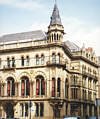
Designed by
Edward Solomons and John Philpot-Jones in 1870-71, the Reform
Club in King Street was the last to be built in the popular so-called
Venetian Gothic style. It comprises three storeys topped by a
balustraded parapet and with corner rounded gable end towers with
lanterns and spires. The windows of the first floor have small
balconies, with a larger balcony over the main ground floor entrance.
Marble lined state-of-the-art lavatories were installed in the
1890s. Inside is a grand staircase with wood panelling climbing
up to the second floor billiard room. It was here that the city's
gentry escaped to sample privacy, quietude and the fellow company
of other like-minded men.
Back
to Top
The Mechanics'
Institute, Manchester
In 1854 the
architect John Edgar Gregan was commissioned to build the new
Mechanics' Institute at 103 Princess Street - it was intended
to be a centre of learning and education for the 'educable working
classes'. It was to be Gregan's last work. The Institute had already
been in existence since 1825 in a premises in Cooper Street, but
the new building was to mark the growing success of the venture.
Workmen, ranging from shopkeepers to labourers, could attend evening
classes to study English, grammar, writing, reading, arithmetic
and Latin, as well as several foreign languages and music.
The building is in the palazzo style, common in the warehouses
in the vicinity of Portland Street, and stands out as superior
to most of those that followed. It has three tall storeys with
a basement and hidden attic storey behind a balustrade. It is
built in red brick with stone string courses and semicircular
pediments over the first floor windows. Later it became the Museum
of Labour History, which subsequently moved to the Pumphouse
- now the Peoples' History
Museum, though it still contains many labour history archives
which are available for inspection by special permission.
Memorial
Hall, Albert Square, Manchester
On the corner
of Albert Square and Southmill Street stands the Memorial Hall.
It was designed and built by Thomas
Worthington in 1863-66. Described as a brick and stone clad
building of Venetian Gothic style with distinctive stone tracery
on all windows and a decidedly palatial exterior. The building
was originally a commemoration of the secession of Nonconformist
clergy in 1662. The ground floor was always intended as a commercial
space, available to any concern that was prepared to pay the rent
- now a pub (The Square Albert). Worthington designed this two
colour building after his second tour of Italy in 1858, and this
is thought to be the main influence in his design.
The Masonic
Hall, Bridge Street, Manchester
The Masonic
Hall was designed by Percy Scott Worthington in 1929. This Grade
II Listed building is in Portland Stone and won the Royal Institute
of British Architects Gold Medal for Worthington in 1930. Externally
it is rather plain and forbidding, with its rusticated ground
floor and severe sheer walls rising two floors, and relieved only
by the square cut windows. A low balustraded balcony is cantilevered
out over the ground floor entrance.
However, its interior is a joyous affair in the Neo-Classical
style with a huge coffered barrel vaulted ceiling supported on
elegant Ionic columns.
|
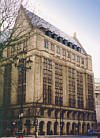
Town Hall Extension
from Albert Square
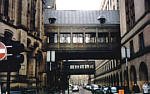
Bridges over Lloyd Street
connect the Town Hall
to the Extension Building
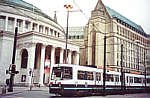
Town Hall Extension from
St Peter's Square
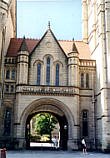
University of Manchester
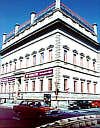
Former Mechanics
Institute Building
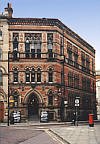
Memorial Hall,
Albert Square
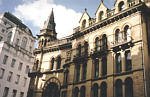
Above & Below:
The Reform Club,
Spring Gardens/King Street

Masonic Hall,
Bridge Street
|