|
NAVIGATION









































Virtual
Hosting by

TheServerBank
Photos
by John Moss
|
 |
 |
Manchester
Museums & Exhibitions
|
|
|
The
Gallery of Costume
& Platt Hall
Platt
Hall & Park, Platt Fields, Wilmslow Road,
Rusholme, Manchester M14 5LL
Tel: 0161- 224 5217. Fax : 0161-256 3278
Website: www.manchestergalleries.org/html/costume/
Open
every day March-October from 10.00am-5.30pm and November-February
daily from 10.00am-4.00pm, but please note that opening times and
prices may have changed - please check before setting out.
The Gallery
boasts one the finest collections of clothing, textiles and fashion
accessories in the country. An extensive library of fashion and
design books, magazines, catalogues and prints is also available
to students and researchers (Tel: 0161-224 5217 for an appointment).
Admission free. Groups welcomed by prior arrangement - maximum size
80. Toilets, parking, disabled toilets, no dogs allowed (except
guide dogs).
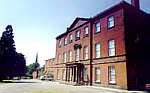
Platt
Hall
An
elegant early Georgian house set in one of Manchester's largest
public parks at Platt Fields in Rusholme, about 2 miles from the
city centre, located on the corner of Wilmslow Road and Platt Lane,
with ample parking in Platt Lane. Once the home of Charles
Worsley, the staunch Parliamentarian leader in the Civil War,
and close confident of Oliver Cromwell. The original Worsley family
home which stood here was an Elizabethan half-timbered building,
which was replaced by the present Georgian house in 1764. In 1775
the estate, which included the whole of the adjoining present-day
Platt Fields Park passed to the ownership of the Caril-Worsley's,
which family was responsible for the building of the neighbouring
Holy Trinity Church in Rusholme (the steeple can be seen in the
background of the photograph above). The Gallery of English Costume
now contains one of the finest collections of costume and fashion
in the country, and is a mecca for the serious fashion student.
The collection includes items from the 17th century to the present
day.
See
also: Platt Fields (Parks
& Gardens)
|
|
|
|
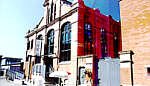
The Pumphouse
|
The People's
History Museum
(Formerly
the Pumphouse Peoples' Museum)
The People's
History Museum, The Pump House,
Bridge Street, Manchester M3 3ER.
Tel: 0161-839 6061.
Website: www.phm.org.uk.
Email: info@phm.org.uk.
The museum is based in an Edwardian pumping station which provided
hydraulic power to the city of Manchester from 1909 to 1972. It
houses the galleries of the National Labour Museum (which was formerly
in the TUC building in Princess Street ). The collection includes
over 300 banners associated with workers' groups and Trades Unions.
It is dedicated to the ordinary people of Britain and traces their
living and working conditions through lively reconstructions, videos,
demonstrations and exhibits.
Guided tours are available - please telephone for details. There
are recreations of the infamous Peterloo Massacre of 1819, life
in the cotton mills, the work of women and children in factories,
and a recreation of a 1930s Co-op shop. Material also includes exhibits
of the Women's Suffragette Movement, and the Pankhursts.
There is a large bookshop with books on or about Manchester and
its districts, a wide range of period postcards, T-shirts, souvenirs
and other memorabilia. Educational visits can be arranged - telephone
the Education Officer for an information pack on 0161-839 6061.
The Engine Hall may be booked for corporate functions, and a Hospitality
Pack is available from the Promotions Officer. There is a Café Bar
("The Clarion"). Numerous visiting and temporary exhibitions are
mounted. The museum is well signposted, and is next to the Gartside
Street Car Park, a few hundred yards from Salford Central Station.
Admission is now free for everyone.
Open Tuesday to Sunday from 11.00am-4.30pm. Closed on Mondays. There
is disabled access to all areas of the museum galleries, café and
shop. The Archive and Study Centre and the Textile Conservation
Studio are at the 103 Princess Street Building in the city centre,
and can be visited by appointment.
|
|
|
|


|
Urbis
Manchester’s
Centre for Urban Culture
Corporation Street, Cathedral Gardens,
Manchester City Centre M4 3BG.
Tel: 0161-605 8200. Fax: 0161-605 8201.
Advance Booking: 0161-907 9099.
Website: www.urbis.org.uk
Email: info@urbis.org.uk

Urbis, Triangle
and Cathedral Gardens, Manchester
Aerial Photograph
Courtesy of www.webbaviation.co.uk
© 2005
CLICK
ON IMAGE TO ENLARGE
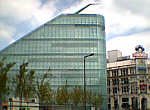
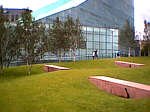
Ultra modern
all glass structure set in the recently named Cathedral Gardens.
Billed as Manchester’s Centre for Urban Culture, a museum of
modern Manchester, the world's very first industrial city, but exhibits
also show life in other cities, including Los Angeles, Paris São
Paulo, Singapore and Tokyo. There are many interactive displays
and more are planned.
The building was designed by the Ian Simpson Company of Architects
and was awarded as a result of an international competition. Lead
academic advisor and originator of the concept for the museum was
Dr Justin O'Connor, who is Director of the Manchester Institute
for Popular Culture at the Manchester Metropolitan University. It
cost £30 million of which £20 million was a grant from
the Millennium Commission. It's unusual ramp-like shape, (described
as "a glass ski slope"), dominates the approach to Manchester
city centre from Cheetham Hill and Bury in the North.
There
are 6 floors at Urbis, 4 of which contain exhibition space, with
the new Modern Bar & restaurant (formerly 'Le Mont') on levels
5 & 6. Exhibits are of an historic and futuristic nature. Many
might find the building itself far more interesting than the exhibits.
There is the Conservatory Café at ground level and the entrance
foyer has touch screen displays and video presentations.
All 4 exhibition levels of the building are accessed via a sort
of funicular glass lift. This "Glass Elevator", offers
a one-minute sky glide that transports visitors directly to the
fourth floor. With the City as backdrop, visitors then explore at
their own pace four cascading, themed floors of permanent interactive
displays and exhibits, created for Urbis by leading UK exhibition
designers, At Large, Land Design Studio and Event Communications.
The Urbis
project was overseen by the City Council's Special Projects Team,
as part of the wider Millennium Quarter redevelopment - the last
stage of regeneration after the IRA bombing of the area in 1996.
Some £42 million had been allocated for the Millennium Quarter
- from the Millennium Commission, the European Regional Development
Fund, Manchester City Council (who will underwrite the museum to
the tune of £1 million a year for the time being), and the
Department of Local Government Transport & Regions.
On its
western side is the newly created plaza, part of the Cathedral Gardens
complex and will offer recreational and performance areas for the
Cathedral and Chetham's School of Music which border it.
Entry:
Entry is free.
Opening Times:
Sunday to Wednesday: 10am – 6pm.
Thursday to Saturday: 10am – 8pm.
Getting There:
Train: Urbis is located immediately adjacent to Victoria Station.
Tram: Metrolink Trams run from Bury in the North, Eccles
and Salford Quays in the West and from Piccadilly Rail Station to
Victoria Station.
Bus: Many buses run to Victoria Station nearby, the Shudehill
Interchange is only 200 yards away, and there is a free city centre
bus service operating between Victoria and Piccadilly Rail Stations.
Car: No on site parking, but car parks nearby at the MEN
Arena on Victoria Street, the Arndale Centre Car Park, the Shudehill/Printworks
Car Park and the Marks & Spencer Car Park in Deansgate.
Disabled
Parking:
adjacent to Urbis in the Todd Street lay-by.
|
National Museum
of Labour History |
Former National
Museum of
Labour History
(Now part of
the People's History Museum)
103
Princess Street, Manchester M3 3ER.
Tel: 0161-839 6061 or 0161-228 7212.
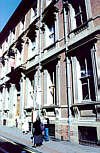
The National Museum of Labour History was, until quite recently,
housed in this historic building, and a reading room containing
a great deal of archive material still remains, although its main
exhibits have now been moved en bloc to the Pumphouse Peoples History
Museum in Bridge Street (see above).
Serious students can use the Archive and Study Centre and the Textile
Conservation Studio by prior arrangement - contact the Pumphouse
Museum, telephone number : 0161-839 6061 or 0161-228 7212.
This building, formerly the Mechanic's Institute saw the first ever
assembly of the Traders Union Congress (the TUC) convened by the
Manchester and Salford Trades Council during Whit week in June 1868.
A plaque on the side of the building commemorates the occasion.
Local Manchester tradesman William Wood was elected first president
in recognition of the role that Manchester had played in the forming
of the congress. The "New Unionism" spread outwards from Manchester,
with the General Union of Labourers first to be formed in Manchester
during the winter of 1889-1890, followed by the Dock Labourers Union,
and the Tramway Employees Union in 1900. This museum marks the pivotal
role which Manchester held in the formation of the Trades Union
movement nationally and internationally.
See
Also: Children's
Museum Entertainments
|
|