Imperial
War Museum North

Imperial War Museum North
Aerial Photograph
Image Courtesy of www.webbaviation.co.uk
© 2005
CLICK
ON IMAGE TO ENLARGE
Trafford
Wharf Road, Trafford Park, Manchester M17 1TZ
Tel: 0161-836 4000. Fax: 0161-836 4003.
Education/Group Visits Department Tel: 0161-836 4064.
Catering Manager Tel: 0161-836 4042.
Email: info@iwmnorth.org.uk.
Website: www.iwm.org.uk
THE
MUSEUM CONCEPT
Opened on 5 July 2002, the long awaited IWM North is situated on
the banks of the Manchester
Ship Canal on the Trafford wharfside of Salford
Quays about 2 miles from city centre Manchester. It is located
diametrically opposite the Lowry Centre
on the Salford side, to which it is linked by the dramatic Lowry
Footbridge across the Ship Canal.
The building is an attraction in itself, and is expected to be visited
by around 400,000 visitors a year. It is an inspired concept of
internationally renowned architect, Daniel Libeskind, who also designed
the adjoining Lowry Footbridge. Polish-born in 1946, and with his
main office now in Berlin, Libeskind overcame severe budget cuts
- from £40 million down to around £28.5 million when the millennium
lottery grant failed to materialise, to produce this masterpiece,
the first of only 3 buildings by the architect. His other two include
the Jewish Museum in Berlin and the Shoah Centre also in Manchester.
The style, typical of Libeskind's work, has become known as "defragmentation",
and it departs dramatically from conventional vertical and right
angle-built architecture in its free-flowing forms and asymmetric
geometry. The original plan had called for concrete, the final stainless
steel sheet cladding came as a result of financial constraints.
However, Libeskind rose to the challenge - never one to shirk tough
challenges.
The building has joined an ever-growing list of celebrated 21st
century structures appearing around Manchester, and is expected
to attract continuing international interest for designers and students
of architecture. It is a further contributor to the rebirth of Manchester
as a world-class architectural environment and as such is instrumental
in shaking off more than a century of drabness and grime which has
long been associated with the area.
 Photo ©
courtesy of Andrew C Theokas
Photo ©
courtesy of Andrew C Theokas THE
SHARDS
The design concept is based on the globe, broken into three fragments
to depict the shattering effect of war on the history of the world.
These three fragments, or "shards", are structurally interlocked
to represent world conflict on land, water and in the air.
The Earth Shard provides the main museum space while the Water Shard
is, naturally, close to the canal itself. The Air Shard, is open
to the elements and has a dominant towering observatory, offering
panoramic views across the Ship Canal and the Manchester city centre
skyline.
EXHIBITIONS
& DISPLAYS
The Museum utilises many new and innovative modern exhibition design
techniques and used the very latest interactive technologies to
enhance the visitor experience, although, thankfully, there are
still some reassuringly conventional glass cases with memorabilia
and exhibits to satisfy the more conservative visitor, as well as
there being occasional free standing artefacts of war - a field
guns, a Russian tank, and a Harrier Jet, among others.
The Museum's interactive multimedia facilities elevate it from being
merely another dry exhibition space to produce a truly 21st century
centre aimed at bringing the stark realities of war to visitors
of all ages. Libeskind was involved in not only the overall building
design but advised on the disposition of the internal spaces and
exhibits.
The museum also has an extensive art collection with paintings and
drawings commissioned during the two World Wars, as well as collections
of photographs, film and other period documentation.
|
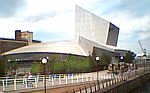
Imperial War Museum North seen from the Lowry Footbridge
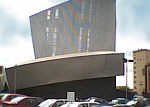
The Air & Earth Shards
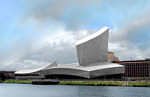
The Museum seen from across the Manchester Ship Canal
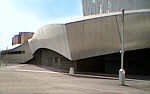
The Earth Shard - main exhibition block

Steel framing inside the
towering Air Shard
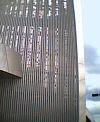
The Air Shard from the exterior
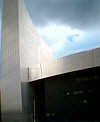
Air and Earth
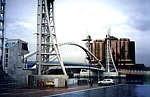
The Millennium Lifting Footbridge
|
THE
BIG PICTURE
An audio-visual presentation drawn from the Museum's extensive
sound and image archives, which runs in the main exhibition areas
for 15 minutes every hour. Set on an immense scale, other displays
are blacked out during the presentation, which uses 60 projectors
on 20 screens of around 5 metres height. The Big Picture is well
worth waiting to see, but beware, it contains flashing lights
and loud sounds which may be problematic for some visitors or
very small children - warning announcements allow ample opportunities
for those who wish it to leave the area.
THE
TIMELINE
The Timeline forms the main layout of the exhibition, following
a broad historical development and charting the changing balance
of world power through various zones including:
"1900-1914: A New Century"
"1914-1918: First World War"
"1919-1939: Between the Wars"
"1939-1945: Second World War"
"1946-1990: Cold War"
"1990-Present: Into a New Century"
SILOS
Discrete exhibition spaces are provided for in so-called "silos",
which afford opportunities for visiting, temporary or changing
exhibitions. These six partially enclosed tall exhibition spaces,
(called "Silos"), present a range of themes that are
central to the history of war and conflict, including:
"Experience
of War"
"Women at War"
"Impressions of War"
"Empire, Commonwealth & War"
"Science, Technology & War"
"Legacy of War"
OPENING
Open daily from 10.00am - 6.00pm from March-October, and closes
at 5.00pm from November-February. The Museum is closed Christmas
Eve, Christmas Day and New Years Day..
ADMISSION
& PARKING
Admission to the Museum is free, but there is a car parking charge
of £4.00 for the whole day. Very little other street parking
is available near the Museum. It is possible, however, to park
in the Lowry Designer Outlet secure car park (paying) opposite
across the Ship Canal, and to approach the Museum on foot by the
Lowry Footbridge.
LOCATION
The Museum is located about 2 miles from Manchester city centre,
on the south bank of the Manchester Ship Canal, opposite the Lowry
Centre, (from which it can be accessed on foot via the Lowry Footbridge).
It can be easily accessed by Metrolink Trams via the Harbour City
Station or Bus Nos. 250, 291 and 290.
FACILITIES
Shop open during public hours, sells souvenirs and memorabilia.
Extensive library of books on war-related topics on sale. Restaurant
in the Water Shard open all day. Ground floor café selling
light refreshments and sandwiches. Accessible throughout to disabled
and wheelchair users. Lifts throughout. Large print guide leaflet
available. Disabled Parking. Toilets. Group visits welcomed but
advanced booking preferred - teachers should contact the Education
Department on 0161-836 4064, or via email at learning@iwmnorth.org.uk.
Corporate Hire for dinners, receptions or dancing - contact the
Catering Manager on 0161-836 4042.
Back
to Top
|