Manchester
& the Northwest Region of England
Papillon
Graphics' Virtual Encyclopaedia of Greater Manchester
Including
Bolton, Bury, Manchester, Oldham, Rochdale, Salford, Stockport, Tameside,
Trafford & Wigan
NAVIGATION
Virtual
Hosting by
TheServerBank
Photos
by John Moss
New
& Modern Bridges in Manchester
Manchester's Architectural Heritage
Merchant's
Bridge
Catalan Square, Castlefield, Manchester
A
dramatic curving white steel footbridge which crosses the Bridgewater
Canal at Castlefield Basin, Merchants Bridge was designed by Whitby
Bird Limited (www.whitbybird.com) and the steeIwork contractor
was Watson Steel. Completed in 1996, this torsion structure was
selected for a Millennium Product Award amid fierce competition,
and connects the Barça Cafe in Catalan Square in Castlefield
and the Quay Bar on the other bank. The sweeping dynamic curve
of this structure is a product of the computer age, and its white
paintwork contrasts dramatically with the red and dark blue brickwork
of Castlefield's older railway viaducts and canal wharfages all
around it. It is a fitting centrepiece for the renewal of the
Castlefield area of the City of Manchester, and offers the best
of 20th century design and engineering while complementing the
seven established bridges at the site which cover 200 years of
history.
Trinity
Bridge
St Mary's Parsonage,
Salford
Designed
by the Spanish engineer Doctor Santiago Calatrava and completed
in 1995, Trinity Bridge marks another major inner city regeneration,
this time over the River Irwell, which has always marked the invisible
border between the Cities of Salford and Manchester. The whole
structure rests on one single 40 foot pylon - a kind of tent pole
- leaned over at a rakish angle, from which the suspending tension
cables hang down to suspend the footbridge deck beneath. Its sculptural
appearance and white paintwork inject a striking elegance in an
area that has long awaited such a development. This area was a
dark, dank, long neglected back end to the city, the such a new
development has resurrected the area, especially with the ongoing
construction of the new Lowry Hotel on the Salford bank of the
river. Also on this bank at the end of the bridge is a substantial
riverside piazza with gardens and benches offering a welcoming
pleasant recreational area for surrounding business workers. This
was a joint project between Salford City Council and Salford Pheonix,
and was formally opened by the Lord Mayors of Salford and Manchester,
symbolising a new and important link between the two cities.
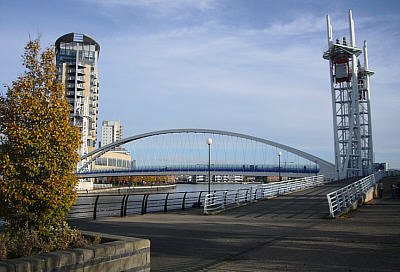
Opposite the
Lowry Art Gallery/Centre, this remarkable
footbridge, linking Salford to Trafford across the Quays, was
designed by W Middleton of Parkman Limited and the main engineering
contractors were Christiani and Neilsen; it was completed in 2000
- hence the 'Millennium' Bridge.
It crosses
the Manchester Ship canal near its terminus at the old Manchester
Docks, and conveys foot passengers over to Wharfside Road, where
the new Imperial War Museum
North (by Daniel Libeskind) was opened in July 2002.
Its four giant piers each winch the road deck high into the air
to provide adequate clearance for large ships to pass beneath
into the old Dock area and the redeveloped Lowry Designer Outlet
shopping centre.
Hulme
Arch Bridge
Stretford Road,
Hulme, Manchester 13
This dramatic
road bridge was designed by Chris Wilkinson Architects, completed
in 1990 and engineered by Ove Arup & Partners. Hulme Arch
Bridge was one of Manchester's first new bridges of modern times,
created to span the busy Princess Road/Princess Parkway arterial
road south of the city centre on its way to Wythenshawe, the M60
and M56 Motorways and Manchester Airport. It stands about 1 mile
due south of the city centre. It has a single span arch which
rises almost 30 yards above the carriageway and spans 50 metres
in a diagonal formation. Spiralled steel cables suspend the road
deck from the arch.
In the past few decades, Hulme had become a rather run-down and
somewhat controversial district of Manchester - first for the
wholesale demolition of its 19th century slum dwellings, then
in the 1960s for the construction of huge monolithic concrete
high rise tenements which became known as "Fort Hulme".
All kinds of social and economic problems ensued, and it had gained
a rising crime-based reputation. Hulme was top go through a second
regeneration as the 30 year old concrete structures were removed
in the early 1990s. This fine bridge in many ways typifies the
corporation's aspiration to remove the stigma that the area had
come to represent, and to replace it with a new, inspirational,
elegant and optimistic edifice on the main approach to Hulme.