|
Virtual
Hosting by

TheServerBank
Photos
by John Moss
|
Manchester
Mills
in
the 18th and 19th Centuries
|
Textiles
& Cotton Mills In Manchester & Lancashire
Manchester,
and the towns of the region, generated much of Britain's 19th
century wealth, as well as pioneering much of its technological
groundbreaking achievements. Methods in spinning, weaving and
dyeing had become fully mechanised by the middle of the 19th century,
through inventors like Samuel
Crompton, and his spinning Mule, James
Hargreave's Spinning Jenny, Richard
Arkwright, and many other's works of invention. Steam
and water had made power plentiful and still cheap, coal came
from just down the road at Worsley through
Lord Egerton's
Bridgewater Canal, the new railways and the Ashton & Rochdale
Canals had made transportation close and convenient. Mass production
methods were gradually introduced and productivity was at an all-time
high.
Only the American Civil War interrupted profitability. Raw Cotton
from the Confederate Southern Sates was being blockaded by the
Union North, and this resulted in a major depression in all the
textile trades by the early 1860s - a period known as "the cotton
famine". Nevertheless, many of the mills survived that period,
and were in active and profitable manufacture until well after
the Second World War, when they failed to win orders against cheaper
foreign imports. Some of these mills are with us today. Several
are derelict, most are converted to other commercial or industrial
uses, though their tall, now smoke-free, chimneys still stand
proudly, bearing witness to a time when they were important buildings
of trade and commerce.
The Manchester
Mills
REDHILL
STREET MILLS
This mill
was commissioned by two Scottish businessmen, James McConnel and
John Kennedy in 1790, and was constructed in 1818 as a spinning
mill. One writer, Alexis de Tocqueville, described Redhill Street
Mill in 1835 as "...a place where some 1500 workers, labouring
69 hours a week, with an average wage of 11 shillings, and where
three-quarters of the workers are women and children". (See
"Working & Living Conditions")
Eight storeys high, it was the tallest iron framed building in
the world in its day.
|
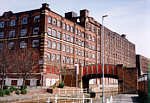
Redhill Street
Mills, Ancoats

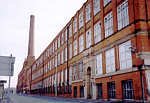
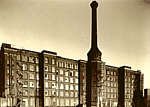
Victoria Mills,
Miles Platting
|
During
the Cotton Famine, the company had obtained rights to Heilmann's
new combing machine, and managed to tick over during the depression.
In 1865 the building was altered by the new owner, Sir William Fairbairn,
to install larger automated spinning mules. By this time it was
the biggest mill in the Manchester region. Further buildings were
added in 1868 and 1912 to cope with the demand for increased output.
THE OLD
MILL & THE NEW MILL
The so-called
Old Mill was built on Henry Street in 1799 for James McConnel
& John Kennedy who were textile machinery manufacturers with
interests in weaving. This mill was rebuilt in 1912 and became
known as the Royal Mill. In 1801, with improved profitability
after several lean years McConnel & Kennedy commissioned the
building of the New Mill, completed in 1806. This factory had
8 floors and covered an area of 650 square yards. Gas lighting
was installed in 1809 by Boulton & Watt. By 1811, with a downturn
in trade, like many others, the firm of McConnel & Kennedy
went bankrupt. Later, in better times, they were to build the
Sedgewick Mill.
THE SEDGEWICK
MILL, UNION STREET, MANCHESTER
In 1815 McConnel
& Kennedy purchased land on Union Street in Ancoats
to construct the new Sedgewick Mill, which was not commissioned
till 1819, when it was designed by James Lowe. Bricks were made
from local clays to save money, and the mill was U-shaped with
8 storeys and a 17 bay front on Redhill Street. It was completed
in 1820, though additions were made in the 1860s.
CAMBRIDGE
STREET MILL
In 1814, Hugh
Birley began the building of a mill complex on Cambridge Street
in Chorlton-on-Medlock.
Birley was a local magistrate and one of the commanders of the
Manchester & Salford Yeomanry responsible for the Massacre
at St Peter's Field in 1819.
The mill had six storeys and two basements with 20 loading bays
along Cambridge Street. A further block was added later, in 1845.
This mill was one of the first in Manchester to use cast iron
columns and iron framing, in-filled with brickwork. The mill was
driven by a beam engine made by Boulton & Watt and had gas
lighting, supplied by its own gas storage tanks in the basement.
The several mills on Cambridge Street were interconnected by underground
tunnels and rail tracks to ensure rapid transit through the new
factory system.
By the end of the 1830s, Cambridge Street mill had a 600 loom
shed and employed 2,000 people in spinning and weaving - at that
time probably the largest mill in Manchester. In the 1860s the
mill was bought out by Charles McKintosh & Company to produce
rubberised waterproofs, for which he subsequently became world
famous, the word mackintosh becoming the generic term for
waterproof over-garments.
Back
to Top
VICTORIA
MILLS, MILES PLATTING
The Victoria
Mills in Varley Street, Miles
Platting, were constructed in 1867 and 1873 for William Holland,
by the Architect George Woodhouse of Bolton. The earlier Georgian
Mills had long since outlived their usefulness, and were soon
outgrown in the face of increased production, and Holland decided
to vacate his former Adelphi Mill in Salford
after severe flooding.
He chose to move to Miles Platting, which was beginning to be
developed by other mill-owners at that time, and planned his huge
mill to be built in two stages, six storeys high, and of two identical
buildings joined by a common engine house. The dominant feature
was to be the chimney. In those days steeplejacks were paid according
to the number of bricks they used, and as a result they ingeniously
contrived to cap chimneys with as much masonry as it could stand.
This chimney was no exception - it is tall octagonal and graceful,
its slender shaft falling into a large drum with arcading.
The mill still worked until 1960, and thereafter remained in a
sadly derelict condition for many years. More recently it has
undergone a renaissance as new apartments and offices for the
NHS.
BEEHIVE
MILL, ANCOATS
This mill
was built in the early 1820s on Bengal Street in Ancoats in three
sections to facilitate 3 different owner/occupants. A further
wing, the Jersey Wing, was added later in 1824. It had a revolutionary
prototype fireproof system of stone flags laid on cast iron beams
with no woodwork at all. The roof was also supported on iron trusses.
This form of "fire-proofing" was to catch on, and many
subsequent mills, factories and warehouses were to employ the
system.
BROWNSFIELD
MILL, ANCOATS
Built on Great
Ancoats Street, it had seven storeys and was in an L-shaped formation.
Initially used in the cotton trade, it later had several different
occupancies and was used for smaller trades. It was in this mill
in 1910 that Verdon
Roe established the AV Roe Company manufacturing aeroplanes.
Back
to Top
THE SOHO
FACTORY, MANCHESTER
It was not
only textile manufacture that thrived in Manchester, but, by the
mid-nineteenth century, thanks largely to engineers like William
Fairbairn and industrialists like Joseph
Whitworth that the city became a manufacturer and supplier
of mill machinery, spindles and other goods to the surrounding
towns to fuel their burgeoning textiles industries. The Soho Factory
had many specialist manufactures within its 100 yard frontage,
including machinery makers, spindle makers and calico printing
machinery makers. They also supplied goods and parts for the dyeing,
bleaching and growing local chemical industries.
BRUNSWICK
MILL, BRADFORD ROAD, MANCHESTER
Built in Bradford
Road alongside the Ashton
Canal, this 1840 building was designed by David Bellhouse.
Its seven storeys had 35 loading bays facing directly onto the
canal as well as front warehousing facilities. The Brunswick Mill
was one of the largest in Britain at that time and by the 1850s
held some 276 carding machines, and 77,000 mule spindles.
See Also:
Recommended
Reading:
"Cotton
Mills in Greater Manchester"
by Mike Williams with D A Farnie.Greater Manchester Archaeological
Unit in association with the Royal Commission on the Historical
Monuments of England. Published in softback cover 1992 by Carnegie
Publishing Limited, Lancaster LA1 4SL. Website: www.carnegiepublishing.com.
ISBN: 0 948789 89 1.
A comprehensive account of the mills of the region copiously illustrated
with graphic drawings, schematics and period photographs as well
as detailed text accounts of construction and histories. A major
reference work.
|
|