|
Virtual
Hosting by

TheServerBank
|
Victorian
Manchester
Life
in Manchester in the 19th Century
|
Work, Health,
Housing and Working People in the City of Manchester
|
THE WORKING
PEOPLE OF MANCHESTER
Despite the
growing wealth due to trade and commerce, prosperity lay in the
hands of very few of Manchester's residents. The working people,
who actually produced the wealth, lived, worked and died in conditions
of the most desperate poverty and degradation. Innumerable reports
and surveys were carried out during the 19th century, and they
all told much the same story : poor wages, impossibly long working
hours, dangerous and unsanitary working conditions, even more
unsanitary dwellings, little or no health provisions, high infant
mortality and a short life expectancy. A map of Manchester showing
age of death figures in the mid-nineteenth century revealed that
life expectancy was directly related to wealth. Put simply, the
poor died younger and the rich lived longer. At that time, Ancoats
was the death black spot of Manchester.
Records
show that by 1830 there were over 560 cotton mills in Lancashire,
employing more than 110,000 workers, of which 35,000 were children
- some as young as six years of age. Wages for children were about
2s.3d. (two shillings and three pence) per week (about 11½
new pence), but adults were paid about 10 times more. Hence, it
made economic sense to employ as many children and as few adults
as possible, and this is exactly what happened. Youngest children
were employed to crawl beneath machinery (while still in operation)
to gather up loose cotton - they were known as "scavengers"
and many died by getting caught up in machinery. Those that survived
to adulthood had permanent stoops or were crippled from the prolonged
crouching that the job entailed. The typical working day was 14
hours long, but many were much longer, as, without regulation,
unscrupulous mill owners could demand any terms they liked.
MANCHESTER
- VICTORIAN ATTITUDES
Any attention
that the plight of working people drew from a wider middle class
public was generally disparaging and attitudes tended to be laisser
faire. The poor were regarded as an underclass, whose degradation
was largely their own fault; frequently it was stated that God
wished them to be poor; they were a semi-class of probable criminal
tendencies.
Victorians distinguished between the "deserving" and
the "undeserving" poor. Widows, orphans, old people
and those whose sickness rendered them incapable of work were
regarded as deserving and could receive help through the system
of Poor Houses, degrading though these were. The other poor or
unemployed were regarded as undeserving and, without any social
support system in place, were left entirely to their own devices.
Acquired wealth, on the other hand, was commonly seen as a visible
sign of virtue: the poor were bad, the rich were good - it was
a natural order. Another popular concept was that if one worked
hard, this would be rewarded by an increase in wealth.
Back
to Top
|
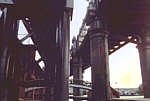
Castlefield
- urban Victorian industrial landscape

The River Irwell
near the Cathedral in the early 19th Century

Platt's Mill
in Oldham around the end of the 19th Century

Salford Cellar
Dwelling from "The Builder" 1862.
|
Find
People & Places in the 1901 Census
www.census.pro.gov.uk
Find out about who lived in your house in 1901 and
research your Victorian ancestors. You can also research
vessels and
institutions.
|
|
POPULATION
GROWTH IN MANCHESTER
Manchester
saw exponential population growth during the early 19th century
- while London's population doubled, Manchester's trebled! Here
are figures for population growth in Manchester, based on local
period censuses:
| 1717: |
c10,000 |
|
1821: |
126,066 |
| 1758: |
c17,000 |
|
1831: |
182,016 |
| 1773: |
22481 |
|
1841: |
235,507 |
| 1801: |
75,281 |
|
1851: |
303,382 |
| 1811: |
89,068 |
|
1971: |
351,189 |
WORKERS'
HOUSING IN MANCHESTER
By and large
the workers lived near and around their workplace, and the wealthy
lived a few miles outside the city in their garden suburbs. Houses
were "jerry" built, without control or regulation of any kind.
Builders, usually the employer, would build so as to cram as many
houses as possible into the space available.
There was no water or services, and no attempt to provide privacy
of any kind. People worked in shifts and shared beds. Ten or twelve
people could share the one bedroom, and up to 100 houses shared
the one "privvy" - usually a deep hole dug in the corner of a
yard, or a "midden" - a heap against a wall.
Houses were
damp - there were no damp-proof courses, and no double brick walls.
Rain leeched through walls, and even in dry summers, damp rose
up the walls. The only relief from damp was the building of cellars
to contain it. However, these cellars inevitably became dwellings
for subtenants.
Manchester
and Salford's cellar dwellings were the root of most health problems,
and became a national disgrace. "The Builder" magazine
of 1864 illustrated the worst dwellings, and many celebrated figures
emerged to urge for improvement of the lot of working people.
John Kay published
"The Moral and Physical Conditions of the working Classes"
in 1832, Engels wrote
his well-known "The Condition of the Working Class in
England" in 1844 based on the plight of the Manchester
underclass, and in 1842 Edwin Chadwick published his "Report
on the Sanitary Conditions of the Labouring Population".
'Official' paupership figures for the "Township of Manchester"
were the highest in Britain - higher even than in London's east
end.
Back
to Top
LABOUR &
WAGES
Average wages
in 19th century Manchester were well below subsistence level.
A report by Fred Scott for the Manchester Statistical Society
in 1889 found that over 40% of working men interviewed in Salford
were "irregularly employed", and that 61% could be defined as
"very poor" with a weekly income of less than 4 shillings (20p)
per week.
The main problem
was casual labour. Payments from the Manchester & Salford District
Provident Society's Poverty Fund in the winter of 1878-79 revealed
that the vast majority of qualifying applicants were casual and
seasonal workers - among them were warehousemen, builder's labourers,
general labourers, storemen and transport men - most of these
were of Irish descent. In the days before any welfare provision,
there was no sick pay - if you couldn't work, you weren't paid.
Many people worked up to 14 hours a day for 7 days a week; a few
"benevolent" employers allowed a 6 day week with compulsory church
attendance on the seventh.
Back
to Top
MANCHESTER'S
IMMIGRANT POPULATION
Immigrants
also formed a large proportion of the poor. By 1851, Irish immigrants
comprised around 15% of the city's poor. Half of the people registered
in the New Bridge Street Workhouse in the 180s and 1890s were
Irish Catholics. Most lived in Ancoats, (40% Irish according to
the 1900 census), probably the poorest and most deprived area
of the city. A small area of Chorlton on Medlock was also known
as "Little Italy" on account of the large numbers of
immigrant Italians who lived there in a sort of ghetto situation.
They formed the largest section of the vast casual labour force,
which put to hard long hours when trade was good, were first to
be laid off in leaner times. They formed the largest part of the
Smithfield Market labour force, comprised the majority of the
city's street sellers and hawkers, dominated the building trade
and figured largely in domestic service (females in particular).
Back
to Top
DISEASE
& HEALTH ISSUES IN VICTORIAN MANCHESTER
Manchester
had become a very unhealthy place to live in. Coal burning domestic
fires and innumerable factory chimneys meant that the city was
overhung with a permanent pall of smoke, drenched with acid rain,
and suffered plagues of respiratory diseases (bronchitis, influenza,
pneumonia, asthma, as well as other industrial dust-related diseases).
Life expectancy
of a working man in Salford in the 1870s could be as little as
17 years. While the opening of some hospitals after 1850 and the
application of public health measures saw a fast decline in infectious
diseases such as small pox, scarlet fever and other communicable
diseases, there were still many endemic diseases which plagued
working people.
In sewage
disposal, the city had little or no policy until the late 19th
century. Ashpits and communal cesspits were common, and they overflowed
in rainy periods, and had to be emptied and carted away. This
was, however, rarely done. There were frequent official accounts
of "midden" overflowing into the cellars in which a large number
of workers lived, with no attempt made to relieve the problem.
Even by 1907
only about one-third of the city's privvies were water closets.
Such water closets as there were before the 1870s simply ran directly
into the Irwell, from which most people obtained their drinking
water. Cholera was a common summer visitor to the city. The Manchester
and Salford Sanitary Association was formed in 1852 to promote
public health and sanitary reform. They had a vigorous programme
which included distributing thousands of tracts (though few poor
people could read), and delivering hundreds of public lectures.
They also created isolation hospitals for the worst diseases.
Despite all this the city's health failed to improve.
But it was
the airborne diseases which accounted for the greatest mortality
figures. Pulmonary Tuberculosis killed most people in Manchester.
The highest death risk areas of the city were all inner city zones,
occupied by the working poor : Ancoats, Chorlton-on-Medlock, Hulme
and Ardwick. It was not until the 1850s that relatively clean
drinking water came into the city from the completion of Longendale
reservoir, (though ordinary people had to queue at street standpipes
to obtain it), and that Thirlmere in the Lake District was added
to the system in the 1890s. These measures had a significant impact
in improving the health of the city's residents. Cholera and typhoid
were virtually wiped out at a stroke.
Things were
no better in the working mills of Lancashire. "Mill Fever",
aching head, limbs and nausea was common. Workers usually developed
tuberculosis, bronchitis and asthma due to cotton lint and dust
which hung in the air - there were, of course, no health or safety
precautions or safeguards in place.
Back
to Top
INFANT MORTALITY
IN VICTORIAN MANCHESTER
The main killer
of children was diarrhoea. Despite greatly improved water supplies,
the main threat still came from backyard middens, insect borne
germs, inadequate washing facilities, poor food hygiene, and from
a very poor diet. Manchester's slow rate of conversion to water
closets and sewage disposal were at the root of its extraordinarily
high infant death figures. Many middens and privvies were still
in use well into the early 1900s.
HEALTH REFORMS
Not until
later in the century did significant health reforms improve the
lot and the longevity of working people. New sewers and sewage
treatment plants and the appointment of Manchester's first Medical
Officer of Health in 1868, who closed down virtually all of the
city's cellar dwellings, made great improvements to the health
and well-being of ordinary people. The creation of public bath
houses and fine "water palaces" like Victoria
Baths in Hathersage Road saw Manchester thrust into the forefront
of a burgeoning public health drive.
Regulations
governing the standards of new houses were introduced after 1875,
which controlled such things as the size and number of required
windows and permitted light levels, enforced the introduction
of back yards (albeit very small ones) and back alleyways. Waterways
and public taps, as well as public laundries and wash houses were
also introduced.
The foundation
of Manchester's Unhealthy Dwellings Committee meant that around
500 houses a year were refurbished up to the new standards between
1885 and 1905, and over 2000 houses a year after that. By the
turn of the century, much of the worst insanitation of Manchester
had been removed, and the city's health had improved so that it
was no longer the black spot of England.
See Also:
The
Coming of Canals
The
Railway Age
Book about
Victorian Manchester
|
|