THE ANTI-CORN
LAW LEAGUE
Due to fierce
competition from cheap imported foreign corn in the early 19th
century, wealthy and influential gentlemen farmers had lobbied
the ruling parliamentary party, the Tories, to prohibit their
import by the imposition of Corn Laws in 1815. With this monopoly
in place, British corn rose to prohibitive prices, making it impossible
for the poor to buy bread.
The Corn Laws were seen by ordinary people as a symbol of the
dominant ruling aristocracy's feudal power over them, and of the
suppliers' unashamed self interest, at the cost of their staple
food. Protests by Lancashire mill-workers at the imposition of
such severe measures soon grew.
In September 1838, mill owners and local politicians joined protesters
in the formation of an Anti-Corn Law League, at the York Hotel
in King Street, Manchester, with George Wilson as its chairman.
Support grew so fast that a temporary wooden hall was built in
St Peters Street to hold protest meetings - it became known as
the Free Trade Hall. Later a stone building replaced this original
wooden one. Two major figures emerged as leaders of the Anti-Corn
Law movement, Richard
Cobden, a Bolton calico manufacturer, and
John Bright,
a Rochdale mill-owner and a Quaker. Cobden and Bright, both persuasive
orators with powerful local backing, (including Archibald
Prentice, radical editor of the Manchester Times newspaper),
succeeded in getting elected to parliament, (Cobden - MP for Stockport
in 1841) where they constantly lobbied and harassed the Prime
Minister, Sir Robert Peel (born in Bury). Peel, under severe pressure
from the League and its growing band of ever more powerful supporters,
repealed the Corn Laws in 1846, thereby splitting the Tory party,
and effectively ending his own political career in the process.
Manchester would, henceforth be associated with the principle
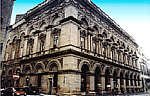
of Free Trade. The Free Trade Hall, the third and now a fine permanent
stone building, was built later as a monument to honour the Manchester
movement.
THE REFORM
MOVEMENT - RADICALS & CHARTISTS
By the early
19th century, despite its massive growth, Manchester had no real
political representation - most parliamentary places were held
by local gentry in surrounding suburbs, who had little or no political
interest. Many of these 'constituencies' comprised no more than
a half dozen houses. The vast majority of Manchester people had
no voice, and were not represented in parliament. Many educated
businessmen of the region thought it high time that the political
system should be reformed so as to be more representative of the
contemporary demography - most constituencies and boundaries had
been drawn over 400 years earlier, and bore little resemblance
to actual population distribution at the time.
The Reform Movement had begun as early as 1790, when the Manchester
Constitutional Society had been formed, under the leadership of
Thomas Walker. This "radical" movement was deeply suspected and
opposed by local churchmen and magistrates, largely conservative
in their attitudes, and in privileged positions, who were generally
satisfied with the way things were.
THE PETERLOO
MASSACRE
A public reform
meeting was called, to be held on Monday 16th August 1819 in St
Peters Fields (now St Peters Street), as there was no building
thought big enough to hold the anticipated crowd. Henry
Hunt, a national reform leader, and noted orator who had spoken
elsewhere that year, was to address the crowd. Estimates put the
crowd at variously 30,000 and 150,000 people - in any case, we
can be certain that there were more people present than Manchester
had ever seen in one place before. Disturbed such large crowds,
magistrates called in local militia to stand ready.
Some 1500 troops assembled, comprising the 15th Hussars (professional
soldiers) and soldiers of the Manchester and Cheshire Yeomen Cavalry
(a largely volunteer force), commanded by Lieutenant-Colonel Guy
L'Estrange. Magistrates, fearing insurrection and riots, ordered
Hunt and other leaders to be arrested before they could speak,
though the meeting had been thus-far peaceful and orderly. Inadvertently
a mounted solder brushed and knocked down a mother, killing the
child she was carrying, and panic ensued. Magistrates, and the
troop commander, misread what appeared to be a riotous outbreak,
and ordered Yeomanry, who were standing ready just off Portland
Street, to go in to break up the affray.
The armed cavalry, sabres drawn, charged the crowd, cutting people
down indiscriminately. Men, women and children were hacked down
or trampled by horses or people in flight. After ten minutes of
havoc and slaughter, the field was deserted except for the broken
hustings platform, bodies of the dead, wounded and dying. A soldier
of the Yeomanry company, who had fought at Waterloo in 1815, likened
the carnage to that battlefield, and the term "Peterloo" took
hold, and survives as an historic event even today.
After news of the massacre spread across Britain, local authorities
clamped down on all public meetings, in breech of all laws to
the contrary, and took severe measures to ensure public order.
It had been arguably the most important day in Manchester's political
history. Rumours spread that the attack had been planned and may
possibly have been ordered, well in advance of the event, by the
government in London.
Fears of the recent French Revolution permeated British political
awareness to such an extent, that the authorities were paranoiac
in case ordinary people followed the French example - local authorities
had been ordered to stamp out any risk at source and summarily.
Another viewpoint blames bystanders throwing stones provocatively
at the troops.
Debates on the causes of the Massacre continue. Meanwhile, Hunt
and the other Peterloo leaders had been incarcerated in Lancaster
Castle prison. Thousands of supporters lined the streets when,
after being released on bail, Hunt made the return trip to Manchester.
Hunt had always insisted on peaceful and legal means to achieve
political change, despite being urged to armed protest by many
of his supporters.
The Peterloo Massacre successfully stifled Manchester's bid for
reform for a decade. Stinging from the attack for many years to
come, political meetings henceforth moved into the surrounding
towns of Oldham, Stockport and Blackburn, where the predominance
of mill-workers saw many eager to join the movement, and though
somewhat muted for a time, the movement gradually grew - most
popular amongst the unfranchised working people of Northern England.
It was not to be until the 1830s and '40s that parliamentary reform
could be fully ressurrected in Manchester. The Chartist Movement,
begun in London, but taken up eagerly and pioneered in Manchester,
was also a growing force. Chartists wanted universal suffrage
for all men, secret ballots and annual elections. Political reform
was in the air and the people of Manchester and the numerous spinning
and weaving towns surrounding it, were at the vanguard of the
movement.
A Chartist meeting was held at Kersal Moor in September 1838,
despite the Peterloo Massacre, and a second at the same site in
May 1839. Another was held at the Griffin Inn in Great Ancoats
Street in July 1840, and 6 other meetings in Lancashire in 1841.
The Chartist Movement dominated British politics in the 1840s,
and Manchester had been the flashpoint for the chain reaction
which it caused, and for the eventual political reforms which
were brought about through the constant efforts of its supporters.
See Also:
|

Richard Cobden

John Bright
The Free Trade
Hall, Manchester

A contemporary
illustration of the Peterloo Massacre
|
"...a
few broken and hewed flag-staves, and a torn and gashed
banner or two dropping...whilst over the whole field were
strewed caps, bonnets, hats, shawls and shoes, and other
parts of male and female dress, trampled, torn and bloody..."
Samuel Bamford, Peterloo eyewitness.
|
|
Find
People & Places in the 1901 Census
www.census.pro.gov.uk
Find out about who lived in your house in 1901 and
research your Victorian ancestors. You can also research
vessels and
institutions.
|
Books about
the Anti-Corn Law League
|