Banking
in Manchester
By
the 1830s, Manchester was a self-evidently growing metropolis
with the needs of any great city in the making. In 1829 an Act
of Parliament had created its own Police Commissioners (hitherto
it had been part of the Salford force). The Reform Act of 1932
had created 2 Members of Parliament, and the Municipal Reform
Act of 1835 had provided for the election of borough councillors,
aldermen and magistrates. In 1838, due largely to reforming pressure
groups led by Richard Cobden, Manchester
was granted Municipal Borough status and included the districts
of Chorlton-on-Medlock, Hulme, Ardwick, Beswick and Cheetham.
It now had its own mayor and alderman.
The establishment of a 'proper' civic infrastructure, the increasing
profitability of the textiles and cotton industries, and the large
amounts of money that began to flow around the city prompted an
explosion in the setting up of banking facilities.
Hitherto, cash had been transported by coach to London banks,
guarded by men carrying blunderbusses, and prey to notorious highwaymen.
By 1772, Arthur Heywood's Bank was already established in Manchester,
and sometimes made use of this method of cash transportation -
more normally Manchester trading depended on paper, IOUs and promissory
notes.
However, the first 'true' bank, (holding its own reserves of coins
and notes) was the Bank of Manchester, established in January
1829 on the corner of Brown Street and Market Street. Later, in
1834, The Manchester & Liverpool District Bank was established
in Spring Gardens, others soon followed, and the area of Spring
Gardens, Fountain Street and King Street became the banking centre
of Manchester.
The
Manchester Banks
The
Former Bank of England Branch Building
King Street has been the banking centre of
Manchester for the best part of 2 centuries, and some of its finest
Victorian buildings are situated here. Number 82 has been through
several transitions since its early days as the Bank of England
Branch which was designed by Sir Charles Cockerell and built between
1845-46. Cockerell had been employed as chief architect by the
Bank of England and was also commissioned to design branches in
Liverpool and Bristol at that time. The top pediment of this imposing
building, pierced by a so-called "lunette" window, spans
three of the six huge attached columns of the facade. The entrance
leads through a tunnel vault into a large domed banking hall.
(See Also: "Who
Built Manchester?").
Back
to Top
The
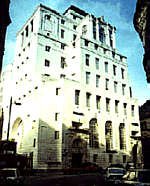
Midland Bank, King Street/Spring Gardens
This massive Art Deco bank, clad in white stone, is the major
work of Sir Edward Lutyens in Manchester (his other being the
Cenotaph in St Peter's Square). Lutyens had collaborated with
engineers, Whinney, Son & Austen Hall in its construction
between 1933-35, and surface carvings were local sculptor, J Ashton
Floyd. Still known by most Mancunians as the Midland Bank Building,
it is now actually a branch of HSBC (the Hongkong & Shanghai
Bank of China). Successive irregular "stages" are set
back or stepped in keeping with the ziggurat style popular in
the period. The ground floor banking hall has large arched windows
on all four sides.
(See
Also: "Who Built
Manchester?").
Number
10 Norfolk Street
The former Palatine Bank at the corner with Brown Street, was
built by Briggs, Wolstenholme & Thornley in 1908 and is a
veritable pot pourri of architectural detail: circular corner
towers, giant colonnades, conical roofs, battlements and parapets
- all built in Portland stone.
(See
Also: "Who Built
Manchester?").
Parrs
Bank / The Athenaeum
The former Parrs bank building was designed by Charles Heathcote
in 1902, is a superb example of Edwardian baroque with some increasingly
fashionable art nouveau detailing, particularly in the wrought
ironwork. Now a winebar-café known as the Athenaeum, it
is in red sandstone with an imposing corner entrance topped with
a dome. Probably one of Manchester's most opulent banking halls,
with deep mahogany woodwork, green ceramic and marble walls, rich
ceiling plasterwork, stained glass windows and elegant Ionic columns.
(See
Also: "Who Built
Manchester?").
Back
to Top
Prudential
Assurance Building, King Street
Built between 1888-96 this distinctive red brick and terra cotta
building is a fine example of the work of Alfred
Waterhouse in Manchester (others of his buildings include
Manchester Town Hall
and Strangeways Prison).
Successive modern refurbishments have somewhat destroyed the frontal
simplicity, which are now shop fronts.
(See
Also: "Who Built
Manchester?").
Lloyd's
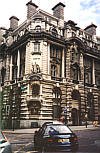
Bank, King Street
Three of the four banks at the crossing
of Cross Street and King Street are the work of Charles Heathcote
& Sons, and the grand baroque Lloyd's Bank is one of the the
most imposing. In a fine corner setting, this huge banking hall
was completed in 1915 in highly ornamented Portland stone with
exterior carvings and decorations by Earp, Hobbs & Miller.
It remains a main Lloyd's Bank branch for the city.
(See
Also: "Who Built
Manchester?").
Eagle
Star House, Cross Street
Another Charles Heathcote design, this modest Edwardian baroque
building, completed in 1911, is possibly one of the prettiest
buildings in the banking district. It occupies an island site
with rounded corners.
(See
Also: "Who Built
Manchester?").
Number 25 St Ann's Square
Designed by J E Gregan in 1848, for Benjamin Heywood's Bank, and
thought to be one of the finest examples of palazzo style architecture
in Manchester City Centre, this building now belongs to the Royal
Bank of Scotland and occupies the dominant corner position with
St Ann's Street facing St Ann's Church.. The ground floor is rusticated
and the windows are all arched, first floor windows having triangular
pediments and the top floor with square windows in true Italianate
style.
Back
to Top
Old
Bank Chambers
Corner of Old Bank Street, adjacent to the Royal Exchange Building
now Barclay's Bank, formerly the Manchester Liners Building, a
Portland stone building designed by Harry S Fairhurst in 1925.
(See
Also: "Who Built
Manchester?").
Royal
Bank of Scotland, Mosley Street
Set between York Street and Spring Gardens on Mosley
Street, now the Royal Bank of Scotland, this fine building was
designed by Edward Walters for the Manchester & Salford
Bank in 1862. It was extended by Barker & Ellis in the 1880s
with further modern developments by Fairhurst & Son in 1975.
(See
Also: "Who Built
Manchester?").
Portico
Library / The Bank
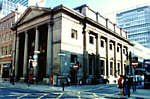
Corner of Charlotte Street and Mosley Street, the old Portico
Building, latterly the Bank café-wine bar, built in 1802-06
by Thomas Harrison. Manchester's oldest Greek revival building.
Its elegant loggia with its classical triangular pediment and
slender Ionic columns has dominated Mosely Street for nearly 2
centuries and has long been a centre for academics. The library
is now separated upstairs by the inclusion of a later galleried
first floor.
(See
Also: "Who Built
Manchester?").
See
Also:
|

Former Bank
of England Branch Building, King Street

The Athenaeum, formerly Parrs Bank
HSBC Bank, King Street (formerly the Midland Bank)

Prudential
Building, King Street
The Portico
Library / The Bank, Mosley Street
Lloyds Bank,
King Street - now Lloyds TSB Bank

Eagle Star
House, Cross Street - now the Leeds Building Society
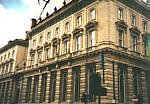
Former Manchester
& Salford Bank, now the Royal Bank of Scotland, Mosley Street
|