The Rochdale
Canal
The original
Rochdale Canal runs for 33 miles between Sowerby Bridge in West
Yorkshire, and Manchester. It begins at Castlefield, at "Dukes"
Lock 92, as the name implies, crossed the hills to Rochdale, before
it fell into disuse. Dukes Lock marks the end of the Bridgewater
Canal, and the start of the Rochdale Canal, though it was named
after the Francis Egerton, Duke
of Bridgewater
who had to pay for its construction as a condition of being
allowed to connect his canal to the Rochdale system. It is number
92, as the last lock on the Bridgewater. A pretty lock -keepers
cottage overlooks this lock, and the adjacent wine bar has borrowed
the name.
This once great canal is paradoxical - it was, until recently,
a very short reach, covering just under 2 miles, with its 9 double
chambered locks, and yet boats had to pay a sum of about £30 for
the privilege until as recently as 2000 AD, and a Rochdale Canal
Licence had to be purchased from the office nearby the top lock
at Dale Street. However, extensive restoration has resulted in
it being reopened to navigation as far as Littleborough since
summer 2002. Further stretches are planned to be reopened in time
- refer to the official website for current progress information
at their website: www.penninewaterways.co.uk/rochdale.
The Canal offers an alternative view to Manchester, rising as
it does, mostly unseen by the bustling traffic above, and occasionally
emerging into pleasant aspects where bystanders invariably stop
to watch this ancient ritual enacted.
Towards the top of the flight, the canal tunnels beneath a 20
storey office block, into a subterranean cavern where the canal
cuts through the enormous concrete pillars which support the building
overhead.
The
Rochdale Canal company was transferred across to the Waterways
Trust in August 2000, and all running of the canal has been contracted
out to British Waterways since then.
British
Waterways Regional Office is at:
Middle Warehouse, Castle Quay, Manchester, M15 4NJ. Tel: 0161-819
5847.
Websites:
- www.waterwaystrust.org.uk
- www.britishwaterways.co.uk
- www.waterways.org.uk
UPDATE
The Rochdale Canal was re-opened to navigation along its entire
length in July 2002 after extensive renovation over several years.
The Leeds
& Liverpool Canal
The Leeds
& Liverpool Canal is 127 miles long, with 91 locks, and is the
single longest canal built by one company in the United Kingdom.
It took well over 40 years to complete, after a great deal of
disagreement about its route from Lancashire to Yorkshire. The
company was established in 1770 and construction began at once,
with John Longbotham as its engineer; later he was succeeded by
Robert Whitworth, and after many delays due to the outbreak of
war with France in 1792, it was finally completed in 1816. In
1820, a branch was opened to connect it to the Bridgewater Canal
at Leigh.
Owing to its huge double locks, and the large payloads its boats
could carry, the company was very profitable, despite fierce competition
from the blossoming railroad companies. In its heyday, the canal
carried 50,000 tons of coal a year from the Lancashire coalfields
to Liverpool, whence most was exported to America.
Water, however, was constantly a problem, as double locks used
great quantities of it, and in spite of the building of several
feeder reservoirs along its length, it regularly had to be closed
in periods of drought through water shortage. Navigation freight
gradually declined, carriage having moved to the railways and
to improved road freight haulage made possible by the opening
of the motorways, and by the early 1960s, like many other canal
companies, the trade was untenable. It closed in the hard winter
of 1962-63, and was thereafter abandoned. Not until the rebirth
of canal cruising in the late 1970s, this time as a leisure pursuit,
was it possible to restore the canal to boat traffic. Nowadays,
one of its most famous landmarks is the beautifully restored Wigan
Pier, immortalised in George Orwell's novel "The Road to Wigan
Pier".
The Ashton
Canal
The Manchester
& Ashton Canal was the first canal to reach Portland Basin, opening
in 1796. It originally connected Manchester, (and thence the Bridgewater
Canal) to the Huddersfield Canal . It was never the most prepossessing
of canals, as it passed, and still does, through the industrial
heartland of Victorian Manchester, with all of its factories and
industrial spoilage, and through the housing estates of the poor
unfortunates who worked in those factories. Yet there are things
worth seeing on the stretch. It is another hard uphill slog, with
locks all the way, over 30 to Ashton-under-Lyne, all padlocked
against vandalism. Locking downhill from Ashton is rather more
inspiring, as it offers panoramic views of Manchester city centre.
A short walk from the canal at Fairfield is the Moravian Settlement,
a secluded other-world settlement established by Protestants in
the 15th century. Please note : boaters wishing to cruise the
Ashton Canal will need special padlock keys. These can be purchased
from British Waterways Offices at Ancoats, or from the lock house
at Fairfield.
|
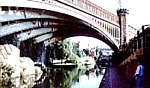
Railway bridges
over the Rochdale Canal at Castlefield
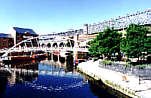
Dukes Lock
92
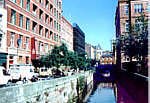
The Rochdale making its way through Manchester's Gay Village
The Leeds &
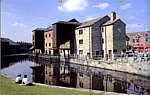
Liverpool Canal at Wigan Pier
|