The Trent
& Mersey Canal was completed in 1777, one of the earliest inland
waterways to be navigable in Great Britain. Its prime motivators
were the pottery industries of the northern midlands, centred
on Stoke-on-Trent.
Then, most
of their clay from Cornwall and flint from Sussex had to be shipped
to Liverpool by boat, and then transported by horse-drawn wagons
to the Potteries, making it expensive and time-consuming.
The decision
was made to link the navigable River Trent to the River Mersey
to overcome this difficulty, and the great engineer, James Brindley
was commissioned to oversee the survey, the design and the construction.
It was to
run from Preston Brook in the north, to Shardlow in the south,
some 92 miles, intersecting at Fazeley (Birmingham) with the so-called
"Grand Cross" of waterways linking the north-south and east-west
estuaries of the Humber, the Mersey, the Thames and the Severn.
Seven miles
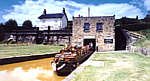
from Preston Brook, at the village of Anderton, stands the Anderton
Lift, an ingenious device by Thomas Telford, to lower boats from
the Trent & Mersey Canal above down into the River Weaver
below.
It has stood
derelict for nearly 2 decades. However, recent restoration work
has restored it as a working lift - after many years of campaigning
by waterways pressure groups it is now once again fully operational.
The canal
also passes through Middlewich, one of the three "wiches" of Cheshire
(Northwich and Nantwich being the other two) - ("wich"
is old English for "salt"), and was to be instrumental in improving
the business fortunes of the county's salt mine owners.
Cheshire salt
was still transported by canal until the early 1960s.
Locks are
abundant on the canal, particularly the long haul up from Middlewich
to Hardings Wood Junction, some 30-odd locks raising the canal
nearly 300 feet, known by the 19th century navigators as "Heartbreak
Hill".
In the 1830s,
duplicate locks were installed over much of this flight, to speed
up traffic - many survive today.
Fortunately,
there is ample respite half way up the hill at Hassal Green where
there is a lockside restaurant, good overnight moorings and the
newly refurbished "Romping Donkey" pub.
At Hardings
Wood Junction the water turns a dramatic deep orange-red colour
due to the iron oxide leeching into the water inside Harecastle
Tunnel. Also, at this junction a branch
off to the right marks the beginning of the Macclesfield
Canal.