NAVIGATION









































Virtual
Hosting by

TheServerBank
Drawings
by John Moss
|
 |
 |
Manchester
Celebrities
The Visual Arts (2)
Artists
and Architects around Manchester
|
| See
Also: Local
Artists of the Region |
Edgar
Wood
(1860-1935)
Born in Middleton on the 17th May 1860, the son of a mill owner,
and sixth of eight children, Edgar Wood went on to become an internationally
famous architect having designed and built many hotels, churches,
schools, shops and homes in the region - many still exist in the
Rochdale and Middleton area today.
Wood's father was also a Unitarian, a Liberal and a strict disciplinarian.
Edgar was educated at the local Queen Elizabeth Grammar School
and his father expected that Edgar would follow him into cotton
business - but Edgar had an ambition to become an artist. This,
however, was far too revolutionary for his father to accept, and
after much argument a compromise was agreed and Edgar began training
as an architect at the Mills and Murgatroyd practice in Manchester.
He went on to work as a designer and architect and was active
in the Manchester area for over twenty years, though the majority
of his work is in nearby towns, such as Rochdale, Oldham and Middleton
as well as some outlying districts like Bramhall and Hale. Edgar
became an Associate of the Royal Institute of British Architects
in 1885 and set up his own office in Middleton shortly thereafter.
He was also one of the founders of the Northern Art Workers' Guild
(in 1896) who were devotees of the so-called English Arts and
Crafts Movement. He became president of the Manchester Society
of Architects from 1911. By 1892 his practice was flourishing
and he moved into new premises at 78 Cross Street in central Manchester.
He also became a prolific designer in various other crafts, including
furniture, jewellery and metalwork in which the influences of
the Arts and Crafts Movement and of Art Nouveau are apparent -
his work exhibits a fairly clean break with the excesses of Victorian
design. He went on to design around 100 buildings in Middleton
and around Manchester, ranging from small, simply-built terraced
cottages to banks and schools. His First
Church of Christ Scientist in Daisy Bank Road, Rusholme is
still an outstanding example Arts & Crafts design and of his
own personal design capabilities. He also designed the Methodist
Church in Long Street, Middleton, and Almshouses Wood's own house,
Redcroft, was built in 1895 on Rochdale Road.
Edgar wood died in 1935, by which time he had achieved international
notoriety and world-wide recognition.
Back
to Top
|

Edgar Wood
- Architect
Books by Edgar
Wood
|
Thomas
Worthington
(1826-1909)
Thomas Worthington was the architect and designer of Manchester's
Albert Memorial which dominates the square in front of the Town
Hall. He was born in The Crescent in Salford,
the son of an affluent local businessman. A talented young man,
he worked for the architects Bowman and Crowther from the age
of 14, and had already by the age of 18 won a Society of Arts
Gold Medal for one of his designs. He had already contributed
many drawings to the book "The Churches of the Middle Ages".
In 1845, at the age of 19, he was given his first complete project,
and he designed "Broomfield", a large house in Alderley Edge,
Cheshire. Later he married the daughter of this house, and was
to live there himself from 1869 until he died in 1909. He worked
with the notable Sir William Tite, accompanying him on a tour
of Italy to see and draw some of its architectural splendours.
Shortly after arriving back in England, he set up his own small
company in Manchester, which was highly successful and received
many large and important commissions. A strong moral purist and
socialist, Worthington attended the Unitarian church and was to
be associated with other local social reformers like Mrs
Elizabeth Gaskell, the novelist.
Whenever possible, he sought to secure "social" commissions, and
wrote a book "Dwellings of the Poor" in 1857. In this connection
he designed the Manchester & Salford Baths and Laundries in 1857,
and the Chorlton Union Hospital in 1865 ( later to become part
of Withington Hospital). His pioneering hospital design won the
praise of no less a figure than Florence Nightingale. In 1861,
on the death of Prince Albert, was perceived as a great national
tragedy, and Memorial Funds to build monuments to his memory sprang
up all over Britain. Manchester was no exception. The Mayor donated
a statue of Prince Albert to the city, and in 1862 Worthington
was commissioned to design a suitable place in which to stand
it. His design was the first in Britain, and its better known
London counterpart designed 15 months later by Sir George Gilbert
Scott borrowed a great deal from Worthington's style and concept.
The monument is, naturally, "Gothic", a style in which Worthington
excelled; it takes the form of a medieval canopy ( or "ciborium"),
which is decorated with representations of Art, Science, Commerce
and Agriculture, in keeping with Prince Albert's wide interests,
as well as portrait heads and heraldic motifs and finials.
As yet, the present Town Hall was to built - it was to be erected
15 years later - and Worthington's monument dominated Albert square.
Worthington had many other architectural successes in Manchester.
The City Police & Sessions
Court, built in Minshull Street in the city centre in 1868
is, in many ways, one of his greatest planning achievements. On
a more modest scale, he also designed many Unitarian chapels on
the outskirts of the city. "The Towers", in Didsbury was a collaborative
effort between him and his partner John Elgood. It was here, the
home of engineer Daniel Adamson, that the very first meeting of
the promoters of the Manchester
Ship Canal Company met in June 1882.
Back
to Top
|
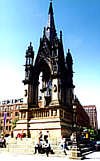
Worthington's
Albert Memorial in
Albert Square
|
John
Knowles
(1810-1880)
John Knowles
was responsible for the building of the Theatre Royal in St Peter's
Street in Manchester and was its manager for some thirty years.
Knowles was born in Chapel Street, London Road in Manchester,
the son of a successful businessman, whose interests included
being a coal merchant and a manufacturer of decorative stone fireplaces.
His father also ran the Peacock Coach office which ran coaches
from Manchester to London. Knowles had been manager of the former
Theatre Royal in Fountain Street, when in 1844, it was burnt down
by fire. He bought the rights to the theatre and purchased the
present site, formerly where the Wellington Hotel and Concert
Room had stood. His new £23,000 Theatre Royal was completed in
1844. He had commissioned the architectural firm, Irwell and Chester,
to design the theatre, and insured against future fire by having
a tank holding 20,000 gallons of water permanently placed on its
roof.
The
theatre opened on 29th September 1845 to an audience of 2,500,
and the programme included a performance of Weber's "Oberon" and
an elaborate ballet "The Court Ball in 1740". Knowles became well
known for his own Christmas pantomime spectaculars. Many famous
people acted there, including Charles Dickens on one occasion.
In 1860, Henry Irving joined the theatre company. Other famous
Victorian actors to tread its boards included Charles Calvert,
Edmund Kean, Barry Sullivan and Jenny Lind. In 1875, Knowles left
the theatre and it became a limited company. He was always a shrewd
businessman and clever financier, and had, amongst many other
business dealings, significant holdings in His Majesty's Theatre
in the Haymarket, London. In recent years the Theatre Royal has
suffered a rather chequered history, having been a cinema, stood
vacant, been a bingo hall, and currently it serves as a discotheque
and nightclub.
Back
to Top
|
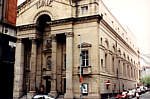
The Theatre
Royal Building
in Quay Street
|
Harold
Riley
(Born
1934)
Born in Salford
on 21st December 1934, this celebrated local artist has painted
portraits of a long list of celebrities and dignitaries, including
American President Gerald Ford, Pope John Paul, Nelson Mandela,
the Duke of Edinburgh and the golfer Jack Nicklaus.
Like his friend and mentor, L S Lowry,
he also extensively painted the local northern scene. Riley showed
very early promise, being only 19 when his first one man show
was exhibited at Salford
Art Gallery, and being selected to attend the Slade Drawing
School where he studied for six years before further studies for
two years in Europe. This was followed by two years in the army
doing national service under conscription.
He was also a keen footballer, and was actually selected to play
for the Manchester United
Youth Team, and played alongside Duncan
Edwards. However, Riley eventually chose to follow his career
as an artist and has remained in his native Salford and continued
to paint his beloved northern people.
Back
to Top
|

Harold Riley
- Artist
|
John
Ralston
(1789-1833)
Although born in Scotland in 1789, John Ralston is nowadays a
little known Manchester-based artist who was much celebrated in
the early 1800s. Some of our best records of late 18th and early
19th century Manchester rely on drawings made by Ralston, including
his many studies of Market Sted Lane (now Market Street), Dr White's
house in King Street (later a branch of NatWest Bank and currently
a Virgin store) as well as views of Blackfriars Bridge.
Ralston also made an extensive record of the people of Manchester,
offering a first hand insight into ladies and gentlemen's fashions
of the period. Details of his life are very scant, other than
a few records of his being the son of a calico printer's engraver,
and that his family moved to live in Strines (near Marple) in
Derbyshire.
At the age of 17 he became a student at Manchester School of Art,
under various tutors including Parry and Rathbone. For much of
his adult life he lived at number 26 Brazennose Street near Manchester
Town Hall. Apart from the smarter buildings of Manchester, he
was also attracted to make drawings of inner city dereliction
and slum dwellings.
He was also an accomplished violinist and helped found the orchestra
of the Manchester Gentlemen's Concert. A poor businessman, and
much forgotten in later life, he died in poverty, aged 44 in 1833.
Back
to Top
|
|
Lawrence
Isherwood
(1917-1989)
James Lawrence Isherwood was an acclaimed world class artist who
was born in Wigan in 1917, a contemporary of Salford artist L.S.
Lowry. John Berger, the notable art critic, ranked him among "
the best English painters of our time'. Isherwood was a rather
private and introverted man who rarely allowed his paintings to
be sold. His most typical work was in representing the northern
English industrial landscape.
However, he first came to a wider public attention in the 1960s
when he created somewhat controversial paintings of celebrities.
Prince Charles, the Prince of Wales bought one of his works. He
is widely regarded as one of the best impressionist-expressionist
painters that Britain has ever produced. He was a prolific painter
whose best work was perhaps produced from the late 1950s to the
late 1980s. His work is now represented in art collections throughout
the world, including the USA , Canada, South Africa, Spain, Australia,
Portugal, Italy and many other European countries.
Back
to Top
|

Lawrence Isherwood
|
Joe
Sunlight
(1890-1979)
Russian-born Joe Sunlight was the Manchester-based pioneering
architect and at one time one of the city's wealthiest citizens.
Born into a Jewish family on the 2nd January 1890, his family
fled from Russia and settled in Manchester around 1902. Joe was
to become a prolific architect, having designed 1000 houses in
the Prestwich district alone. His greatest landmark is the 14
storey Sunlight House in Quay Street - it was Manchester's first
high rise office block as well as its tallest building when it
was erected in the depressed 1930s. It was also very forward looking
with its high speed lifts and its unique vacuum cleaning system
which was designed to keep its 3000 windows dust-free.
Sunlight planned an even taller building on the adjacent plot
in Gartside Street, next to the Opera
House, some 40 storeys high, inspired by a visit he had made
to Chicago, but the local planning authority's short-sightedness
caused the plan to be rejected, and a carpark, regrettably, now
stands on the site.
An inveterate gambler and racehorse owner he was reputed to spend
around £1 million a year on horse racing.
Later, he became a Liberal Member of Parliament, had the distinction
of being Manchester's biggest taxpayer and when he died, in 1979
left a (then) fortune of nearly £6 million.
Back
to Top
|

Joe Sunlight
- Architect
|
Harry Rutherford
(1903-1985)
Harry Rutherford was born in Market Street in Denton, the son
of a local hatter, the third of four brothers. The family made
several moves during his childhood, including New Mills and Hadfield
in Derbyshire, before finally settling in Hyde.
His father William was already a gifted artist and had helped
form the Hyde Arts Group - Harry received much encouragement and
teaching at his father's knee. While still at school, he also
attended the local Hyde School of Art on Saturday mornings, and
on leaving school went to the Manchester School of Art, a contemporary
of Lowry. On leaving, he worked at a lithographic printers in
Manchester and learned the printing and illuminating trade as
well as becoming proficient in calligraphy and lettering.
He formed a close friendship with leading British artist Walter
Sickert and was substantially influenced by Sickert's style, philosophy
and subject matter. Shortly after Sickert's departure from Manchester,
Rutherford was employed as an artist by a Manchester Advertising
Agency and subsequently as a topical cartoonist by the Manchester
Evening News.
In 1930 his painting entitled "Penzance" was
accepted at the Royal Academy. On the strength of this numerous
commissions followed, included the Duke of Devonshire at Chatsworth,
for whom Rutherford made several watercolour paintings of the
estate. Later, in London, he did freelance work in Fleet Street
and his work appeared in many magazines. Some of the work he produced
for The Listener magazine gave him an introduction to television
and film.
By the outbreak of war in 1939, Rutherford was employed to design
camouflage patterns for aircraft and aerodromes. Meantime, he
continued his own more serious painting.
After the war he had his own childrens' television show called
"Sketchbook" in which he visited various towns
and villages to paint - it ran from 1950 to 1956. He had also
continued to submit paintings regularly to the Royal Academy Shows,
including "Northern Saturday" in 1948 - one of
his best known works.
On his return to live in Hyde in the late 1952, he was employed
as a teacher of Art at the Regional College of Art in Manchester
until his retirement in 1968. Hyde Town Hall still proudly displays
his Festival of Britain mural, painted in 1951. In 1961 he was
elected president of the Manchester Academy of Fine Arts. His
work can be found in galleries in Manchester, Salford and Oldham,
and the Borough of Tameside owns more than 30 of Rutherford's
paintings, which can be seen at the Astley Chetham Art Gallery
in Stalybridge.
Harry Rutherford died at his home in Nelson Street in Hyde in
April 1985.
Back
to Top
|

Harry Rutherford
- Artist
|
|