NAVIGATION









































Virtual
Hosting by

TheServerBank
Drawings
by John Moss
|
 |
 |
Manchester
Celebrities
The Visual Arts (3)
Artists
and Architects around Manchester
|
| See
Also: Local
Artists of the Region |
Louise
Jopling RBA
(1843-1933)
Louise Jopling, was born Louise Goode in 1843 in Manchester. One
of a family of nine, she was orphaned at a young age, and at the
tender age of only seventeen, she married Frank Romer.
Romer became private secretary to Baron Rothschild in Paris, but
it was his wife the Baroness who first recognised Louise's talent
and encouraged her to take up art seriously, and arranged for
her to train at the studio of Charles Chaplin, a British painter
living in Paris.
Unfortunately, Romer was dismissed by Rothschild in 1869, and
the couple returned to England. Subsequently, Louise had three
of her pictures in hung in the Royal Academy Exhibition of 1871.
Romer died suddenly in 1872, and Louise remarried in 1874, to
the Joseph Jopling, a watercolourist.
Louise Jopling became a celebrated painter of domestic scenes
and portraiture, including her painting of the actress "Ellen
Terry".
Her book, "Hints for Amateurs" was published
in 1890.
Louise's work is represented in the Lady Lever Gallery and at
the Russell-Cotes Museum in Bournemouth. A self portrait, done
in 1871, is in the Manchester
Art Gallery, where there is also a portrait of her made by
her son, Lindsay. In 1879, the celebrated Pre-Raphaelite painter
John Everett Millais, an old friend of her husband, painted a
most striking and beautiful portrait of Louise which is now owned
by the Ashmolean Museum in Oxford.
Louise Jopling was the first woman to be elected a member of the
Royal Society of British Artists.
Back
to Top
|
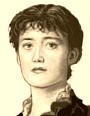
Louise Jopling
after a portrait by
John Everett Millais
Books by Jopling
|
|
|
Walter Kershaw
(Born 1940)
Walter Kershaw is a celebrated Oldham-based artist who has been
described as "... of an independent mind and means".
Born on the 7th December 1940, he was educated at the De La Salle
College in Salford from 1951-1957, and later at Durham University
from 1958-1962.
Kershaw specialises in large wall murals in oil and watercolour,
and much of his work can be found locally. Large scale wall murals
by him are found in Bury, Heywood, Rochdale, and Manchester, as
well as nationally and abroad, including at the Trafford
Centre, British Aerospace, Wensum Lodge in Northwich, Manchester
United, the University of São Paulo and Metro Recife in
Brazil, Sarajevo International Arts Festival, and in Bosnia.
The Trafford Park Mural was painted on the side of the building
in 1982. Kershaw replaced it in 1993 when it was unveiled by football
legend, Denis Law. It
is reputedly the largest piece of industrial art in Europe.
His paintings have been exhibited at the Victoria & Albert
Museum, the National Portrait Gallery and the Tate Gallery in
London, at the British Council in Berlin and at São Paulo.
He has won many prizes for his art including the Salisbury Heywood
Prize, and awards from the Manchester Academy and the Gulbenkian
Foundation.
Walter Kershaw enjoys travel, cricket and photography and is a
member of Littleborough Cricket Club. He currently lives at his
studio in Todmorden.
Back
to Top
|
|
Roger Fenton

(1819-1869)
Born in Rochdale in 1819, the son of a Lancashire mill-owner and
banker, Roger Fenton is now best remembered for his definitive
photographs of the Crimean War. But, Fenton had a much broader
portfolio, which often misses public attention.
After studying at London University, Fenton studied art in London,
and later in Paris under the painter Paul Delaroche. However,
having had little success as a painter, in 1844 he returned to
London and studied law.
In 1851 he went to Paris and was immediately impressed by the
work of French photographers. In 1852 he visited Russia, and his
photographs were amongst the first ever to be seen in England
and immediately earned him artistic notoriety.
It was he who proposed the setting up of a London Photographic
Society, and in January 1853 the origins of what was to become
the Royal Photographic Society were set in place, with Fenton
acting as its secretary for the next 3 years.
As a now distinguished proponent of the new art form, Fenton photographed
Queen Victoria's family, and was appointed as the official photographer
to the British Museum.
Soon after the outbreak of the Crimean War in 1853 the inadequacy
of medical provision became evident, more troops dying though
disease than injury, and in 1855, in response to disastrous criticism
of the government's handling of the war, Fenton was commissioned
to photograph it, and produced over 350 pictures of the conflict,
which are largely responsible for his abiding reputation. Later,
criticisms of the legitimacy of his photos were made, as it was
perceived to be little more than a propaganda exercise, as he
was bound to show the wellbeing of the troops, and in any case
he wanted to sell his pictures, and the more gruesome realistic
ones were not thought to be commercially viable.
After the war he published bound volumes of his prints, but they
did not sell as well as he had hoped. From a commercial viewpoint,
photographs were not yet permanent enough and tended to fade over
time, as an adequate "fix" was not yet available.
Fenton also produced a number of Stereoscopic images, a popular
format at the time. His pictures of architecture, landscapes,
cathedrals and still life subjects proved much more popular. Inexplicably,
his series of photographic prints from an expedition to the Scottish
highlands were never published and by 1861 he had given up photography
completely and returned to practicing law.
Roger Fenton died in 1869 at the age of forty-nine. Over 800 of
Fenton's photographs are known to exist and 600 prints are kept
in the Royal Photographic Society archives.
|
|
Arthur
Devis & Son
(1712-1787)
The artist Arthur Devis was born in Preston in 1712 and best known
nowadays for his 'conversation pieces' - portraits of local landed
gentry and their families. His style has an unmistakenly naïve
quality and his figures are thought to be 'doll-like' in their
appearance. This is probably because Devis rarely painted from
life, but preferred small wooden 'lay-figures' or models, and
tended to only include the sitter during the final stage to achieve
a good likeness.
Nevertheless, Devis was a successful artist and had a studio in
London for some twenty years from the 1740s until his style fell
out of fashion in the 1760s. His popularity was relatively short-lived
and by the time of his death Devis was virtually unknown, forgotten
and working obscurity.
Devis's son, Arthur William Devis, was born in London, but was
registered as a Guild merchant by his father, whom, arguably,
he outshone.
Arthur William Devis produced many elegant and subtle paintings,
and is widely considered to be the greatest painter of all the
Devis family. He was also a noted adventurer, having experienced
both shipwreck and debtors' prison, and his work ranged from commercial
portraiture to observations of village life in India.
His most famous work, "The Death of Nelson", exists
in three versions - one in the Royal Collection, one at the National
Maritime Museum, Greenwich and one on HMS Victory itself, where
Nelson died.
A substantial collection of Devis family paintings can be seen
at the Harris Museum and Art Gallery in Preston.
Back
to Top
|
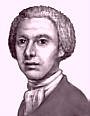
Arthur Devis
Books about
Devis
|
Nick Park
CBE
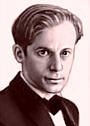
(Born 1958)
Nick Wulstan Park was born in 1958 in Walner Bridge, near Longton
in the Ribble Valley of Lancashire. He is best known as the Director
and animator of the Aardman Animations Company, and creator of
the popular Wallace and Gromit series of animation films
made for television.
He became interested in animation as a child and started making
films in his parents' attic at the age of 13. He was then a keen
amateur ornithologist, and his love of birds and wildlife has
continued with him into adulthood
He was awarded a BA in Communication Arts at Sheffield Hallam
University in 1980, and subsequently joined the National Film
& Television School in Beaconsfield, where he began work on
"A Grand Day Out", the very first of his Wallace
and Gromit characterisations.
His first animated short to be aired was in 1975, with 'Archie's
Concrete Nightmare'.
He joined Aardman Animations in February 1985, and on completion
of the film, was delighted to be nominated for an Academy Award
in 1990, as well as winning a BAFTA award. In that year also produced
'Creature Comforts', which actually won an Academy Award,
as did subsequent Wallace and Gromit films, 'The Wrong
Trousers' and 'A Close Shave'. Following on from a
deal with DreamWorks, Aardmen Animations began work on the feature
film 'Chicken Run' which took over five years to complete
and was released in 2000.
In 1997, Nick was made a Commander of the Order of the British
Empire. Nick is a devoted Lanastrian and widely praises its landscape
and natural beauty.
Back
to Top
|
|
|