NAVIGATION









































Virtual
Hosting by

TheServerBank
Footballer
drawings
by Andrea Reynolds
and John Moss


|
England
Caps
Everything
about the
England Team
EnglandCaps contains over 100 articles all written by our team
of experts and we add around new 10 articles each month.
www.englandcaps.co.uk
|


|
 |
 |
Manchester
Footballers
Giants
from Manchester United and Manchester City Football Clubs
|
|

|
Sir
Bobby Charlton
Charlton
may be fairly said to be the most famous English footballer in
the world. He epitomises the highest traditions of sportsmanship
and integrity. Born 11th October 1937 in Ashington, County Durham,
by 19 he had already played in the FA Cup Final. A natural talent,
he was a midfield player and striker of great flair and consistency.
He played as a forward for Manchester United from 1956 to 1973,
having been one of the few survivors of the Munich
Air Disaster in 1958. A miner's son, born into a footballing
family, he had joined United after winning England Schoolboy Inter-
national honours. He was a high scoring and individualistic player,
noted for his long swerving runs and deadly accuracy with a football.
His highly developed skills were evidenced in the fact that during
his playing career he amassed a then record 106 England caps,
and that he was included in the English World Cup winning team
in 1966. Also in 1966 he was voted "Footballer of the Year". By
the end of his career, his name had become a byword for sportsmanship
the world over. Shortly after this he was appointed manager of
Preston North End. In 1994 he was knighted for his services as
an ambassador for English football - the first soccer player to
receive the honour in 30 years. In the whole of his professional
career, he was never once sent off the field. Twenty years after
his last appearance as a United player, "Sir Bobby" is still remembered
and reverenced as the supreme sportsman and instinctive footballer.
|
|
|
|

|
Denis
Law
Denis
Law joined and débuted for Manchester City Football Club
in March 1960 after the most expensive transfer fee up to that
time - £55,000. A lethal goal scorer, first class tackler and
midfield "minder", he was contemporary with, and ranks alongside,
such great players as Bobby Charlton. 77 appearances and 37 goals
later, he transferred to Torino (Italy) for £125,000 (another
record fee), before returning after a year to join Manchester
United.
He played as a forward striker for Manchester United from 1962
to 1973. His lightening reflexes and heading skills made him a
great crowd puller and favourite with United fans. Born in Aberdeen,
Scotland on 24th February 1940. Dubbed "The King" by fans. Slightly
built and lightweight, he had become Huddersfield Town's youngest
player at 15 years of age, and Scotland's youngest National Team
player in 1958. Also played for Manchester City FC. Bought by
United in 1962 for a then record fee of £110,000. Always a high
goal-scorer, during his 393 appearances for United, he scored
236 goals. He scored six goals in the match against Luton Town
in January 1961. Reputed to be the highest FA goal-scorer of all
time. In July 1973 he rejoined City and scored the winning goal
against Manchester United in the Derby match of April 1974. Winner
of 55 Scottish caps.
|
|
|
|
|
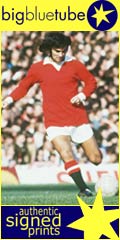
George
Best

(1946-2005)
Born
22nd May 1946 in Northern Ireland, George Best was one of the
most outstanding British soccer players of all time, though his
career was short-lived. Described as a "wayward genius", he had
a superb sense of timing and balance, and appeared twice as a
league championship winner with United and won the "European Footballer
of the Year" award in 1968. A superstar figure, he was often known
as the "Fifth Beatle"
He occupied a forward position in the team from 1963 to 1974,
when an otherwise promising career was shortened due to controversial
personal life, and his professional unreliability. He seemed unable
to cope with the pressures of super-stardom which his footballing
skills had attracted. His career was dogged by scandal and he
was constantly harassed by tabloid newspapers and the sensational
reporting on his alleged womanising and drunkenness. Soon, his
frequent late arrivals and failure to show for training sessions
and declining fitness were to bring him into conflict with the
Manchester United managers and in 1974 he was forced to leave
the club. He is quoted as having said that football bored him.
However, he later played for both Fulham and for Stockport County
football teams.
Of his 466 appearances with the United team, he scored 178 goals,
most memorably scoring six goals of the eight against Northampton
Town in February 1970.
Plagued by a severe alcohol problem, he was given a second chance
through a complete liver transplant in 2002. However, in late
2005 his health rapidly declined as he contracted a serious lung
infection, and he was admitted to the Cromwell Hospital in London.
On life support and in an intensive care unit, he deteriorated
into a deep coma, and on Friday 25th November, sadly, George Best
lost his fight and died at the age of 59, surrounded by his family
at his bedside.
|
|
|
|
|
Sir
Matt Busby OBE

Born
in Bellshill, Lanarkshire in Scotland, Sir Matt Busby CBE had
2 footballing careers : first, as a player for Liverpool and Manchester
City, and then, probably more famously as Manager of Manchester
United. Signed up in 1928 aged only 17, he subsequently played
in both the 1933 and 1934 FA Cup Finals for City. He went on to
make 226 appearances as a midfield defender and halfback, and
scored 14 goals for City, and then made 118 appearances for Liverpool
before the War ended his career.
A Scottish international, who played in wing-half position before
the Second World War for Liverpool and Manchester
City. Signed up for City aged 17 when about to emigrate to
America with his widowed mother. He took over the bombed-out Old
Trafford management in 1945, and within three years had created
one of his several memorable teams who won the FA Cup in 1948.
His so-called "Busby Babes" went twice into European Cup Semi-finals,
before disaster struck the team at Munich in 1958. He died 20th
January 1994. Much-loved and respected by team-players and fans
alike, known as a fair honest and kindly man, thousands of the
people of Manchester turned out to his funeral in 1994 in tribute
to "Sir Matt", who had brought so much honour to it.
|
|
|
|
|
Duncan
Edwards

Duncan Edwards played halfback for Manchester United from 1952
to 1958, when his life was tragically ended in the Munich
Air Disaster. Born in Dudley, (then in Worcestershire, now
in the West Midlands metropolitan County) on 1st October 1936,
he was one of the truly outstanding members of Matt Busby's policy
of promoting new young football talent. He had joined United straight
from school in 1952, and was playing for United in the First Division
by the age of 16. He was a prime example of a "Busby Babe". He
appeared in England schoolboy and youth teams winning many medals
and caps. He had control, size and speed, with great mid-air ability,
and a specialism in the cross-field pass. Of his 175 appearances
for United, he had scored 21 goals. After putting up a strong
fight to survive the aircrash, he died from injuries on 21st February
1958. A permanent memorial stained glass window to his memory
can be found in St. Francis Church in Dudley.
|
|
|
|
|
Bryan
Robson OBE

Born
in Chester-le-Street on 11th January 1957. Midfield player with
United from 1981 to 1994. Nicknamed "Captain Marvel" and "Robbo".
Had sustained 3 broken legs in earlier days with West Bromwich
Albion, and his later career was dogged by back and hamstring
injuries - all of which he persistently overcame. Manager Ron
Atkinson had paid around £2 million to acquire Robson. He was
a motivational force in the team, who led by example and engendered
high team spirit. Captained United as well as the England Team.
Dynamic, inspiring, a skilful attacker and defender. Played 435
matches and scored 97 goals.
|
|
|
 |
Martin
Buchan
Born
in Aberdeen, Scotland on 6th March 1949, Martin Buchan was one
of the coolest and classiest defenders of his day. He had a good
sense of position and could turn a fast pace when necessary. Transferred
to United from Aberdeen in March 1972 for a fee of £125,00. Voted
"Scottish player of the year" in 1971 and capped 34 times for
Scotland. Spent 11 years at Old Trafford, six as club captain.
Appeared 455 times for United and scored 4 goals. Left in 1983
for Oldham Athletic.
|
|
|
|
|
Eric
Cantona

Born in Paris, France on 24th May 1966. Cantona signed to United
in 1992 for a transfer fee of £1.2 million, after an extensive
career in various French teams since his debut as a 14 year old.
A visionary attacker, his new blood and flair brought inspiration
to his United team-mates. Quickly became a popular cult hero to
fans, and voted "Player of the Year" in 1994. Cantona made 181
appearances for United and scored 80 goals. Reportedly planning
to return soon to Old Trafford to coach the youth team. Made a
foray into acting in the Film "Elizabeth".
|
|
|
Steve
Coppell

Born
in Croxteth, Liverpool on 9th July 1955. After debuting for Tranmere
Rovers, he transferred to United when Tommy Docherty signed him
in 1975. An orthodox winger with great heading skills, and a good
turn of running speed. A serious knee injury in 1981 failed to
respond, despite three operations, and he was forced into premature
retirement in 1983. Collected 42 England caps. Appeared for United
395 and scored 70 goals. Briefly was manager at Crystal Palace
but was fired in 2001, and went on to manage Brentford.
|
|
|
Bill
Foulkes

Born
in St Helens, Lancashire on 5th January 1932. Discovered when
only a schoolboy, playing for Whiston Boys Club in 1950, and described
as a "granite-hard" defender, Foulkes. A survivor of the Munich
Air Disaster, he was a solid centre forward, strong, fit and powerful
in the air. He won a record four League Championship medals and
appeared for United 679 times between 1952 and 1970. Better known
as a goal-stopper than a goal scorer - 9 goals in all.
|
 |
Steve
McClaren
An
Assistant Manager who arrived at Manchester United from Derby
County in 1999. A highly respected and inventive coach who brought
new ideas to the club, he was widely tipped to follow Sir Alex
Ferguson as manager, but management did not always see eye-to-eye
with him and it was just not to be, and McClaren left the club
to manage Middlesborough in 2000.
|
|
|
|
|
Teddy
Sherringham

Played
in a forward position for Man United from June 1997 to May 2001.
He had transferred from Tottenham Hotspur for a fee of £3
million, largely as a replacement for the departing Eric Cantona
(above), and afterwards returned to Tottenham on a free transfer.
There was a great deal of opposition to this cockney's appointment
to the team, despite his being a powerful and important goal-scorer.
His game was marked by a speed that made defenders look like they
were standing still, an accurate passing and deadly aim. In all
Sherringham made 98 appearances for the team and scored 48 goals,
and during his brief term at United was voted Football Writers'
Association Player of the Year.
|

More
Footballers >...
.
|