|
Virtual
Hosting by

TheServerBank
Photos
by John Moss
|
Victorian
Manchester
19th
Century Industry in Manchester
|
Textile
Warehouses in Manchester
|
King Cotton
& Cottonopolis
On visiting
Manchester in 1825, the German architect Karl Schinkel wrote of
his visit that "the enormous factory buildings are seven to eight
storeys high...where three years ago there were only meadows".
He went on to say that the buildings were so black that they looked
as if they had stood already for a hundred years. King cotton,
textiles, spinning, weaving and dyeing were the staple commercial
enterprise of Manchester and the host of small mill towns that
surrounded it. The city became known locally as "Cottonopolis".
Thanks to the infrastructure of a well connected canal system,
the coming of the railways, and later, the Manchester
Ship Canal, Manchester was ideally placed to receive incoming
raw materials, had the large workforce required to process them,
and the means of distribution for finished goods. It was, in many
ways, the warehouse of the western world.
So the city built warehouses - many of them - fine and architecturally
elegant pioneering buildings which often belied their purpose.
They were also structurally advanced, being the first large scale
commercial use of cast iron frameworks - then a revolutionary
new material whose integrity was largely untried. Thankfully,
due to the enduring quality of the building method, many still
survive intact today -some have found new functions, as in the
originally Watts Warehouse, now the Britannia
Hotel.
Manchester's
Main Warehouses
WATTS
WAREHOUSE
Built
in Manchester's Portland Street, just off Piccadilly Gardens in
1851-56 for S&J Watts by the architects Travis and Magnell, this
spectacular building housed the largest wholesale drapery business
in the city, and is regarded by many authorities as the queen
of Manchester's warehouses. From the start it was regarded as
an ambitious and showy structure, eminently suited to its owner,
a self-made businessman and entrepreneur. The building is constructed
using classical devices, each storey in a different style - Italian
Renaissance, Elizabethan, French Renaissance and Flemish, and
each corner is topped by a large tower with Gothic Rose Windows.
It typifies the confidence of its owner and the civic pride which
men such as he had for the city of Manchester. He numbered the
rich and famous among his friends - politicians and churchmen
all dined regularly at his home in Cheadle, and Prince Albert
chose to stay with him when he visited Manchester to open the
Art Treasures Exhibition in 1857. The building narrowly avoided
demolition in 1972, and now thrives as the Britannia
Hotel.
THE GREAT
NORTHERN RAILWAY COMPANY'S GOODS WAREHOUSE
Still
rising high above the streets of Manchester, this fine large warehouse
in Watson Street still boldly proclaims its lineage in large white
letters under its cornice. Built in 1898, quite late in commercial
terms, it was to be the forerunner of modern freight transportation
systems, in that it provided an interchange between rail, canal
and road networks in Manchester. A tunnel ran beneath to connect
it directly to the Manchester & Salford Canal Junction. Trains
arrived directly from the Central Station (now the GMEX Centre)
alongside on a specially constructed iron viaduct into its huge
marshalling yards, and goods were raised and lowered using hydraulic
power.
The building acted until recent years as a car park for visitors
to the GMEX Centre, but is now under considerable refurbishment
and development with fully restored fabric and shopping and leisure
facilities being created out of virtually derelict spaces. Good
to see such a fine old building coming back into its former glory.
The new public square created in front of the warehouse offers
several cafés and bars as well as meeting and performance
spaces. The whole row of frontage shops in Deansgate have also
been vacated and restored so as to reflect their original cohesive
and uncluttered architectural styling, as well as allowing visual
access to the warehouse behind, obscured as it was for decades
by a virtual 'shanty town' of shop frontages and signage.
LONDON
WAREHOUSE, PICCADILLY, MANCHESTER
Piccadilly
Railway Station was originally called London Road Station, and
was opened by the Manchester & Birmingham Railway Company in 1842.
Later its use was shared by the Manchester, Sheffield and Lincolnshire
Railway, and the two companies jointly built the new station in
1865.
The MS&LR erected four large warehouses nearby for goods storage,
of which only this one survives. It stands seven storeys high
in brick, with large stone cornerstones (quoins). Internally it
has a skeleton of massive cast iron columns with wrought iron
box girders and brick arched floors, all designed to minimise
the risk of fire. It was originally joined by the Ashton Canal,
but this has long since been filled in to provide access to the
building which for many years has been used as a car park. The
whole building is currently being lovingly restored to be commercially
viable once more as a luxury and executive apartment block.
PRINCESS
STREET WAREHOUSE
In
the mid-19th century, Portland Street was devoted almost entirely
to warehouses. Many stood until the Second World War when they
suffered fatal damage through bombing. Fortunately, a few remain.
Many, like the Portland Street Warehouse, were built in the very
highest architectural styles. This one, on the lines of a great
Italian Renaissance palazzo, with a simple elegance and
monumental strength which exudes security and confidence. Its
grand central staircase leads up to the storage floors, for, while
buying was actually done at the Royal Exchange, goods would be
inspected in the warehouse prior to delivery. The basement house
a steam engine and boilers which powered the hoists to raise goods
up and down the building. Loading and unloading was never done
on the street side - this always presented a dignified Victorian
elegance. The rear of the warehouse is the hoist loft (or hovel),
where work was actually carried out. In 1871, the periodical The
Manchester Civic, describing the architecture of Manchester
commented on its warehouses : "...the high quality of the town's
architecture is mainly derived from these buildings".
Back
to Top
|

Watts Warehouse
(now the Britannia Hotel)

Watts Warehouse

The Great Northern
Railway's
Goods Warehouse
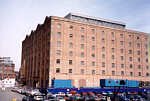
London Warehouse,
Piccadilly

Joshua Hoyle's
Warehouse - now the Malmaison Hotel

Grocer's Warehouse, Castlefield

Middle Warehouse, Castlefield

Dale Street Warehouse
Books
about Manchester Textile Manufacture:
|
Castlefield
Warehouses
GROCER'S
WAREHOUSE
Partially
rebuilt in 1987, this warehouse had been demolished in 1960. First
built in the early 1770s, as a terminus to the Bridgewater
Canal along which coal had been transported from Worsley,
the warehouse overhung the canal so that narrowboats could moor
in below and goods could be raised by winch the 20 feet up to
the warehouse above.
The reconstructed front shows two docks- one, the entrance to
James Brindley's original
tunnel by which coal was offloaded, and the other constructed
much later in about 1807.
THE MIDDLE
WAREHOUSE, CASTLEFIELD
On
the south side of the Castlefield Basin lies this large 5 storey
brick built warehouse constructed between 1828-3, still has two
large arched openways to allow boats direct access at water level.
It was substantially restored in the late 1980s, when it was converted
into luxury flats and offices. It can be accessed from the canal
basin through a wooden lift bridge which owes more to nostalgia
than practicability.
THE MERCHANTS'
WAREHOUSE
Built
entirely in brick in 1825, this is the oldest surviving warehouse
at Castlefield, though it stood dangerously derelict and decaying
for many years until it was restored between 1995-97 by Ian Simpson
Architects. Standing 3 storeys high at street level and four at
water level with 2 arched water entrances for boats. Later glass
stair units were subsequently placed at either end of the warehouse.
Some of the interior work has been preserved in the renovation,
including the wooden king posts and some of the original hoisting
gear.
See Also:
Castlefield
Other
Manchester Inner City Warehouses
NUMBERS
3, 5, 7 & 9 PORTLAND STREET
The
first three are now the Thistle Hotel,
(formerly known as the Portland Hotel) and No. 9 are offices,
of which only the facades survive on all, these buildings were
designed by Edward Walters between 1851 and 1858 - (Walters was
responsible for at least 10 major warehouses in Manchester city
centre, the Free Trade Hall in St
Peter's Street). This row of fine buildings has distinguished
ground floor rustication with arcading (a wall of arches - now
glazed). As a point of interest, No.1 Portland Street was formerly
the Queens Hotel, replaced by a modern steel and glass structure
by Charles, White & Hood in 1974.
NUMBER
101 PRINCESS STREET
Now
the Princess Hotel, this building was formerly known as the Pickles
Building, standing on the corner of Portland Street, and was designed
by Clegg & Knowles between 1858 and 1863. Built in a so-called
"continental gothic" or palazzo style, popular at that
time due in large part to its introduction by Alfred
Waterhouse. Its exterior carries fine gothic stone carvings
(oak leaves and quatrefoils), though it lost the elegant tall
chimneys some years ago. Clegg was to go on to design many of
the warehouses on Princess Street.
NUMBER
83 PRINCESS STREET
(Corner
of George Street). Thought by many to be the earliest warehouse
to be built in Manchester city centre, No. 83 was built by Travis
& Mangnell around 1847. Described in a contemporary edition
of The Builder, as "the best warehouse in Manchester".
JOSHUA HOYLE'S
WAREHOUSE, MANCHESTER
Now
the Malmaison Hotel, but originally
designed by Charles Heathcote in Piccadilly-London Road for Joshua
Hoyle in 1904, this is a steel framed building, elegantly clad in
brick, terra cotta and distinctive green ceramics. It stood idle
and decaying for several decades before its modern conversion to
a hotel by Darby Associates in 1998.
HARVESTER
HOUSE
Number
37 Peter Street, opposite the Free Trade hall, built for Clegg
& Knowles by the Ralli Brothers in 1868. Its ground floor
is rusticated stone forming a series of circular headed openings,
and the building was much criticised in The Builder in
that year as having little architectural merit.
SAMUEL
MENDEL'S WAREHOUSE
Designed
and built by Speakman & Charlesworth in 1874, this warehouse,
now known as Chepstow House, is situated in Chepstow Street and
is a fine clean cut three storey brick building with stone banding
with a frontage of some 300 feet. It has a magnificent 10 foot
wide grand staircase and wide corridors. Recently converted into
76 luxury flats.
PORTLAND
HOUSE
(Corner
of Portland and Princess Streets). Large building by Pennington
& Bridgen in 1887. Built in red brick with stone string courses.
PORTLAND
BUILDINGS
At
the corner of Portland Street and Oxford Street this plain brick
building with stone detailing was designed by P Nunn in about
1860 for Louis Behrens & Sons. It is of four storeys with
23 bays running along Portland Street. The ground floor level
is entirely stone clad.
DALE STREET
WAREHOUSE
Probably
designed by William Crosley in 1906, this is the earliest surviving
warehouse in the city, it shows the early use of cast iron columns
supporting wooden floors throughout.
Back
to Top
See Also:
|
|