Manchester
& the Northwest Region of England
A Virtual
Encyclopaedia of Greater Manchester in the Third Millennium
Including
the Boroughs of Bolton, Bury, Oldham, Rochdale, Salford, Stockport, Tameside,
Trafford & Wigan
NAVIGATION
Virtual
Hosting by
TheServerBank
Modern
Manchester Buildings (1)
20th
Century Buildings in Manchester
Manchester suffered
like many UK cities from the excesses of high rise building in steel
and concrete in the 1960s and 70s, (the Crescents in Hulme, now
thankfully gone, being possibly the most infamous examples), and
some of the city's best buildings were demolished to make way for
many of these 20th century monstrosities. Fortunately, there were
some excellent buildings to offset the others - here are the best
and a few of the worst.
Gateway House
Station
Approach, Piccadilly Rail Station, Manchester
Running along the whole length of Piccadilly Station Approach,
Gateway House is one of the visitor's first views of the City
of Manchester. It was carried out as part of a greater improvement
and refurbishment of Piccadilly Station in the 1960s, and was
actually completed in 1969. Designed by Richard Seifert &
Partners, its sweeping curved glass frontage adds a somewhat baroque
sense to the old London Road approach to Manchester. At ground
floor level are shops. The site formerly houses several derelict
warehouses of the old Manchester, Sheffield and Lincolnshire Railway
(the MS&LR). Only one, the London
Warehouse, still survives, nowadays as a new high class luxury
apartment block.
Corporation
Street, Manchester.
On 15 June 1996, a 3,000lb terrorist car bomb exploded in Manchester,
ripping into the fabric of the city's main shopping centre - among
them the original Marks & Spencer Department Store. See
IRA Bombing. In the aftermath, the old store had to be completely
demolished, but M&S decided to rebuild - bigger, grander and
better. What resulted was the largest M&S department store
in the world, measuring over 32,500 square metres of space on
four floors. The designers, Building Design Partnership, conceived
a monolithic concrete form, poured on-site, covering a footprint
measuring 65 metres by 100 metres. Reinforcement of the concrete
took 4,200 metric tons of steel, erected by the Bovis Company.
Most of the exterior is covered by glass curtain walling, with
masonry in Jura Limestone cladding. The whole project, computer
designed had to be constructed and completed over a two year period.
The new building is umbilically joined to the Arndale Shopping
Centre by a superb glass suspended walkway bridge to replace the
original which was fatally damaged in the bombing. The new building
presents essentially glass wall on all facades and has a major
access point at the newly created Exchange Square side to the
north.
Piccadilly
Gardens, Manchester
Designed by Covell Matthews & Partners and built between 1959
and 1965, this was, from the outset, one of Manchester's most
controversial buildings. Its sheer size out of all proportion
to its architectural merit or importance. Dominating Piccadilly
Gardens on the south side, it was remodelled and refurbished in
2001 by Leslie Jones Architects. The complex is effectively four
discrete units, the horizontal podium block, the Piccadilly
Hotel block, Sunley Tower, and Bernard House, (currently under
demolition and replacement). The ground Floor of the podium contains
shops, and there is underground car parking. For many years the
Plaza been home to Manchester's Piccadilly Radio.
For much of its life, the Plaza's untreated concrete has grown
ever more shabby, and in such a high profile central location,
nobody quite knew what to do with it.
In many ways, however, it is architecturally quite daring. The
hotel slab, with its cantilevered block overhanging Portland Street
below is initially quite breathtaking. Conversely, the office
slab, Sunley House, rises 24 storeys above the podium showing
a rather blank concrete side face to Piccadilly Gardens and the
bus station below. This aspect is actually surface decorated with
concrete printed circuitry motifs standing out in relief - a detail
that has always failed to be recognised by passers-by, and none
but students of architecture have ever identified them - a complete
waste of time and effort.
The Plaza is a good example of the" Good, the Bad and the
Ugly" and Mancunians tend to either love it or hate it.
Part of Piccadilly Plaza showing the Hotel Piccadilly.
Sunley Tower/Piccadilly
Plaza
Arndale Centre
By the mid-1960s,
the inner city area lying between Withy Grove, Corporation Street,
Shudehill and Market Street, was ready for some serious redevelopment.
It had grown up haphazard and hotchpotch, many of its old cobbled
streets were shabby and congested.
Begun in 1972, by Arndale Property Trust, headed by Sam Chippendale,
on completion in 1979 it was the largest covered town shopping
centre in Europe, encompassing some 30 acres in the old city centre,
with over 200 shops, major department stores, restaurants and
fast food outlets. It has become a busy and active shopping arcade
with over 75,000 shoppers a day!
The Centre also houses an 1,800 space multi-storey car park, shopping
malls on two levels, office space in the tower, residential flats
at roof parking level, and the Arndale Centre Bus Station at Cannon
Street, (closed by the IRA
bombing of Manchester in 1996, and not yet reopened - its
future somewhat uncertain).
The design
for the Centre was made by the architects Hugh Wilson and Lewis
Womersley, who had already redeveloped the University Precinct
on Oxford Road, as well as a considerable involvement in the redevelopment
of housing in the Hulme area.
It was a controversial development, obliterating some of Manchester's
old streets and alleys, and stubbornly defying all the old Victorian
grandeur surrounding it, with its massive monolithic concrete
forms and unrelieved ceramic cladding. The whole project cost
some £100 million - a then unthinkable sum.
The land earmarked
for rebuilding had been designated as a "Comprehensive Development
Area" by the City Council. Many different companies had bought
and owned the land through the 1970s, but it was eventually to
be built by Town & City Properties, who, in the face of mounting
financial difficulties and substantial underwritten loans of over
£16 million, sold the lease to P&O Properties, who managed
the complex until 1998 when it was taken over by the Prudential.
The Centre
houses many major department stores and famous High Street names,
including W.H.Smith, BHS, Littlewoods, Mothercare, Tandy's, etc,
as well as innumerable other smaller concessions.
It's very large beige coloured tiled cladding is looking a little
tired nowadays, despite having been designed as "self-cleaning"
- an experiment that clearly failed! The whole northern frontage
in Corporation street has been completely rebuilt in the aftermath
of the bombing, and presents an altogether more attractive aspect
to the newly created Exchange Square.
Generally, though its interiors provide a pleasant enough shopping
environment, the exterior is widely disliked for its blandness
and scale: there are many (residents and visitors alike) who feel
that this mid-1960s concept is too gargantuan an edifice to dominate
the city centre, surrounded as it is with so many other fine period
buildings.
UPDATE
A complete renovation of the much-hated exterior of the Arndale
Centre has recently been completed as well as revamping Market
Street. Work began in February 2003. Its infamous yellow tiles
have disappeared! A new entrance atrium, Cromford Court, has been
created and floodlit at night. Further redevlopment is currently
in progress at the Cannon Street-Shudehill end of the complex.
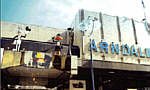
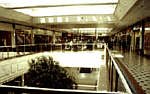
Above and Below: exterior and interior of Manchester's
Arndale Centre
The Arndale Centre
Tower
The CIS Tower
The Co-operative
Wholesale Society,
Miller Street, Manchester
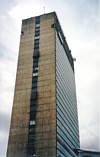
Probably the best of all the 1960s high rise Manchester office
blocks - it rises some 25 storeys, over 400 feet above ground
level. Building began in 1959, and this tall tower dominates the
approach to Manchester from Bury and Cheetham Hill in the north.
It was to be the Co-operative Society's flagship head office and
administrative centre in Manchester.
The design team, who included the Co-op's own G.S.Hay and Gordon
Tait of Burnett, Tait & Partners, had actually visited Chicago
in the USA to study the Inland Steel Building by celebrated architect/engineers,
Skidmore Owings & Merril to gain inspiration for the project
- a fact, no doubt, that explains the outstanding quality of the
CIS building, which still holds its own among later more high
tech city centre buildings today.
Three aims had been dictated by the owners - 1) the building should
create prestige for the company, 2) it should complement and improve
the skyline of Manchester, and 3) it should provide a first class
working environment for the staff. It was deemed to have fulfilled
all three requirements on completion in 1962.
The building is really two stuck together - one a steel and glass
tower, which is the working offices area of the building, and
the other adjoining as a windowless mosaic covered concrete service
tower. No expense was spared on quality - all steel was black
enamelled, and the mosaic covering, though expensive, was designed
to protect and render the concrete virtually maintenance-free.
Both materials have withstood the subsequent 40 years of Manchester
grime, and the building still looks relatively smart after four
decades of exposure to the worst that Manchestervhas thrown at
it.
The spacious entrance hall carries a fibreglass mural by William
Mitchell. The interior cherry and teak veneers were researched
and recommended by Misha Black and the Design Research Team.
55 King
Street, Manchester
In its time this National Westminster Bank building was the most
expensive in Manchester, costing over £12 million. Designed
by Casson, Conder & Partners between 1966-69, it is a fortress-like
edifice, purposely built in black stone to resist the (then) notorious
Manchester soot which covered virtually all the buildings in the
city centre. This sombreness was also thought appropriate for
the bank's former northern headquarters, overseeing 700 branches
throughout the northwest of England.
Eventually to be knighted, Sir Hugh Casson was senior member of
the design partnership - it had been he who had laid out the Festival
of Britain in London in 1951. Later he was to become President
of the Royal Academy.
The bank was constructed in situ of monolithic poured concrete
with steel reinforcement, as an all-concrete shell with transfer
beams and external voids for window apertures - a simple elegant
design solution.
It's rough hand-tooled vertically ribbed dark cladding of Swedish
granite is perhaps its most distinctive external feature, apart
from its great bulk as it dwarfs other commercial buildings around
it - though only six storeys above ground it has an outstanding
massiveness which dominates King Street. There are also 3 basement
storeys below street level.
The building's ground floor is now a small retail shopping complex.
"Looking
at Buildings"
http://www.lookingatbuildings.org.uk
Launched in 2001, this is the latest venture from the Pevsner
Architectural guides, and an expanding guide to understanding
and
exploring the build environment. The site contains hundreds of
illustrations, interactives and reference resources for all enthusiasts.