Manchester
& the Northwest Region of England
A Virtual
Encyclopaedia of Greater Manchester in the Third Millennium
Including
Bolton, Bury, Manchester, Oldham, Rochdale, Salford, Stockport, Tameside,
Trafford & Wigan
NAVIGATION
Virtual
Hosting by
TheServerBank
Photos
by John Moss
Modern
Manchester Buildings (2)
Continuing with
some of Manchester's 20th century buildings.
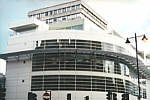
Aytoun Library
& Computer Centre, UMIST
Manchester Metropolitan University Business School.
Opposite the UMIST Aytoun Campus and dominating the corner of
Aytoun Street and Whitworth Street, this modern white powder coated
aluminium clad building comes as a refreshing change after some
of the less glamorous shoebox styles of the 1960s which so often
blighted the city centre. It stands in front of an earlier tower
block which had been designed by the City Architect, S G Besant
Roberts. The Library was was designed by the Mills Beaumont Leavey
Channon Company and completed in 1993.
Cleverly made to fit into an awkward irregular corner plot, the
sweeping curve of the visible facade offers a most modern and
elegant Art Deco-ish style to Whitworth Street and the original
old UMIST building opposite.
Its continuous horizontal fenestration is quite reminiscent of
Bauhaus design of the mid 1920s, but interpreted in contemporary
terms.
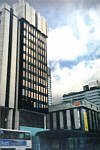
Former
Bank of England Northern Headquarters Portland Street, Manchester
Designed by Fitzroy Robinson & Partners in 1971, this twelve
storey fortress like building amply provided that sense of unshakeable
security which the Bank of England sought to convey. Its windows
are in bronze and it is clad in black and white stonework, The
whole tower block stands atop a concrete podium, clad in smooth
polished black granite, reminiscent of a medieval castle battlement.
The Bank of England moved out several years ago, and around its
outer perimeter there is current reconstruction taking place which,
unfortunately, masks most of the lower storey of this imposing
building. A new Tourist Information Centre is being created at
its base.
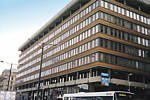
Former
Greater Manchester Council Building
On the corner of Portland Street and Aytoun Street stands County
Hall, testament to one of the Great Metropolitan County authorities
which Prime Minister Margaret Thatcher abolished as they grew
ever more powerful. The GMC had been imposed earlier on the ten
towns which still make up the Metropolitan County. Designed by
Fitzroy Robinson & Partners and completed in 1974, it stands
six storeys on top of a commercial podium with shops and pubs
at ground floor level. It is a very typical building of the period
with unbroken horizontal bands of windows and courses of intervening
brickwork with a separated "lid" of a roof sitting above
it like an umbrella.
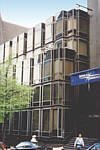
Sun Alliance
Assurance Building, King Street
Somewhat dwarfed by the former NatWest
Building alongside it, award winning Pall Mall Court was designed
by Lionel Brett & Pollen for the Sun Alliance Insurance Company
and completed in 1969. It actually occupies an L-shaped footprint,
wrapping round two sides of the adjacent Norwich Union Building,
with a secluded square which has recently been developed into
shops and cafés. This is an elegant building which replaced
the company's older one on the same site and was an outstanding
building in its day for its bold use of square boxed bronze framing
and all darkened bronze glass walls suspended on an internal steel
and concrete skeleton - it still holds up well over 30 years later.
Parts of the service tower are clad in blue mosaic, and beneath
the building are garages.
Lionel Bret, the design company's chief architect, was President
of the Royal Institute of British Architects in the 1960s. Not
surprisingly, the building (and Norwich Union next door) won the
RIBA awards on completion - obviously entirely coincidental.
The
Museum of the Modern City
City Park, Corporation Street, Cathedral
Gardens, Manchester City Centre.
Website: www.urbis.org.uk
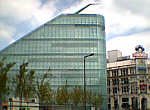
Ultra
modern all glass structure on the edge of the newly named Millennium
Quarter. Billed as a museum of modern Manchester, the world's
very first industrial city. Many interactive displays are planned.
The building was designed by the Ian Simpson Company of Architects
and was awarded as a result of an international competition. It
cost £28 million of which £20 million was a grant
from the Millennium Commission. It's unusual ramp-like shape makes
it stand out and dominate the entrance to Manchester city centre
form Cheetham Hill and Bury in the North. Six of its floors will
house exhibitions of an historic and futuristic nature. There
is a café at ground level and the entrance foyer will have
touch screen displays and video presentations; a restaurant is
planned for the top floor offering panoramic views across the
city skyline.
On
its western side is the newly created plaza, part of the so-called
Cathedral Gardens complex and will offer recreational and performance
areas for the Cathedral and Chethams School of Music which border
it.
Above and below:
the nearly completed Urbis building