Although
Egerton, knownlater as "the Canal Duke", lost
a fortune in his investment, he finally began to recoup his
money in ripe old age, to die, happily, a rich man again. The
canal was purchased for £1,120,000 in 1872 by the newly formed
Bridgewater Navigation Company, and they in turn sold it to
the Manchester Ship Canal Company in 1885.

Aerial
View Bridgewater Canal & Old Packet House, Worsley.
Aerial Photo Courtesy of www.webbaviation.co.uk
© 2005
CLICK
ON IMAGE TO ENLARGE
The building
of the Manchester
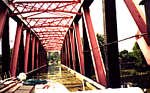
Ship Canal necessitated the removal of Brindley's stone aqueduct
over the River Irwell, and its replacement by the present Barton
Swing Aqueduct.
This is a
steel trough enclosed by gates at both ends, and pivoted on an
island in the Ship Canal, about which it rotates to allow ships
passage on the Ship Canal beneath. The weight of water carried
by the aqueduct amounts to 1500 tons.
The Bridgewater
canal continued to carry working traffic until 1974, for its branches
pass through the heart of Trafford Park, Manchester's huge industrial
estate, where large companies, such as Kelloggs and Courtaulds,
still manufacture produce.
By the time
that trade ceased on the canal, it was carrying 10,000 tons of
American grain a year into Trafford Park .
As the canal
approaches Manchester, there are close-up views of the Ship Canal
and of Salford Quays, as well as a circuit of Manchester United's
Old Trafford Football Stadium, before arriving at Castlefield
Basin, and the end of the Bridgewater Canal. Today, as with most
inland waterways, its only business is in pleasure craft.