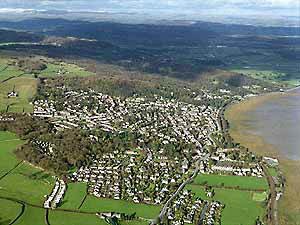
Grange-over-Sands
is a sleepy Edwardian resort set across the estuary from Lancaster
and Morecambe, and may (at some risk) still be crossed by an ancient
pathway when the tide is low. It was a firm favourite to Victorian
and Edwardian holidaymakers, being accessible by the Furness Railway,
and, due to its protected setting, enjoys more sunshine than any
other place in the Lake District.
It still retains
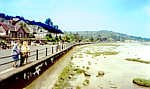
much of that charm and tranquility, with a long seaside promenade
walk with its attractively well-maintained ornamental gardens
and extensive collection of waterfowl, which parallel the town's
main street which bustles with charming and characterful shops,
and a profusion of high quality accommodation within all price
brackets. It is a leisurely mature town, and attracts an older
clientele than other more famous and developed seaside resorts
across the bay in Lancashire.
The town's
name derives from the fact that some 800 years ago it was the
site of a large mill or "granary", and it was originally called
the 'Granary-over-the-sands' by the people of Morecambe over the
estuary, who obtained most of their flour from Grange. The granary
building also stored many other kinds of sea freight and goods,
and helped establish Grange as a one-time major sea port for the
region. Over the years the name has been condensed to its present
form.
Grange became
inextricably linked with the City of Lancaster by the Oversands
path, and a warden was appointed to guide walkers over the treacherously
shifting estuary for many years. It was a major thoroughfare until
well into the late 19th century; before the building of metalled
roads and turnpikes, it was the only reliable way into Lancashire,
and saved a whole day's travel.
Walkers may
still tread the path, as it is recognised as a Public Right of
Way, though novices would be well advised to seek advice and a
tidal times manual from the Tourist Information Centre in Grange
town centre before attempting the walk. The approach to the modern
day town is entirely Edwardian, with the quaint railway station,
and the arcaded shops of that period.
Also worth
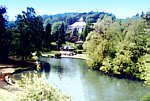
seeing at the eastern town approach is the ornamental gardens,
with its large man-made lake, the probable site of the original
granary, a profusion of wildfowl and water birds, and its exotic
trees, of which a luxuriant 100 feet high Lawson Cypress is the
most dominant. Curiously, the Furness railway separates the town
from its promenade, which can be accessed at three points along
its one mile length. At the western end of the town are seaside
leisure facilities including tennis courts and putting greens,
swimming pool and children's entertainments.