|
|
Trafford
Park, Manchester & Northwest England
 

Papillon
Graphics' Virtual Encyclopaedia of Greater Manchester
Including
Bolton, Bury, Manchester, Oldham, Rochdale, Salford, Stockport, Tameside,
Trafford & Wigan
|
|
NAVIGATION









































Virtual
Hosting by

TheServerBank
Contents
of this page are believed to be correct at the time of publication -
please inform us of changes, errors or to suggest inclusions, deletions
or update







|
Trafford Park
20th Century Manchester
|
The Creation
of Trafford Park
The development
of Trafford Park as the world's first industrial park, (and still
its biggest), was dependent upon the construction of the Manchester
Ship Canal. It was this canal which made it suitable
for import of raw materials and export of mercantile goods directly
to the River Mersey and on to the world beyond.
The port of
Manchester still ranked as fourth most important in the UK, thanks
to the Manchester Ship Canal and its direct access to the sea.
It ran directly through the Trafford Park Industrial Estate, where
other new industries had emerged.
Trafford Park
is some 1,183 acres, originally parkland with deer, and Trafford
Hall as its centre. The hall was destroyed in the blitz of 1940.
It was purchased
in August 1896 by Ernest Hooley for the sum of £360,000.
Hooley immediately created the Trafford Park Estates Company and
set about developing it as an "industrial estate" -
then a radically new concept.
The Companies
who came to Trafford Park
Trafford Park
was the industrial home of the Co-operative Wholesale Society
(the CWS), a Rochdale-born
organisation, which had a major food packing factory
and a flour mill there - they had purchased land at Trafford Wharf
in 1903. Within the next few years, over 40 companies had relocated
to Trafford Park, and it was, from the outset, a major economic
success story for Manchester and its working people.
The British
Westinghouse Electric Company had also purchased large tracts
of land in the Park in 1899 and began manufacturing turbines and
generators there in by 1903. A large housing estate was also built
by the company to house its workers. At that time Westinghouse
employed half of the 12,000 people working within Trafford Park.
In 1919 Westinghouse renamed the company Metropolitan Vickers
- it was here that Alcock
and Brown met each other and talked the company into
building and supplying the Vickers Vimy Aeroplane which they flew
across the Atlantic in 1919.
|
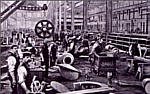
Shop floor
at Westinghouse, Trafford Park
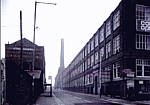
CWS Wholesale
Food Packaging Factory

Trafford Park Eurofreight Terminal

Kelloggs
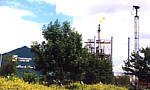
Courtaulds
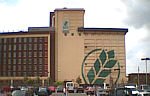
Rank Hovis
|
Some of Trafford
Park's earliest constructions were wooden grain silos built by
the Hovis Flour Mill (now Rank Hovis McDougal) to receive the
corn from America and Canada which would feed the population of
Manchester. These silos were also destroyed in the 1940 blitz
and were subsequently replaced by concrete silos just near to
Dock 9 on the adjacent Ship Canal. The Hovis company, had opened
the mill in 1914; their brown loaf became synonymous with good
quality and "natural" baking. Kemp's Biscuits were also produced
there from 1923.
With widespread
laying-off of textile workers in the two decades after the Great
War of 1914-18, Manchester came to depend more than ever on its
distribution infrastructure.
In 1938 the
Kellogg company opened a major industrial complex at Barton Dock,
and massively increased the importation of maize and grain products
into the region - their factory uses Trafford Park as its European
headquarters, and still makes Corn Flakes there to this day.
After 1945,
Brook Bond moved their tea packaging factory at the canal side
in Ordsall.
Many foreign
businesses were attracted to Trafford. By 1933, over 300 American
firms had bases in Trafford Park. The Ford Motor Company moved
to the Park in 1910 and by 1913 was in production of the Model
T Ford Car, before its relocation to Dagenham in 1931- they returned
to Trafford during World War II to build Rolls Royce aircraft
engines.
The Guiness
Company began brewing in the Park, and even went so far as to
sink artesian wells to obtain clean water for their products.
ICI built its first purpose-built factory for the mass production
of penicillin. Rank-Hovis still have major production facilities
in the Park.

The Fall &
Rise of Trafford Park
By the outbreak
of the Second World War, Trafford Park had so grown as to acquire
the status of a borough in its own right. At its peak (around
1945), the Park employed over 75,000 workers. Trafford Park has
continued to grow throughout the years, and has offset many of
the worst effects of depression on employment in Manchester. Many
new service industries have moved in as well as light engineering
and cleaner hi-tech industries.
The decline
of the Manchester Ship Canal and the closure of the Port of Manchester
in the 1960s and 1970s reflected the depression in the Park's
fortunes. However, in recent years there has been a complete turnaround,
as the M62 and M60 motorways now fulfil a similar function; the
Park has once again found itself connected to the rest of the
world. Today there is a distinct sense of revival to Trafford
Park.
The prestigious
new award winning Lowry
Centre has been built on the site of the old derelict
docks; the Imperial War Museum
North now stands defiantly facing the Lowry; the Trafford
Centre retail and leisure park built at Dumplington
- all signs of regeneration and new life back to the former deer
park at Trafford.
See
also:
|
|