Manchester
Before and after the Great War
Labour &
Socialist Politics in Manchester
By the end
of the 19th century, some conditions had improved in the workplace,
thanks mainly to new notions of "collective bargaining" brought
about by the new 'Model' Trades Unions. The Manchester & Salford
Trades Union Council , later the Trades Union Congress had been
founded in Manchester as early as the 1860s. In fact, Manchester
had become one of the key centres in the early years of the British
Labour Movement, and the establishment of the Labour Party.
The Manchester Labour Party had several MPs by 1914, and by 1895
over 300 local branches of the party had sprung up. In 1896 an
estimated 40,000 people had gathered at Boggart Hole Clough to
hear Kier Hardy, one of the founders of the modern labour party,
speak. By 1906 there were 3 Manchester Labour MPs and the city
council had 13 Labour members, with Salford having 6 further.
Women's
Suffrage in Manchester
The movement
to secure votes for women had begun in Manchester with the protests
and petitions of two women in Manchester, Mrs
Emmeline Pankhurst and her daughter Christabel. She
had helped found the Women's Suffrage League, and later the Women's
Social & Political Union. Thanks largely to their efforts, by
the general election of 1918, women (albeit over the age of thirty)
were entitled to vote for the first time. By 1928, after a long
struggle, women secured the vote at 21, in line with men. Manchester
had been the home of the Suffragette Movement, and there is a
museum dedicated
to that movement in the Pankhurst's former home.
Manchester's
Improved Amenities
Increased
manufacturing production, and the wealth which that generated,
though firmly in the hands of a few leading industrialists, did
impact upon the city's standard of living. Schools, hospitals,
libraries, swimming baths, public wash-houses - all these could
now be afforded as a municipal duty, and paid for out of rates.
And, by the early 20th century, Manchester had begun to take its
civic responsibilities seriously. It was to install not only clean
water and sewers (due to the laying of a pipeline to the Lake
District), but gas, electricity and an electric tram system were
added to the city's amenities.
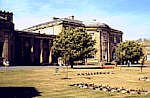
In 1903 the city purchased Heaton Park, for the use of the people
of Manchester, and set about the building of a Corporation housing
estate at Blackley. Under the Unemployed Workmen Act of 1905,
the city formed a local distress committee to seek to find ways
in which the Corporation might create employment opportunities.
The Manchester Technical School was opened by the prime minister,
A J Balfour, in 1902 - this was to become one of Britain's leading
scientific and technical teaching and research institutions. Eventually
it would combine with the Victoria University of Manchester to
become the noted University of Manchester Institute of Science
& Technology (UMIST). It was a city which believed in education,
and several schools opened for the teaching of adults. New wealth
also caused a blossoming of shops and major department stores
where the people of Manchester could spend their new-found wealth.
Lewis's Department Store in Piccadilly (still trading there),
Paulden's Department Store (later to become Debenham's), and Woolworth's,
which traded in Piccadilly until it was burnt out by fire in the
late 1970s. Though the building was restored, Woolworth's never
moved back.
Manchester
Cotton, and its Decline
The year 1913
was a record year for the Lancashire cotton industry. Exports
of woven cloth from the region topped 7,000,000,000 linear yards
- more than 80% of the entire national textile output, and around
65% of world output. But the industry had failed to invest, and
tended to be produced on Victorian machines. Also, exports, though
high, were mainly to the continent of India, where British goods
had a monopoly.
The First World War cut off supplies of British cloth to India,
who turned to Japanese suppliers. Even when the war was over,
this partially lost market was never fully regained. India had
also realised that its total dependence on British goods was short-sighted
and ultimately not in its own best interests. The Lancashire textile
industries were to suffer the fate of many pioneers, when their
supremacy was usurped by newcomers with cheaper labour and newer,
better machinery.
By the outbreak of the Second World War, the British home market
was still intact. But that would change within a decade. By the
late 1940s, India had developed a powerful and popular movement
to push the British out of India. Led by Mahatma Ghandi, one of
their strategies was to persuade native Indians to refrain from
buying British textiles, and to weave their own, by hand. In 1949,
when the British withdrew from the subcontinent, and India achieved
independence, the Indian market was virtually closed to British
manufacturers.
The failure to introduce new technologies or to secure new markets
meant that by the late 1950s most textiles manufacturing companies
were in serious trouble, many were closing, and all were under
threat. Inevitably, this was to have a drastic effect on the local
economies of the Lancashire cotton towns, and most of the boroughs
surrounding Manchester saw very hard times ahead, and increasing
levels of unemployment. Many of the mills, the main source of
employment, went onto short-time working, laid off many of their
workforce, or went into liquidation and closed down. Even government
intervention, in the form of the 1959 Cotton Industry Act, came
too late, and its enforced modernisation and rationalisation was
pointless, since by now synthetic fibres were already beginning
to replace cotton in many woven goods. By the 1960s, Manchester's,
and Lancashire's cotton industry was dead.
The Development
of Trafford Park
With widespread
laying-off of textile workers in the two decades after the war,
Manchester came to depend more than ever on its distribution infrastructure.
The port of Manchester still ranked as fourth most important in
the UK, thanks largely to the Manchester Ship Canal and its direct
access to the sea. It ran directly through the Trafford Park Industrial
Estate, where other new industries had emerged. Trafford Park
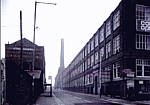
was the industrial home of the Co-operative Wholesale Society
(the CWS), a Rochdale-born
organisation, which had a major food packing factory
and a flour mill there.
The Hovis company, had also opened a mill in Trafford by 1914;
their brown loaf became synonymous with good quality and "natural"
baking. Kemp's Biscuits were produced there from 1923. In 1938
the Kellogg company opened a major industrial complex at Barton
Dock, and massively increased the importation of maize and grain
products into the region - their factory still makes Corn Flakes
at Trafford Park to this day.
After 1945, Brook Bond moved their tea packaging factory at the
canal side in Ordsall. Many foreign businesses were attracted
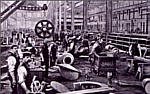
to Trafford, including British Westinghouse (later renamed Metropolitan
Vickers). By 1933, over 300 American firms had bases in Trafford
Park. The Ford Motor Company moved to the Park in 1910 and by
1913 was in production of the Model T Ford Car. Trafford Park
has continued to grow throughout the years, and has offset many
of the worst effects of depression on employment in Manchester.
|

Mrs Emmeline
Pankhurst

Christabel
Pankhurst
Heaton Park,
Manchester
Shop floor
at Westinghouse, Trafford Park
CWS Wholesale
Food Packaging Factory
|