|
NAVIGATION









































Virtual
Hosting by

TheServerBank
Photos
by John Moss
unless otherwise stated.
|
 |
 |
Outlying
& Suburban Churches - 3
The Architectural Heritage of Greater
Manchester
These churches
lie outside of Manchester City Centre in the suburbs, but are considered
to be well worth a visit for their architectural and historical qualities. |
Church of
St Lawrence, Denton
Saint Lawrence,
a Grade II Listed Building, was once a so-called "chapel
of ease", and only became a parish church in 1854. The building
was originally constructed around 1531 and was dedicated to St
James until the discovery of a stained glass window to St. Lawrence
in the mid-nineteenth century. A commemorative plaque lies in
the church grounds.
An unusual and visually striking building, very little of the
original structure actually survives, probably only the timber
posts of the nave and some of the roof timbers are original -
the rest is Victorian. The distinctive black and white external
striping is actually painted on. Much of the stained glass dates
from the 15th or early 16th century.
Long known affectionately to locals as Th' Owd Peg because
its wooden framework construction which is held together by joints
fastened with wooden pegs - a common constructional practice in
the 16th century.
The churchyard also has the grave with a stone memorial commemorating
Colonel Duckenfield of Dukinfield Hall, the Civil War hero from
the Tameside district. There is also a blue plaque in his honour
on the front of Dukinfield Town Hall. Robert Duckenfield was a
Puritan who in 1651 commanded the forces that secured the Isle
of Man and in 1653 was appointed to Cromwell's Little Parliament.
Extensive restoration of the church is in progress as part of
a major conservation project including repairs to the north wall
of the nave and to the north transept roofs, in collaboration
with English Heritage.
See also: Denton
and Dukinfield
Back
to Top
|


Photo courtesy
of Ian Rhodes. See more of his church photographs on the family
website at www.rhodesfamily.org.uk/churches
|
|
|
Brookfield
Unitarian Church,
Hyde Road, Gorton
Brookfield
in another fine Grade II Listed Victorian Gothic Church, opened
in 1871, built by Thomas
Worthington, and commissioned by Richard Peacock of the powerful
local Peacock and Beyer engineering and locomotive building firm.
Known in its time as the "Unitarian Cathedral", it has
a peel of eight bells in its tall steeple - all named for members
of Peacock family.
Before its construction, in times of religious dissension and
persecution, worshippers met secretly in an upstairs room of a
house nearby at the junction of Abbey Hey Lane and Cross Lane.
Thereafter, in more tolerant times, a chapel was built in Gorton
Vale which served worshippers from the surrounding districts of
Denton, Reddish, Gorton, Openshaw and Levenshulme. Several memorial
plaques from this now long gone chapel were transferred into the
new church at Brookfield.
The massive eight bells, originally suspended on oak beams, were
too much for the steeple, which was in danger of serious damage,
and in the early 20th century they were re-hung on steel beams.
The largest of the bells weighs just under three-quarters of a
ton and the smallest one weighs about 4 hundredweight. A notable
London fresco and mural painter was commissioned to do the murals.
It took some time before a final name was was chosen for the church
- at one point it was thought that Brook Meadow Church would be
appropriate, but it was later changed to Brookfield, the name
by which it is known today.
See also: Gorton
Back
to Top
|

Photo courtesy
of Ian Rhodes. www.rhodesfamily.org.uk/churches
|
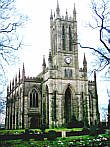
Stand Church,
Whitefield
Located on
Church Lane, in Whitefield (Bury), perhaps, with the local Stand
Golf Course, the last vestige of the old district of Stand (since
the Grammar School opposite was demolished in 2000 to make way
for new housing).
Stand is a Commissioner's Church of 1822, the first known building
to be designed by celebrated architect, Sir Charles Barry - it
cost £13,729 to build. In all likelihood, it was on the
strength of this building achievement that he secured the commision
to design the Manchester
Art Gallery in Mosley Street in Manchester city centre.
Barry's accuracy in reproducing an almost perfect perpendicular
gothic architecture marks Stand Church out as probably one of
his best buildings.
Its splendid tower dominates the hill and is a local landmark
to be seen from miles around in every direction.
Distinctive decorated pinnacles seem to have been placed wherever
there was space to fit them. The windows are long tall lancets,
and the tower has polyagonal buttresses.
Inside, it's four bay nave has slender perpendicular piers which
carry the star-shaped plaster vaults - one for each two bays.
Brightly coloured stained glass windows were installed around
1840. There are several monuments to local bigwigs of the period,
including James Ramsbotham, and James Clegg, as well as another
bust with relief figures on the base depicting Faith, Hope &
Charity.
Author's
Footnote:
It was a nostalgic visit back to see this church, as I had worked
for several years opposite at Stand Grammar School for Boys. I
was employed there as a young teacher and fondly remember Founder's
Day and Christmas Carol Services in this fine church - days shared
with the nearby Stand Grammar School for Girls - a rare treat
indeed!! These, and numerous art lessons drawing in the adjacent
graveyard, proved a welcome distraction from the many humdrum
hours (and years) of teaching art to the more-or-less unwilling
youth of the district.
Back
to Top
|
Stand Church,
Whitefield

|
The Holy
Name of Jesus RC Church, University, Chorlton on Medlock
Designed by
Joseph Aloysius Hansom and built between 1869-1871, the late Professor
Nikolaus Pevsner, one of Britain's leading experts on art and
architecture, counts this as the finest work by Hansom. His original
massive design called for a spire atop the tower, but this was
never built. The present octagonal top was actually by Adrian
Gilbert Scott and was only completed in 1928.
The fortress-like facade of the building is deliberately asymmetrical
and the sides have flying buttresses, outer chapels with small
windows.
The interior is spacious and airy with slender piers supporting
the rib-vaulted roof and high chancel. The vaulting was achieved,
unusually, by using polygonal terra cotta blocks, rather than
stone, which considerably reduced the weight (and the cost) of
the building. The nave has four bays.
Terra cotta is also used for interior cladding as is much of the
ornate detailing. The apse and chancel piers have been compared
in style to those at Chartres in France.
There had been plans to demolish the Holy Name to make way for
the proposed School of Medicine as part of University expansion
in the mid-1960s. This was then thought to be perfectly logical
since most of the surrounding houses had been removed in Manchester's
major slum clearances of that era, and congregations had in any
case dwindled to such an extent as to make the church economically
unviable. However, protests from locals and a militant campaign
headed by Pevsner, (a leading and influential critic of what he
described as "Manchester Corporation's scandalous treatment
of its architectural heritage"...), succeeded in saving
it as a Grade II Listed Building. In the event, the Medical School
was constructed a few yards south, further down Oxford Road.
Back
to Top
|

The Holy Name
Oxford Road, Manchester 15 |
|