NAVIGATION









































Virtual Hosting by

TheServerBank
Footballer
drawings
by John Moss




|
 |
 |
Manchester
Footballers
Players &
Managers from Manchester United and Manchester City Football Clubs
|

Gary Neville
|
Gary
Neville
Born on the
18th February 1975, Gary Neville joined Manchester United FC in
July 1991 and became a professional player with the club in January
1993. He had previously played for Bury and Greater Manchester
Schoolboys teams. His first senior appearance was in the 1992
UEFA Cup against Torpedo Moscow. By the 1994-1995 season Neville
had become a regular United first team player in the full back
position and was a substitute in the 1996 FA Cup Final winning
match against Liverpool. Also in 1996 he was selected for the
England's Euro '96 team.
In the summer of 1998, Neville was included in Glenn Still part
of the England squad for the World Cup in France, Neville played
in three of England's four matches.
A recurring groin injury dogged him during the 1999-2000 season,
but he still managed to win another Cap for the three matches
he played in Euro2000 competition. As a centre-back in the 2000-2001
season, Neville completed his 299th appearance with Manchester
United so that during that season he was offered a renewed contract
for six years guaranteeing a position with the club until July
2007.
A foot injury kept him out of Sven Goran Eriksson's England squad
for the 2002 World Cup, and indeed prevented him from playing
until September of that year.
Back on form by October 2002, he earned a sixth League Winners'
Medal. So far he has earned more than 50 caps to and a veritable
collection of domestic medals. Gary Neville is one of England's
most experienced and reliable players and his defensive ability
has proved crucial for club as well as for the England national
team.
Back
to Top
|
|
|
|
|
Kevin
Keegan
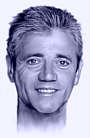
Born 14 February
1951 at Armthorpe, near Doncaster, Yorkshire, Kevin Keegan was
rejected by Doncaster and Coventry as a schoolboy, and joined
Scunthorpe United as an apprentice player in 1968. He made his
league debut at the age of 17 against Peterborough United.
In 1971, Bill Shankly paid £35,000 for him to join Liverpool
FC - here he scored no fewer than 100 goals in 321 matches over
the next 6 years and was twice elected Player of the Year in 1978
and 1979, the only British player ever to be so honoured. Controversially,
he was sold to SV Hamburg in West Germany for £500,000 in
June 1977, which alienated many former fans.
He returned to England to join Southampton in August 1982 and
moved on to Newcastle in May 1984.
Keegan made his England debut against Wales in Cardiff at the
age of 22 in 1972. During his 10 years playing for England he
earned 63 caps, was captain 31 times and scored 21 goals.
His last game for England was in 1982, and he subsequently spent
seven years out of football living in Spain before returning to
join Newcastle United in February 1992.
In September 1998 he joined Fulham Football Club. During his first
year as manager there he took the team from 18th position in the
second division to become division champions, with a record number
of points .
Thereafter he briefly acted as England coach in 1999 before quitting
to take on management of the England team on a part-time basis,
to help them qualify for the Euro2000 competition. Subsequently
he took up the position full time in May 1999, but a miserable
defeat in the opening game caused him to resign immediately. Soon
after, in May 2001, he was invited to become manager at Manchester
City, and led them to promotion into the Premier League in his
first season. During his playing career Keegan earned the reputation
as one of the most popular players in British football, and became
a most respected manager at Manchester City football club for
a short time.
Back
to Top
|
|
|
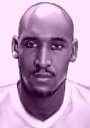
Nicholas Anelka |
Nicholas
Anelka
Paris-born
striker Nicholas Anelka arrived to play for Manchester City FC
at the then Maine Road stadium in June 2002 after an abortive
move to Liverpool. After failing to be signed by Liverpool after
a spell on loan to them, Man City manager Kevin Keegan quickly
seized the opportunity to sign Anelka to the Club.
London Club Arsenal had initially signed Anelka in 1997 as a teenager
for the sum of £500,000, but his temperament earned him
the nickname of "Le Whinge", and in 1999 he was sold
on to Real Madrid for £23million. Another disastrous season
saw his return to Paris St Germaine within the year.
He played in City's losing team at Leeds but went during his first
season to score a hat trick against Everton. A succession of goals
in ensuing games made him a favourite with fans and on one occasion
he was mobbed by adoring supporters in the streets outside Maine
Road.
No stranger to controversy, fined several times for late arrival
at training sessions, Anelka made international news headlines
when he refused to play for his country in their friendly against
Yugoslavia in France. French football authorities countered with
an unsuccessful attempt to get FIFA to ban Anelka from playing
for two matches - Keegan said that it was a domestic issue between
the player and the French footballing authorities, and in the
event no action was taken.
Anelka's early 2003-2004 performance was impressive with a hat-trick
against Aston Villa and a nomination as the Thomas Cook Player
of the Month for September 2003.
Back
to Top
|
|
|
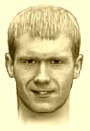
Paul Scholes |
Paul
Scholes
Paul Scholes
was born on 16th November 1974 in Salford, and joined Manchester
United as a trainee in July 1991 before becoming a professional
footballer in January 1993. As a young mid-fielder Scholes was
a promising youth and reserve team player, winning an FA Youth
Cup winners' medal in 1992 and a runners-up medal in the same
competition a year later. He was also a member of the England
Under-18 team which won the European Championships in 1993.
In September 1994 he made his league debut playing against Ipswich
Town, where, despite losing that game, he scored both of Man United's
2 goals. By the end of the 1994-1995 season he had become a regular
first team player and appeared in the 1998 World Cup Finals, scoring
in England's opening match against Tunisia.
A low point in his career came in the 1998-1999 season when he
became the first England player ever to be sent off at Wembley
Arena during the drawn Euro 2000 qualifying match against Sweden.
His game is notable for its accurate passing and bold tackling
and these skills were evident in the defeat of Scotland at Hampden
Park, where Scholes scored both goals in the Euro 2000 play-off.
This performance earned him the England Supporters Club title
of Player of the Year.
By 2001 Scholes had become a regular England player and received
his fifth Premiership Winners Medal at the end of that season
after making 44 appearances and scoring eleven goals, 15 of these
being European Cup goals - one more than the record held by Denis
Law.
In July 2001 his contract at Manchester United was extended until
June 2006. The year 2002 saw him as part of the England squad
at the 2002 World Cup finals in Japan and South Korea. Paul Scholes
is an inveterate striker, and is equally comfortable with a spectacular
long range shot or with a short tap in from on the goal line,
and seems
to save his best performances for big games.
Back
to Top
|
|
|
|
|
Rio
Ferdinand
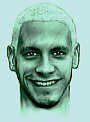
Rio Ferdinand
was born in November 1978 in Peckham, South East London. As a
young aspiring player he was centre-forward for his local junior
team, Bloomfields, where he was reputed to have scored 30 goals
in a season. Later he went on to Eltham Town as an Under-13 and
Under-14 player. It was while he was at Eltham that he was spotted
by a West Ham talent scout.
Ferdinand first signed for West Ham as a schoolboy at the tender
age of fourteen. By the time he was ready to leave school at sixteen,
he had been invited to join Middlesbrough, Norwich City, Millwall,
Charlton and Chelsea. However, he remained with West Ham on a
two-year Youth Training Scheme contract for the princely sum of
£30 per week, and all the boots he could clean. Rio's attitude
and ability clearly impressed West Ham, who signed him on his
first professional contract at the age of 17 - he made his debut
as a professional footballer as a substitute against Sheffield
Wednesday at Upton Park.
By 1997 he was playing in the senior team and on the 1st of February
of that year he scored his first senior goal. In all Ferdinand
was to make 152 appearances for West Ham, before he was signed
over to Leeds United for £18million in November 2000 - at
that time a British record fee for a defender.
By the end of the 2002 season he had been universally recognised
as a most accomplished defender and was much sought after. As
one of England's most outstanding performers in the 2002 World
Cup, his potential transfer value rocketed during the 2002 World
Cup, and Manchester United began to show interest in acquiring
him for the club. After weeks of speculation and subsequent negotiation,
Rio Ferdinand was signed for a new British record fee of £30million
- then the world's most expensive defender!
Initially dogged with injury and loss of form at Old Trafford,
his game slowly developed to top form as United overtook Arsenal
to win the 15th League title in their history.
Back
to Top
|
|
|
|
|
Robbie
Fowler

Born in Toxteth,
Liverpool on the 9th of April 1975, Robbie Fowler claims to have
been playing with footballs since the age of three. His arrival
at Maine Road was possibly one of the shrewdest purchases by manager
Kevin Keegan. As a fervent Everton supporter Fowler was spotted
by a Liverpool scout and signed up as a 14 year old boy. He made
his Liverpool debut in September 1993 as an 18 year old when he
scored all five goals in the second-leg league cup game against
Fulham. In the 1996-1997 season he scored 31 goals and won his
first England cap. His growing reputation began to draw comparisons
with great past British footballers like Jimmy Greaves.
In 330 matches at Liverpool, Fowler scored 171 goals in all, the
peak of his Liverpool career probably coming in 2001, when, as
a stand-in Captain for the team, they won all three major football
trophies.
In November 2001, he moved to Leeds United at Elland Road, where,
despite injuries, he scored 14 goals in 30 league appearances
during a 14 month stay with the club. In 2002 he was a member
of the England World Cup Squad in Japan and Korea.
His move to join Kevin Keegan's Manchester City team at Maine
Road was universally welcomed by fans. His first goal for City
was scored in their 1-0 win over Birmingham.
Robbie Fowler is regarded as probably the best natural goalscorer
in England. He
is equally happy aiming at the goal mouth with either foot, head,
in the box, out the box - in fact, almost anywhere. Ongoing injuries
have prevented him from playing more at international level.
Back
to Top
|
|
|
Roy
Keane
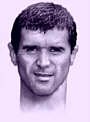
Roy Keane
was born in Cork, Ireland, on 10 October 1971. After several abortive
attempts to get apprenticeships with any English League clubs,
Keane's chance came in 1989 when, at the age of 18, manager Brian
Clough took him to play at Nottingham Forest. A promising youngster,
by the end of his first full season he had played in the 1991
FA Cup Final, collecting a runners up medal.
In May 1991 he was spotted by Jack Charlton, manager of the Ireland
national team, who gave him his first full international cap.
However, Nottingham Forest were relegated the following season
and Keane was sold to Manchester United for a record fee of £3.75
million.
Here he soon emerged as a powerful midfield player, helping United
win six Premier League Championships, including two doubles in
1994 and 1996. He also participated in the 1994 World Cup Finals
and is a regular international for the Republic of Ireland.
In 1997 he was made team captain, but in less than two months
he was sidelined after a serious knee injury. Keane soon fought
his way back to full fitness to lead the team out, at Wembley,
in the 1998 pre season Charity Shield.
His career has enjoyed mixed fortunes: a sending-off against Juventus,
forced him to miss the final in Barcelona. Several ankle injuries
also prevented him from playing for the rest of that season. Rumours
of a possible move from United abounded until in the 1999-2000
season, Keene was offered a new deal. After that, as team captain,
his skills were was recognised by both the Football Writers and
the Professional Footballers Association, who both voted him Player
of the Year. He went on in 2001 to lead United to a seventh Championship
title.
On the international front, despite his on-pitch successes, following
a row with the team manager he was sent off the pitch and subsequently,
he retired from international football 'on medical grounds'.
In his published autobiography, he admitted to having injured
Manchester City's Alf Inge Haaland on purpose during a vicious
tackle, and was punished by a five-match ban and a large fine.
This ban and a serious leg/hip operation put his future in question,
but despite being out of action for almost six months, Keane made
it very clear that he still has a few years left in him yet!
Keane left United in November 2005 after a reported difference
of opinion between himself and Sir Alex Ferguson and disparaging
remarks he is said to have made about several team-mates.
Back
to Top
|
|
|
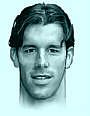 Ruud van Nistelrooy
 |
Ruud
van Nistelrooy
Full name:
Rutgerus Johannes Martinius Ruud van Nistelrooy. Born on 1st July
1976 in Oss, in the south-central region of the Netherlands, Ruud
van Nistelrooy is a natural sportsman who played football for
his local village team, as well as tennis and gymnastics as a
schoolboy. As a boy in his village team he played as a sweeper.
In 1993 his professional football career began when he moved to
the Second Division side FC Den Bosch. Here he was able to show
off his skills behind the forward line. Within four years he had
moved onto the Dutch First Division with SC Heerenveen as a striker.
He quickly accrued 13 goals from 30 appearances.
By November 1998, he had made his international debut for Holland
in a 1-1 draw against Germany, and by the end of his first season
in 1999, he had become top scorer in the Dutch League with 31
goals to be voted Dutch Player of the Year.
His scoring record with PSV Eindoven included 60 goals during
the two seasons. In the 1999-2000 season he scored two hat-tricks
against Ajax.
By April 2000, Manchester United had become interested in acquiring
van Nistelrooy, despite medical tests showing a weakness in his
right knee, sustained in a friendly against Silkeborg that same
month. However, he refused a reparative operation, knowing that
would rule him out for the Euro2000 competition. Ironically, two
days later, back in Eindhoven, he ruptured a ligament in the same
knee and was forced to watch Euro2000 by television.
Considerable encouragement by Sir Alex Ferguson was a source of
strength in the player's rehabilitation, and, with the aid of
a personal trainer, he set out on the road to recovery.
By March 2001, van Nistelrooy made a comeback with PSV, continuing
to score goals, before he made a long-awaited move to Manchester
United, for a then British record transfer fee of £19 million.
At Old Trafford he scored in his very first match - the Charity
Shield defeat to Liverpool. He went on to accrue 36 goals in his
debut season. In the 2002-2003 season he tallied 44 goals and
United went on to win the 2002-2003 Premiership.
Back
to Top
|
|