NAVIGATION









































Virtual Hosting by

TheServerBank
Footballer
drawings
by John Moss




|
 |
 |
Manchester
Footballers
Players &
Managers from Manchester United and Manchester City Football Clubs
|
|
|
Andy
Cole

Born
Andrew Alexander Cole on 15th October 1971 in Nottingham, England,
Andy Cole transferred to Manchester United in January 1995 from
Newcastle for a fee of £6 million. A striker, whose partnership
with Dwight Yorke often results in him getting less credit for
his efforts than he perhaps deserves, and his career has been
dogged by criticisms of insufficient scoring and missed opportunities.
Fortunately, he had the full backing of manager Alex Ferguson.
Earlier he had played for Arsenal and then at Bristol City before
moving to Newcastle in March 1993. His honours include England
Schoolboy Player, England Youth and England Under 21 Player, and
an England International. Later moved to play for Manchester City
FC.
|
|
|
|
|
Dwight
Yorke

Played
for Manchester United and the Trinidad & Tobago national team.
Born 3rd November 1971 in Canaan, Tobago. He was transferred to
United from Aston Villa in August 1998 for a fee of £12.6
million. Awarded the Carling Player of the Year title in 1999.
Although there were initial doubts as to his ability, an early
working partnership formed with Andy Cole proved a winner and
doubts were quickly forgotten in the face of his spectacular goal
scoring. His 29 goals in his first season established him firmly
as a top Manchester United player.
|
|
|
|
|
Tommy
Docherty

"The
Doc" is credited with having been the man who broke the Matt
Busby stranglehold on Manchester United. A stream of would-be
managers had all failed in Busby's shadow, but Docherty was a
tough Scott who was very much his own man. He arrived at United
at Christmas 1972. United's fortunes had declined, and the Doc
set about spending money to buy in new talent (Lou Macari, George
Graham, Alex Forsyth and Brian Greenoff among them). He also brought
George Best back from Spain.
His plans failed, United were relegated to the Second Division,
and Docherty bought in even more players (Stewart Pearson, Steve
Coppell, Gordon Hill, Jimmy Nicholl and Arthur Albiston among
them). Under his leadership and the new blood he'd bought in,
United's fortunes began to turn and improve. However, when a hitherto
secret love affair between him and a United physiotherapist's
wife became public knowledge, he was dismissed, having refused
to resign his post, to be replaced by Dave Sexton. Docherty moved
on to manage Derby County.
|
|
|
|
|
Sir
Alex Ferguson, OBE

Alex
Ferguson arrived from Aberdeen to take over the management of
Manchester United after the departure of Ron Atkinson in 1986.
For several years he struggled to raise United's fortunes, but
it was the 1990s which were to be his decade, as he took the team
on to higher and higher honours at home and in Europe. He had
bought in a great deal of new skill - including Ryan Giggs, Eric
Cantona, David Beckham, Paul Ince, and Andrei Kanchelskis - and
he had brought in Brian Kidd as a much respected coach. By 1994
he had assembled a team to be reckoned with. He was awarded Barclay's
Manager of the Year Trophy in 1993, and Sky Television's Personality
of the Year in 1994. During his time, Manchester United could
be fairly said to be the most famous football club in the world.
Currently
the longest serving manager in English Premier (and possibly the
world) football.
|
|
|
|
|
Peter
Schmeichel

Born
18th November 1963 in Gladsaxe, Denmark, and arguably one of the
instrumental players who helped raise the Manchester United game
to its recent dominant position in English football. Schmeichel
also played for the Danish team, Brondby, and has several major
honours under his belt, including European Supercup 1991, European
Championship 1992, and League Cup in 1999. He transferred to United
from Brondby in 1991 for a fee of £550,000. A renowned goalkeeper,
with highly developed ball-stopping skills, fast reflexes and
superb goal area control. Schmeichel made 392 appearances for
United and scored 1 goal. He left United in 1999 for Sporting
Lisbon.
|
|
|
Billy
Meredith
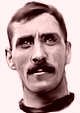
One
of Manchester City's and Manchester United's early great players,
who was at the centre of a scandal in 1905, when while playing
for City, he was accused of attempting to bribe an Aston Villa
opponent in an attempt to improve his team's chances of winning,
despite City winning the FA Cup a year earlier, in 1904, having
beaten their rivals, Bolton Wanderers by 1-0. Meredith was suspended
for a whole year as a result, and then he was sold on to Manchester
United. In 1907 he was among the founders of the Players Union
in Manchester. During his career he won practically every trophy
and honour that was available during the pre-First World War era.
|
|
|
|
|
David
Beckham

Born
David Robert Joseph Beckham on 2nd May 1975 in Leytonstone, England.
Beckham signed as trainee for Manchester United to become one
of United's top players and goal scorers. At the age of 12 he
won the Bobby Charlton Soccer Skills Award. He tried for his local
team, Leyton Orient, and then moved on to Tottenham Hotspur's
School of Excellence, before moving on to Manchester United as
a trainee in 1991. Beckham's career has been constantly under
the media spotlight, especially in view of his marriage to "Posh"
Spice - the star-studded relationship is a constant magnet for
tabloid journalism. Nevertheless, Beckham managed to keep his
game on track despite media pressure. He was named Carling Player
of the Month in August 1996, PFA Young Player of the Year in 1997,
Sir Matt Busby Player of the Year in 1997, and Sky Sports Fans'
Footballer in 1996. Beckham left to join Real Madrid in Spain
in summer 2003.
|
|
|
Wilf
McGuinness

An
unfortunate short-lived successor to Matt
Busby as Manchester United manager during the darker days
of 1969-1970, Wilf McGuinness had been only 31 when he took over,
and his career was to be short and doomed. He was little older
than the players he managed, and the Board of Directors never
gave him full managerial status, having Busby constantly watching
over his shoulder as "General Manager". He made a career
mistake when he dropped the illustrious Bobby
Charlton from the team. After a few disastrous months, and
losing the League Cup semi-finals to Aston Villa from the Third
Division, Sir Matt replaced him after Christmas 1970 and he returned
to coaching the reserves. During his brief management, United
had been thrashed by Everton (at home and away), by Southampton,
and suffered the ultimate indignity of being beaten 4-1 by Manchester
City and then 5-1 by Newcastle.
|
|
|
Joe
Jordan

"Big
Joe" Jordan arrived at Manchester United in 1977. Bought
in from Leeds United with Gordon McQueen, by new manager Dave
Sexton. He left United in 1981. This rather forbidding gap-toothed
player went on to be Lou Macari's assistant at Huddersfield, after
a brief and unremarkable spell managing Bristol City and Heart
of Midlothian in Scotland.
|
|
|
Ole
Gunnar Solskjaer
Born
26th February 1973 in Kristiansund, Norway, Solskjaer transferred
to manchester United in July 1996 from Molde for a fee of £1.5
million. He was an instant success, ending his first season in
a forward position as United's top scorer with 19 goals. He was
at Old Trafford for four seasons, and saw the team win the Premiership
in 1997, 1999 and 2000, the FA Cup and the European Cup - both
in 1999. He was awarded the Player of the Year Award for 1995-96.
Known variously as the "Baby-Faced Assassin" and as
"Norway's Alan Shearer". Plays for the Norway national
team.
|
|
|
|

|
Shaun
Goater
Born
Leonard Shaun Goater on 25th February 1970 in Hamilton, Bermuda,
a Manchester City and Bermuda National team player, (although
initially he had been a youth player for Manchester United). He
transferred from Bristol City in March 1998 for a fee of $400,000
to play in a forward position, he arrived at top level football
late in his career, after spending the best part of the previous
decade in lower division clubs. He actually came from Bermuda
to play with Manchester United, but this only lasted some 18 months,
before being offered out to Rotherham on loan. There his 70 League
goals caught the attention of Joe Jordan, the Bristol City manager,
who brought him to Bristol in 1996. In the past few years both
Goater's and Manchester City's
fortunes have risen and bounced back into Division One. Goater
was in his day City's highest goal scorer.
|
|