|
|
Greater
Manchester & Cheshire Museums in the Northwest Region of England
 

Papillon
Graphics' Virtual Encyclopaedia of Greater Manchester
Including
Bolton, Bury, Manchester, Oldham, Rochdale, Salford, Stockport, Tameside,
Trafford & Wigan
|
|
NAVIGATION









































Virtual
Hosting by

TheServerBank
Photos
by John Moss
& Gary Burns
|
 |
 |
Museums
& Exhibitions
around Greater
Manchester & Cheshire
|
Bolton
Steam Museum
Mornington
Road, Bolton BL1 4EU
Tel: 01257-265003 or 01204-846490.
The
museum is located in an original cotton store on the old Atlas
Mills site off Chorley Old Road (approx 1½ miles North
West of Bolton town centre) and has on display a superb and extensive
collection of fully restored textile mill steam engines.
These were in common use throughout the North of England from
the early 1800's until the 1960's when textile production declined
dramatically and many mills closed.
There is a notable and rare 1840 twin beam engine and a unique
1893 "non-dead-centre" machine. Although no steam supply is yet
available, most engines are in running order and can be seen in
motion, under electric drive, on Open Days. Access to the museum
is via Morrisons Supermarket car park, and is adjacent to the
petrol station.Parking is free.
Telephone for specific dates or informal visits or see their website
at: http://www.nmes.org.
|

|
|
|
|
Helmshore
Mills Textile Museum
Holcombe
Road, Helmshore, Rossendale,
Lancashire BB4 4NP. Tel: 01706-226459.
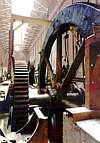
This
is a full working museum with demonstrations of machinery, set
in an original 18th century building with its magnificent water
wheel, and two authentic working mill museum galleries. Visitors
may experience the original (not reconstructed) textile mill with
all of its real sounds and smells. The Higher Mill was built in
1789 by the Turner family with the purpose of finishing woollen
cloths, and had an unbroken working family connection until its
commercial closure in 1967.
The adjacent Whittaker's Mill, conversely, has had a somewhat
chequered career, though by 1920 it had become a cotton spinning
mill. Its machinery is still installed as it was as a working
mill, with no changes whatever made in the interests of 'tourism'.
The visitor may experience the full range of activities that have
been carried out here over the past two centuries, including spinning,
weaving, carding and fulling. The celebrated Water Frame, which
is still powered by the great water wheel, came originally from
Richard Arkwright's own
factory.
Other famous machines may be seen here including Spinning Mules,
Hargreaves' Spinning Jenny, and many others. Talks on "The Lancashire
Loom", the story of the Lancashire Textile Industry every half
hour throughout the day, and a video "Hand to Wheel" at a quarter
past and a quarter to the hour. There are attendants around who
are happy to explain and demonstrate the working of the mills.
There is a Museum Shop on site, a Cafeteria, Picnic Area, a Riverside
Walk and almost full disabled access.
Opening
Times
Open to the public from 1st April-31st October from Monday-Friday
12noon-4.00pm, Saturdays and Sundays12noon-5.00pm. There is an
admission charge. Pre-booked groups and school parties by arrangement.
Free car parking. Please note that times may change and that you
should check befoe settimg out.
Location
Helmshore
is located on the A56 Haslingden bypass or via Rawtenstall town
centre at the northern end of the M66 motorway. Follow the brown
signs. There is an hourly bus service from Rawtenstall and Haslingden.
|
|
|
|
Cheshire
Military Museum
The
Castle, Chester. Telephone : 01244-327617.
The
Cheshire Military Museum at Chester
offers a fascinating exhibition telling the story of four famous
regiments connected with the county of Cheshire. Regiments represented
include "The Carabiniers", "The Skins", the Cheshire Yeomanry
and "The Cheshires". The Carabiniers were an amalgamation of the
3rd and 6th Dragoon Guards, who were involved in the successful
Heavy Brigade charge at the battle of Balaclava. One of the oldest
exhibits is a pike and sleeve of the colour carried at the Battle
of the Boyne in Northern Ireland in 1690. The Skins were a troop
raised by Sir Thomas Grosvenor at Chester in 1685, composed of
the 5th Dragoon Guards and the 6th Inniskilling Dragoons. The
Cheshire Yeomanry came into being in 1797 and still exist as an
active regiment today, raised initially to keep the King's peace
in the county. They were the last regiment to fight on horseback
in the Second World War. The Cheshires were raised in 1689 and
have fought in battles from the Boyne in 1690 to Bosnia in 1993.
There are also tribute exhibits to Captain Oates, the ill-fated
martyr of the Scott Antarctic team, and of Lord Baden Powell in
South Africa, founder of the Boy Scouts movement. The museum is
open from 9.00am to 5.00pm all year round except from 18th December
to 2nd January, but check before setting out. A small entrance
fee is payable with concessions for children, Senior Citizens
and the Disabled. School parties are welcome and Teacher Resource
Packs are available on request.
|

|
|