Manchester
& Lancashire Mining in Northwest England
Papillon
Graphics' Virtual Encyclopaedia of Greater Manchester
Including
Bolton, Bury, Manchester, Oldham, Rochdale, Salford, Stockport, Tameside,
Trafford & Wigan
NAVIGATION
Virtual
Hosting by
TheServerBank
Photos
by John Moss
Mining
Museums 19th
Century Industry in Manchester
Astley
Green Colliery
Higher
Green Lane, Astley, near Tyldesley,
Wigan M29 7JB.
Telephone:
01942 828121.
Astley
Green was a fully operational coal mine until its closure in 1970,
and has now been fully restored as a working museum. It was not
a particularly old colliery, only opening in 1908, but during
its heydays in the 1950s there were two shafts, 14 underground
levels and over 2100 employees. But, by 1970 it had become an
uneconomical pit, as demand for coal decreased and cheaper foreign
imports became available, and it was forced to cease production.
Fortunately, Lancashire County Council, urged on by several other
local leading dignitaries, saw the value of preserving this piece
of local, historical and industrial heritage, the last of many.
Actually, the area had been known for its dozens of collieries,
which, over successive post-war years been closed down and disassembled,
and had Astley Green been demolished no local mines would have
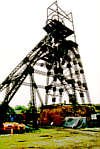
existed today. It now boasts, (sadly), the only surviving headgear
and engine house in Lancashire. It has what is reputedly Europe's
largest steam winding engine, located in a magnificent engine
house - this enormous 3,300 horse power twin tandem compound engine
is well worth seeing.
There are also extensive displays of industrial mining and related
artefacts. This Colliery Museum is now maintained and run by the
members of the Red Rose Steam Society.
Location:
Astley Green is located about 10 miles west of Manchester, on
the edge of Chat Moss, an area whose flatness makes the colliery
headgear a landmark for many miles around. Drive west in the direction
of Liverpool out of Manchester and through Salford on the East
Lancs Road, and you will see the mine to your left just off the
main road.
Opening:
Every Sunday from 12.00noon until 5.00pm, but closed Christmas
Day and Boxing Day. It is also open on Tuesday and Thursdays from
1.00pm to 5.00pm. School parties and groups may visit at other
times by prior arrangement. Please check times before setting
off - times may change.
The surviving
pit headgear
Buile Hill
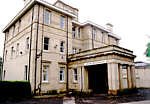
The distinctive
port-cochère
The
Former Lancashire Mining Museum, Buile Hill, Salford
Buile
Hill Park , Eccles Old Road, Salford M6 8GL Tel: 0161 736 1832. Fax: 0161 745 9490
NOW
(SADLY) CLOSED
Set
in this listed Georgian building designed by Sir Charles Barry,
the architect of the Houses of Parliament and the City
Art Gallery in Manchester, the museum consists of two reproduction
coal mines, a gallery to illustrate the history and development
of coal mining in Lancashire and exhibitions of mining art. Admission
is free.
Opening:
Open all year, from Mon-Fri 10.00am-12.30pm and 1.30pm-5.00pm;
Sunday from 2.00pm-5.00pm; closed on Saturdays, Good Fridays,
Easter Sundays, Christmas Eve to Boxing Day and New Years Day.
Building
History
Built between 1825 and 1827 to designs by Charles Barry, Buile
Hill is his only known villa-house in the neo-Classical style.
Its most distinctive feature is arguably the covered carriage
porch (known as a port-cochère). Later additions to the
building were made by Edward Walters, architect of the Free
Trade Hall, Manchester.
The house has had many locally distinguished occupants, including,
from 1825-1840, Sir Thomas Potter, first Mayor of Manchester,
John Potter, his son and MP for Manchester, and John Marsland
Bennett, Mayor of Manchester.
Salford Corporation purchased the house and 80 acres of adjoining
parkland in 1902 for the sum of £23,000, and it was opened
as a Natural History Museum in 1906, and still survived as a Science
Museum into the 1950s.
In 1959, in collaboration with the National Coal Board, the building
was excavated and the Buile Hill No.1 Pit was constructed in the
basement. Later, in the 1930s a drift pit was constructed on the
ground floor.
Extensive dry rot forced its closure in the early 1970s and after
complete restoration it was not fully reopened to the public until
1979.
FOOTNOTE
Financial problems and successive Local Authority cutbacks and
lack of funding eventually closed this fine museum - and it is
currently rumoured to be redeveloped as a hotel or executive apartments.
NOW
CLOSED (Accountants win - we lose!!)
Latest
information is that the house at Buile Hill has now been sold
for around £250,000 for some form of private redevelopment.