NAVIGATION









































Virtual
Hosting by

TheServerBank
Drawings
by John Moss
|
 |
 |
Manchester
Sports & Olympic Champions (1 of 7)
|
|

Alfred Tysoe
|
Alfred
Edward Tysoe
(1874-1901)
Salford Harriers : Olympic Middle Distance Runner
Alfred Edward Tysoe has been described s "the greatest Salford
Harrier of them all". Born at Skerton, near Lancaster, Tysoe ran
part-time with the Skerton Harriers running team, while still
working as a farm labourer. In 1896 he won the Northern Counties
1000 yards and the one mile titles. His running successes brought
him to the attention of Harold Hardwick, founder of Salford Harriers
in 1884, and in 1897 Tysoe was persuaded to join the Salford team.
Within his first year with Salford Harriers, he had achieved the
Amateur Athletics Association championships in one mile and ten
miles. In 1898 he helped the team to win their sixth National
Cross Country championship. He acquired numerous other notable
wins, including the 800 yards in the "Paris International Championships"
in July 1900 - the forerunner of the modern Olympic Games. Just
two weeks before those games he had broken the world record by
running the 800 yards in 1 minute and 57.8 seconds. In the 1900
games he also won a gold medal as part of the 5000 metres team
race. This proved to be his last season on the running track,
as in early 1901 he became severely ill with pleurisy. Nursed
by his father at his home in Blackpool, Alfred Tysoe tragically
died on the 26th of October 1901, aged twenty-seven.
Source:
James W Bancroft Archive
Back
to Top
|
|
|
|
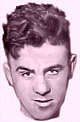
Jackie Brown
|
Jackie
Brown
(1910-1971)
World Flyweight Champion Boxer 1932-1935
Jackie Brown was born into a poor family in Collyhurst,
Manchester in 1910. During his career he was to win the World
Flyweight Boxing Championship, as well as British and European
Titles, all of which he lost in 1935 to the Scotsman, Benny Lynch.
Brown amassed a small fortune during his short career - all of
which he spent on fast living, clothes, parties, cars and women.
During World War Two, he became a physical training instructor,
but after all the fame and fortune, in obscurity he coped very
badly, and was imprisoned for assault on a four month hard labour
charge in Strangeways Gaol. This brought some renewed distinction,
as his case was defended by Edgar Lustgarten, later to be a celebrated
radio and television personality in the field of criminology.
Brown spent the last years of his life, from 1968 to 1971, in
hospital at Crumpsall (now the North Manchester General Hospital),
where he died at the age of 61.
Source:
James W Bancroft Archive
Back
to Top
|
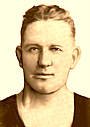
George Wilkinson |
George
Wilkinson
(1879-1946)
Olympic Water Polo Player
A pioneer of British Water Polo, at a time when only the British
really played the game, George Wilkinson is regarded as the world's
first great water polo player. He was born in the Gorton
district of Manchester on 3rd March 1879, where from an early
age he demonstrated that he was a keen and enthusiastic swimmer
at his local Gorton Baths.
Although a top class swimmer, he never won any straight swimming
championships outright, but could only achieve runner-up in the
Amateur Swimming Association's championships. At the age of 15,
Wilkinson took up Water Polo, and was playing in the third division
of the Manchester League when he was spotted and invited to join
the Hyde Seal team in a friendly match against the local champion
Osbourne Swimming Club.
His role was fundamental in the first defeat of Osbourne in seven
years, and as a result he was recruited for the national Olympic
Team by John Derbyshire, superintendent of Osbourne Street baths,
and a powerful figure in Manchester swimming organisation. Wilkinson
was a powerful and versatile player who played in left-forward
position. His shooting accuracy was legend, as was his strong
two-handed power drive and his speciality backhand flip.
Soon after the 1900 Olympic Games, Wilkinson moved to live in
Hyde, and continued playing for the Hyde Seal Club at its home
base in the Union Street Baths. He was captain of this team for
some 22 years, achieving many top awards for himself and the team.
These included 22 Northern Championship wins and 9 National Championships.
Hyde Seal were also World Champions for 3 successive seasons under
his captaincy. He captained both the Lancashire and Cheshire County
Teams, gaining 24 English caps between 1900 and 1922. He personally
gained a second Olympic Championship Medal in 1908, and captained
the winning British Team at the Stockholm Olympics in 1912. In
1925, now aged 46 and virtually retired from active participation,
he was award a large purse and Testimonial Award, to which over
a thousand local supporters had contributed.
On retirement, he became a licenced publican, and, with his wife
ran various Manchester pubs, including "The Sportsman" in Hyde,
"The Hen & Chickens" on Deansgate, "The Mess House" in Oldham
and "The Wheatsheaf" in Hyde, where he remained until his death.
His son, Harry, was to follow in his father's footsteps, and also
became a Hyde Seal Player. After his health began to fail, George
died, aged 77 on 7th August 1946, and is buried in Gorton Cemetery.
A memorial to his memory also honours him in the Swimming Hall
of Fame at Fort Lauderdale, Florida in the United States of America.
Source:
James W Bancroft Archive
Back
to Top
|
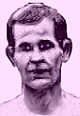
Emil Voigt |
Emil
Robert Voigt
(1882/3-1973)
Long Distance Olympic Running Champion
Emil Voigt was the Amateur Athletic Association's (the AAA) 5
mile Olympic Champion at the new White City Stadium at Shepherds
Bush in London in 1908. This was an astounding feat considering
that at the time he was suffering from an infected foot and had
just decided to retire from competitive running events!
Born in Ardwick, Manchester
in December 1882, the son of Carl Julius Voigt, a German born
instrument maker who had trading premises in Cheetham Hill (see
Footnote below). While still a schoolboy at Rose Place School,
in 1901, he was encouraged to join the Manchester Athletic Club,
based at Fallowfield. A strict vegetarian, he attributed all of
his athletic prowess to this fact. He was also a talented linguist.
Retaining his 5 mile championship in 1908, he went on to win the
one mile championship in 1910. In 1911, then aged 29, he retired
from athletics and emigrated to Australia, where he set up his
own radio station, specialising in wrestling commentaries. He
became President of the Australian Federation of Broadcasting
Stations, and in 1948 he moved to live in Aukland, New Zealand,
where he died on 16th October 1973 aged ninety.
Source:
James W Bancroft Archive
Footnote:
Doubts have been raised as to the birth and dates supplied here
for Emil Voigt. Since confidently writing this account of Emil
Voigt in 1996 on the basis of information researched in James
Bancroft's Book "Olympic Champions of Manchester"
in the Local History Library, I have received a conflicting email
from Robin Voigt, his granddaughter, living in Australia, which
throws into doubt his origins. Robin writes:
"I
was very intrigued to see you have written he was the son of
Carl Julius Voigt (born) in December 1882. I have Emil's birth
certificate here and he was born in March 1883 the son of Emil
Robert (same name) a mantles salesman."
Robin also
supplied the photo of Emil (below) in his 80s with his framed
Olympic Certificate. Robin's email would seem, on the face of
it, to be a very compelling and irrefutable source. However, I
have left the original account intact, in the hope that some (better)
knowledgeable person might throw light on this confusion.
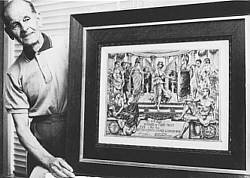
Emil Voigt with
his framed Olympic Certificate
Back
to Top
|
|