|
|
Manchester
Church Buildings in the Northwest of England
  
A Virtual
Encyclopaedia of Greater Manchester in the Third Millennium
Including
Bolton, Bury, Manchester, Oldham, Rochdale, Salford, Stockport, Tameside,
Trafford & Wigan |
|
NAVIGATION









































Virtual
Hosting by

TheServerBank
Photos
by John Moss
|
 |
 |
Manchester
City Centre Churches - 1
The Architectural Heritage of Manchester
|
Manchester
Cathedral
Victoria
Street, Manchester M3.
Tel: 0161 833 2220.
Somewhat
detached now from the main City Centre, by virtue of its riverside
location, the cathedral marked the epicentre of medieval Manchester.
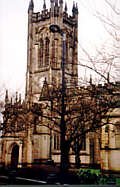
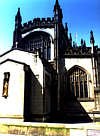
Today's Manchester Cathedral has taken 600 years in the making.
It was dedicated by Henry Vth to St Mary, St Denys and St George,
and is built in the Perpendicular Gothic style, typified by its
tall windows and flat fan-vaulted ceilings.
It was
in 1421-2 that the parish church of the little known village that
was to become Manchester was raised to the status of a Collegiate
Church, and served the surrounding 60 square mile parish. While
much of the exterior of the building is a 19th century reconstruction
carried out by Joseph Crowther, he was scrupulously faithful to
the original building, and none of the original styling has been
lost. The possible exception is the west front, which was rather
ornately over-reconstructed in celebration of Queen Victoria's
Diamond Jubilee in 1897 by Sir Basil Champneys. Other alterations
and restorations have been carried out by J.P.Holden in 1815 and
1868, Sir Percy Worthington in 1934 and Sir Hubert Worthington
after the Lufwaffe bombing of 1940.
The
interior has numerous examples of period woodwork in the form
of the finest late medieval woodcarving, carried out between 1485
and 1506 by the so-called 'Ripon Carvers'. The old Collegiate
Church was elevated to Cathedral status in 1847.
In 1940,
the building sustained a direct hit during the Manchester blitz
in December of that year, and much collateral damage was sustained,
many fine windows being lost forever. Fortunately, much of the
woodcarving survived the bombing, and the particularly fine choir
stalls and misericords (choir seats) are worth seeing. Saxon stone
fragments survive from the 8th century. Now, the Fire Window by
Margaret Traherne, occupies a place near to the site of the impact.
On the west side of the cathedral are five modern windows made
by Tony Holloway and representing "St George", "St Mary", "St
Denys", "Genesis" and "Revelations". The oldest part of the building
are the piers which support the tower, which date from 1380 There
is also a sculpture by Eric Gill.
Evensong,
sung on Tuesdays, Wednesdays and Thursdays from 5.30pm and Saturdays
from 5.00pm.
See: Plan
of Manchester Cathedral
Back
to Top
|

|
|
|
St Ann's Church
St
Ann's Square, Manchester.
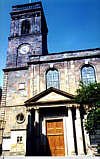
Built in local
pink sandstone, St Ann's church is an elegant, neo-classical building
dating from 1712, and often ascribed to Sir Christopher Wren or
one of his pupils. It is a Grade 1 listed building of historic
and architectural merit. Its distinguished round arched windows
with two-storey Corinthian pilasters is typical of the classical
revival style, as is the large rounded apse at the high altar
end of the church.
Originally
the tower was topped by a wooden spire - long since disappeared.
Inside are galleries supported by rather stocky Tuscan columns,
and windows are glazed with 19th century stained glass by Frederick
Shields. It is still debatable whether the church was named after
St Ann, or after Lady Ann Bland, who seems to have financed most
of its construction.
The
church tower is said to mark the exact centre of the city of Manchester,
and was at one time used as a platform from which surveyors could
make distance measurements - the cut arrow benchmark can still
be found to the left of the tower doorway. The church was initially
frequented by the cream of Manchester society and its pews could
be rented; the best seats cost around £100, a small fortune in
those days!
St Ann's
is the only one of the 19 city centre churches built in the 18th
century to survive. It was restored by Alfred
Waterhouse in 1891. Free recitals and musical performances
are on offer here at lunchtime.
Back
to Top
|


|
St
Mary's RC Church - The Hidden Gem
Mulberry
Street, off Brazennose Street, Manchester M2. Tel: 0161 834 3547.
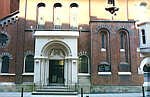
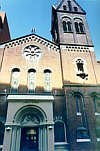
St Mary's
Church marks the site of the first purpose-built Roman Catholic
church in England since the Reformation and was erected in 1794.
The present building dates from 1848 and was designed by Weightman
and Hadfield. It is locally better known as "The Hidden Gem",
after being described thus by a visiting dignitary, and it is
widely signposted as such around the city, though it lies tucked
away just off Brazennose Street off Albert Square and is mssed
by many passers-by.
The influential Victorian architect and critic, Augustus Welby
Pugin expressed his personal dislike for the building, but this
was almost certainly a biased view and sour grapes on his part,
as his own design for the church had been rejected. The building
was nevertheless well received by its contemporaries and its popularity
has persisted over the subsequent two centuries so that it is
deservedly regarded as a Manchester treasure - well worth a look
on your way to Manchester Town Hall
or the Central Reference Library
nearby.
Later additions to the church include Norman Adams' paintings
of the Stations of the Cross - lively images which contrast markedly
with the 19th century interior of the church.
Admission
free. Opening times 8.00am - 4.00pm every day. No sight-seeing
during religious services please.
Back
to Top
|

|
Friends' Meeting
House
Quakers
Religious Society of Friends
6 Mount Street, Manchester M2.
Tel : 0161-834 5797
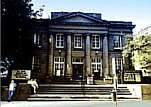
A Grade
2 listed building of architectural merit, built by Richard Lane
in 1828 at the height of the Classical Revival style of architecture
in England. Its imposing approach steps reaching the full width
of the building and, the Greek facade with its four supporting Ionic
pilasters bears witness to the growing importance and influence
on Nonconformism in the City of Manchester at that time. The sides
and rear of the building are, however, in a plainer, more modest
brickwork.
Despite
many attempts at redevelopment, the building still boasts continuous
use and is still used by Quakers today, and it stands up well to
the plethora of civic buildings which surround it.
Back
to Top
|

Suburban
Churches follow next page >
|
|
|
|