|
NAVIGATION









































Virtual
Hosting by

TheServerBank
|
 |
 |
Manchester
Educational & Academic Buildings
|
Regional College of Art, All Saints
Located
in Cavendish Street in All Saints, and now part of the Metropolitan
University of Manchester, the original Regional College of Art building
dates from 1880-81 and was designed by G Tunstall Redmayne. A symmetrical
gothic building with central entrance porch and large studio windows.
Extended at the back in 1898 (to facilitate its growing popularity
and the renewed interest in Arts & Crafts design), the extension
is of red brick and was designed by J Gibbons Sankey. A novel geometrically
constructed bridge connects the two buildings.
Adjacent, also on Cavendish Street, is the old Chorlton (on Medlock)
Town Hall, long part of the Art School and for many years its main
refectory. It was designed by Richard Lane around 1830, and is nine
bays wide of strict Doric Greek style with triangular pediment and
a decorated frieze. Originally symmetrical, though part is now missing
due to Second World War bombing.
Wesleyan Theological Institution, (Didsbury College of Education)
This
fine building, located on Wilmslow Road in Didsbury, has undergone
many different transitions and functions, having begun life as a
Methodist training college, it later became Didsbury College of
Education before being incorporated into the Metropolitan University
of Manchester where it is now their Institute of Education, responsible
for teacher training.
The original building dates from 1842 and is distinctive for its
long stone frontage in a pseudo-Grecian style, eleven bays long
and two storeys high, giant pilasters and end pavilions. The central
three-storey block was originally the Governor's residence. Long
stone built wings behind create a sizable open courtyard. Further
extensions behind the main building in the late 1960s by Francis
Jones & Son.
|

The Shirley Institute
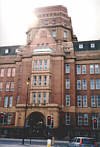
UMIST Building

Hollings College

William Hulmes
Grammar School

Chethams School
|
Shirley Institute,
('The Towers'), Didsbury
Originally
designed in 1865 for the proprietor and editor of the Manchester
Guardian, John Edward Taylor, by Thomas Worthington. The house
on Wilmslow Road, Didsbury, is purported to have cost £50,000
- a small fortune at that time. Ironically when it was purchased
in 1920 by the British Cotton Industry Research Association it
was sold to them for a mere £10,000. It is now a Grade II
Listed Building of special architectural interest.
Described by Pevsner as "... grossly picturesque in red
brick and red terra cotta" it is an imposing gothic building
with an asymmetrically placed porch tower (hence sometimes known
as "The Towers"), a polygonal oriel window and spire.
It was here that the first Manchester
Ship Canal Meeting was held in 1882, and was once the home
of the celebrated Manchester engineer, Daniel
Adamson. During the First World War the building was used
as a recreation centre for wounded soldiers.
The
Shirley Institute as such was established in 1919 as the British
Cotton Industry Research Association (BCIRA). A significant part
of the purchase price was contributed by a cotton spinner and
Member of Parliament for Stockport, William Greenwood, who asked
that the place be named after his daughter Shirley. The first
purpose built laboratories were opened in 1922 by the Duke of
York. Other Royal openings on the site took place in 1953 by the
Duchess of Kent, 1963 by Princess Margaret and 1990 by the Princess
Royal.
Hollings College, Fallowfield
Designed by
Manchester city architect, L C Howitt and built between 1957-1960,
Hollings College, located on the corner of Wilmslow Road and Old
hall Lane, affectionately known as "the Toast-Rack",
is a most distinctive and original 20th century design and local
landmark. Originally called the College of Food & Fashion.
Its nickname comes from its appearance - a tall and closely set
number of parabolic concrete arches with glass infilling. It also
has a large circular hall building on the road side (which was
at one time also affectionately known as "the poached egg").
Manchester
Grammar School, Rusholme
Long one of
the UK's leading grammar schools, MGS is located on Old Hall Lane
and the main building was designed in 1930 by Francis Jones and
Percy Worthington. When the school outgrew its premises on Long
Millgate, adjacent to Chethams
Library in Manchester city centre, it decamped lock, stock
and barrel, to the (then) more spacious campus next to Birchfields
Park in Rusholme. The original Long Millgate building is now part
of Chethams Music School.
The present building consists of a large brick built quadrangle
approached by a long, (almost triumphal), avenue drive from Old
Hall Lane, and entered by a tripartite arch under a clock tower
cupola. (The author has many fond memories of time spent teaching
in the art studios located above the entrance arch and beneath
the clock tower during the late 1960s and early 1970s).
To the east, a second quadrangle leading to the refectory, gymnasium
and swimming pool, now contains a much later 1960s built modern
masters' common room block. The original old library has excellent
wood panelling, as does the Assembly Hall.
Many other outlying additions have been made to the school, but
the original building still stands fairly proudly when viewed
across the extensive playing fields. A bronze statue of Bishop
Hugh Oldham, the school's founder, done by William McMillan
stands behind the Lecture Theatre at the Birchfield Park entrance.
Chethams School of Music, Manchester
In
1655 Chetham's Hospital and Chetham's Library were established from
monies left by Sir
Humphrey Chetham , a wealthy local textile merchant,
in his will at his death in 1653. "Chets", (as it is still known)
was set up as a charitable free school to provide education for
about 40 boys from poor families, who showed aptitude to learn.
Built in red sandstone, like the cathedral, it originally formed
dormitories and quarters for cathedral clergy. The buildings, grouped
around a central courtyard with a defensive entrance gate, were
typical of medieval building style.
From 1547, after the reformation, the premises became the town dwellings
of the Earl of Derby. The college was refounded in 1557, but by
the time of the outbreak of the Civil Wars, the buildings were in
a dilapidated state. Their purchase by Humphrey Chetham almost certainly
saved them from demolition. He purchased the lot for £400 just prior
to his death.
Chetham's is now a music school for musically gifted young men and
women, and attracts young protégés from all over the
northwest of England. It still largely maintains the original principle
of admitting talented youngsters, and barring none because of financial
hardship. The school is well funded and maintains poorer pupils.
Lunchtime concerts are held every Wednesday in the Baronial Hall.
Concerts can be combined with a guided tour of the school and library.
The library, containing a large collection of books, specialises
in local history material. In this library, Frederick
Engels spent many hours researching for his numerous
writings.
Xavarian
College, Rusholme/Victoria Park
Located on
Lower Park Road, just off Wilmslow Road, Xavarian College began
life as a well-to-do villa in the (then) rather smart suburb of
Rusholme. This expensive villa was built in 1874-1875 for the
Hetherington family by top architect Alfred
Waterhouse. The family wealth came from the construction of
Blast Furnaces, which at that time were at the cutting edge of
a new technology, and this is reflected in the status of the building,
as are many of the surrounding buildings in Victoria Park, which
probably contains more of Manchester's Grade II Listed Buildings
than any other district - well worth a gentle walk around just
to look at these houses of former glory - now predominantly converted
into small hotels, guest houses or student accommodation.. Nowadays
it is a Roman Catholic Sixth Form College.
Lancashire
Independent Congregational College, Whalley Range
Located in
College Road, Whalley Range, and now the General & Municipal
Boilermakers' Union National College, the former Lancashire Independent
College is a Grade II Listed Building which was designed by Irwin
and Chester in 1843.
It was built specially for the purpose of training Nonconformist
Ministers, who because of their religious faith, were denied access
to the Universities of Oxford and Cambridge.
It is a gothic-style stone building with octagonal tower and pinnacles,
completed in 1843. Recent refurbishment has converted the building
into a residential college for the GMB Union. The entrance gates
and octagonal gate piers are in the same style and are also listed
buildings. The most prominent building in the district, it lies
within the Whalley Range Conservation Area. It is a splendid example
of Victorian gothic collegiate style architecture set in 8 acres
of its own grounds.
St Bede's College, Alexandra Park
St. Bede's
College is an ornate red brick and terra cotta building in the
Italianate renaissance style, which incorporates the redundant
aquarium building. Designed by Archibald Dunn and Edward J Hansom
in 1880, it is a Grade II Listed Building. The eleven bays of
the college form an incomplete facade as construction ceased in
1880. A chapel to the rear was added in 1898, followed by several
subsequent additions. The three bay porch has coloured tiled reliefs
of a majolica type. One of Manchester's notable independent Roman
Catholic boys grammar schools.
William
Hulme's Grammar School, Whalley Range
Located on
Springbridge Road in Whalley Range, just off Princess Parkway,
William Hulme's Grammar School is an independent co-educational
day school for pupils between 11-18 years of age. It was designed
by A H Davies-Colley in 1886-1887 as a large high building of
red brick and yellow terra cotta. There is a Hall of later date
(c.1910) in the same style. Both buildings are strictly symmetrical.
The school is named after William
Hulme, founder of the William Hulme Charity, who lived at
Hulme Hall (later Broadstone Hall) in Reddish, Stockport.
|
|
|
| Back
to Top |
Last
Page of Topic].
|
|