One of the
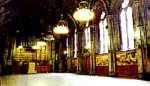
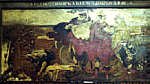
highlights of the tour is the Great Hall with its 12 large murals
by Ford Madox Brown, the celebrated Pre-Raphaelite painter.
(To see more of the murals in larger versions - CLICK
HERE). Also see the tile mosaic work, the vaulted
corridors and the three stone spiral staircases.
The Town
Hall demonstrates Waterhouse's genius in not only exterior detailing,
but internal style and decor. The Great Hall, designed in the
fashion of a Flemish weaving hall, many believe to be the masterpiece
of the building, with its famous murals.
Also notable is the elegant and dignified entrance hall, with
its numerous busts and statues of city fathers and benefactors,
as well as the highly coloured figure of the Duke of Lancaster
in Roman costume.
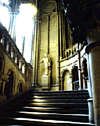
The visitor
is guided up to the first floor by one of the three great spiral
staircases, (bottom centre), included as if to accentuate the
triangular plan of the building, and reminiscent of some great
Gothic cathedral. Internally, a distinct sense of medievalism
prevails, with hammerbeam ceilings, vaulted dark corridors lit
by a large number of pointed Gothic windows, and the evocative
cloister-like atmosphere which all these help create.

The Manchester Busy Bee, floor mosaic - symbol
of industry
The Thirteenth
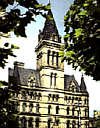
Century medieval Gothic styling of the Town Hall is bold and
freely used maintaining a storytelling ethos which gradually
unfolds the city's history. Externally, the building is decorated
with carved images representing important figures in the city's
history.
The style
was growing in popularity in the mid-nineteenth century, as
the Neo (new) Gothic style was considered a true English style
and therefore most suitable for civic buildings. The style is
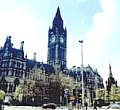
instantly heralded by the 280 feet high bell tower, which would
not shame any great cathedral in its size and imposing style.
Internal detailing reveals the same love of Gothic detail -
in the mosaic tiled floors, the clustered columns and finely
carved pillar capitals.
The Great
Hall itself is dominated by Brown's murals, which depict key
events in the development of the City of Manchester, from the
building of the first fort by Agricola, up to the later experiments
in Science by John Dalton. It is well worth taking one of the
guided tours so that none of the wealth of detail is missed.

Inside the Gothic corridors of power
See: