On Saturday
15 June 1996, at a peak shopping time on Father's Day, a 3,000lb
IRA bomb exploded in Manchester, injuring more than 200 people
and ripping into the fabric of the city's main shopping centre.
In a state of shocked disbelief, police had begun clearing people
from the area some 40 minutes before the blast; fortunately, several
telephoned warnings had been issued to newspapers, radio stations
and to at least one hospital in Manchester an hour before the
blast. Newspaper offices in Dublin and Belfast received similar
warnings.
An army bomb
squad employed a robotic anti-bomb device to check an illegally
parked Ford van, which had been recorded by several closed circuit
security cameras in the city, when the bomb exploded.
Manchester's
ambulance services counted 206 injured people. Most injuries were
sustained from falling glass and building debris. In the immediately
ensuing chaos, ambulances and private cars were used to shuttle
victims to local and regional hospitals.
Local authorities
had to close Victoria and Piccadilly railway stations for several
hours and to seal off the city centre. The evacuation of shoppers
immediately took place from the Marks & Spencer's department store,
which was directly at the centre of the site, outside which the
lorry-bomb was parked.
Initially,
the evacuated staff and shoppers stood outside, right next to
the bomb, but when the emergency services realised this they shunted
them to the nearby Victoria Station. Why Manchester city centre
was targeted by the IRA is uncertain, but it later became clear
that the cause probably lay in the breakdown of the IRA "ceasefire"
in the light of lack of progress with the British Government's
ongoing talks about a permanent peace settlement in Northern Ireland.
It was estimated
that up to 50,000 square metres of retail space and nearly 25,000
square metres of office space have subsequently needed to be reconstructed.
Whilst much of the city centre has now reopened, the immediate
area surrounding the blast site, including parts of the Arndale
Centre, the Corn Exchange, the Royal Exchange, Royal Insurance's
Longridge House and Marks and Spencer's remain cordoned off and
a considerable amount of demolition has had to take place. Marks
& Spencer's store, alas, was totally demolished, and the Royal
Insurance Building is no more, as are several shops in the immediate
vicinity.
Central government
quickly set aside £1million of European Union finance and set
in place a master plan for the redevelopment of the City Centre.
They have also provided £150,000 to support an international urban
design competition, which was launched just one month after the
bombing, and which provided a cohesive plan for rebuilding.
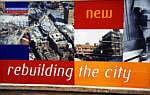
The reconstruction
has been overseen by the new City Centre Task Force, Millennium
Manchester Organisation. The government allocated a further £20
million to Manchester from the European Union regional aid budget
for 1997-99.
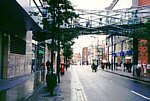
Four years
later, and the whole area of the devastation zone is now completely
restored. The
Royal Exchange has been renovated, the Corn Exchange has been
reborn as the Triangle, and the whole north side of the Arndale
Centre has been rebuilt. Shambles Square including the Old Wellington
Inn and Sinclair's Oyster Bar - the two oldest buildings in the
city of Manchester - have been physically moved some 100 yards
to a new Shambles Square location off Exchange Square and opposite
Marks and Spencer. Finally, Marks and Spencer have rebuilt completely
on the original site, the largest M&S store in the world.