|
NAVIGATION









































Virtual Hosting by

TheServerBank
Photos
& Drawings
by John Moss
|
 |
 |
The
Town & Borough of Oldham
In the Greater Manchester Metropolitan County
|
|
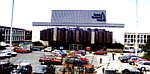
The Queen Elizabeth
Hall
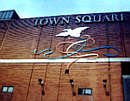
Town Square
|
Oldham
King Cotton
v. Wool in Oldham
Attracted
by higher wages and the promise of regular employment, in the
late 1770s local workers moved into the new cotton mills. By the
end of 1778, 11 other mills had joined Clegg's original Lees Hall
Mill. Oldham's mills employed over 500 people, the majority of
its population at that time. The introduction of
Samuel Crompton's
Spinning Mule in the 1780s enabled the industry to expand ever
faster. Surviving woollen merchant's, quite understandably, objected
to the spread of cotton mills, and took steps to impede the industry's
progress. They successfully lobbied parliament and in 1784 a special
tax was imposed on cotton cloth, forcing the industry into an
instant depression.
Many protest meetings followed in Manchester, led by powerful
local industrialists like John Lees of Clarksfield and James Brierly
of Hollinwood, which culminated in an 80,000 signature petition
being submitted to London. This powerful pressure group managed
to get the tax repealed within a year, and prosperity returned
to the cotton industry. The obvious burgeoning success of cotton,
sounded the death knell of Oldham's woollen goods.
At the Manchester Fair of 1788 about half of the goods displayed
by Oldham merchants were of wool - though all of these were from
the Saddleworth area. Not one merchant attended the Manchester
Fair in 1794 to sell woollen products.
By 1795 the town of Oldham had 22 cotton mills, and by 1805 the
number had risen to 30. Samuel Crompton's own survey of 35 mills
in the Manchester area in 1810 was based on the number of spindles
in use in mills. His survey shows Oldham's largest mill at that
time, owned by John Lees, had 100 mules, each of which allowed
a single operator to produce 200 times the amount of cotton yarn
that a spinner could have made by hand, and that the quality was
superior and consistent.
Other local industries flourished. In 1817, James Butterworth's
first history of Oldham recorded 22 firms involved in the hatting
industry, producing more than 1000 hats a week. Edward Baines,
writing in 1825, also recorded that over 65 mills now existed
in Oldham, and all but 2 were built since 1800, adding that of
the 6,982 families in the parish of Oldham, 6,667 were involved
in some way in the cotton industry.
By 1833 over 11,000 people worked in mills - the transformation
of the Oldham cottage industries to factory production had been
virtually completed. Oldham was now a boom town and the commodity
in demand was cotton cloth.
|

James Lees |
Coal Mining
in Oldham
Although cotton
dominates much of Oldham's recent history, the importance of its
coal industry should not be overlooked. The writer Daniel Defoe,
on a visit to Oldham, described it as a place of "...Coals...upon
the top of the highest hills" in reference to the accessibility
of coal seams lying so near to the surface that little, if any,
digging was necessary. Little wonder then, that even before the
Industrial Revolution, and the need for coal to power steam engines,
locals used coal as a primary fuel source.
The earliest reference to commercial coal mining in Oldham dates
from 1738 when George Hall had ownership of pits at Broadway Lane,
and, after the completion of the Rochdale and Ashton Canals in
the 1790s, the industry became profitable and expanding. Local
pits tended to be of "bell" or "beehive" types, because of their
shape, and were no more than 20 feet deep, due to the problem
of flooding at depths lower than the natural water table. Local
miners who worked these pits were called "delfs".
One of the most successful early mining partnerships was between
Joseph Jones, John Booth and James Lees of Clarksfield. Their
partnership was most successful and gradually took over ownership
of most local pits. James Lees' family gave their name to the
village of Lees, which still bears their name. By 1790 there were
14 collieries operating in Oldham.
The introduction of steam engines (the first used in the Broadway
Lane Colliery) meant that water could be pumped out and mines
sunk deeper. Increased production resulted, and the steam-driven
mill machinery of Manchester eagerly consumed all the coal that
Oldham mines could produce, and that its canals could carry.
By 1832 Oldham boasted 37 collieries, most owned by Lees, Jones
& Company, producing about 200,000 tons a year. The deepest was
at Royton, being 800 feet deep and producing 700 tons a week by
1830. Unlike the cotton industry, the coal industry produced very
few innovations or inventions - methods tended to remain largely
unchanged until the mid 20th century.
|
|

Samuel Lees

Henry Platt
|
Engineering
in Oldham
The third
industry to be developed in Oldham was engineering. Initially
this came about through the repairing of machinery used in spinning
and weaving. The Spinning Jenny was the first made in Oldham by
the engineering firm of Heap and Cowper. The Elson Brothers of
Tetlow Fold, North Moor also set up an engineering firm in the
1780s to repair and replace worn machine parts for local mills
and factories. Despite this, the absence of local skills meant
that most machinery was still brought in from nearby Manchester.
It was the setting up of an engineering business by Samuel Lees
at Holt in 1816, that engineering really took off, as he began
to manufacture rollers, rather than simply repairing them. His
firm rapidly developed so that by the early 1830s his company
was the largest cotton roller manufacturing firm in Lancashire,
with a workforce of over 200 men. Others followed.
Abraham Saville set up a company to produce rollers and spindles
at Lower Moor, becoming the brass and iron founders, Messrs Wolstenholme
& Co in the late 1820s. Spinning Mules were most in demand, and
the partnership between Elijah Hibbert of Ashton and Henry Platt,
which was set up at the Soho works, was to eventually provide
all the mules and carding machines which Oldham's factories could
use. They expanded to open further works at Mount Pleasant and
the Hartford Mill at Greenacres in 1830.
The name of Platt became eventually associated with the Mather
& Platt Company which continued production of heavy machinery
and machine tools right into the mid-20th century.
|
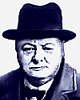
Sir Winston Churchill,
MP for Oldham in 1900 |
Oldham
Politics & Trades Unions
No Unions
had existed in the 18th century mills; in fact they were prohibited
by law. However, growing industrial disputes about poor pay and
conditions in the mines and factories, as well as the punitive
effects of the taxes on bread brought about by the Corn Laws,
prompted numerous demonstrations and protests in the 1750s, and
gradually workers became more organised, more militant and more
politically aware. (See "Anti-Corn Law League"). Bread rioters
in 1757 were joined by coal-workers from the Bridgewater mines.
In 1758 there was a bread riot in Oldham, and the leaders were
arrested. In 1781 apprentice weavers in Oldham refused to work
with cheaper imported unqualified workers. Further food riots
in 1795 caused troops to be brought in to restore peace as local
bread shops were attacked and looted. In that year the first Co-operatives
and Mutual Societies were formed amongst workers who pooled their
money for mutual self-support and to buy food more cheaply in
bulk. Various political movements and meetings, protest marches
and industrial strikes were to take place at the end of the 18th
century and the beginning of the 19th century, culminating in
Chartism and the Reform movement, the popular movement for parliamentary
representation and universal suffrage, organised political dissent,
and the Peterloo Massacre of 1819 in St Peter's Fields in Manchester.
Later that same year, magistrates of Manchester, so fearful of
reprisals for the massacre, closed access to Manchester city on
Oldham Road and set up cannons in anticipation of the 10,000 Oldhamers
rumoured to be on the march. In the event, the attack never materialised.
Oldham people were actively involved in reform.
As early as 1801 three Oldham men had been transported to Australia
for administering "illegal" political oaths - over 30 years before
the more famous Tolpuddle Martyrs were to suffer the same fate.
In 1831 a meeting at Oldham Grammar School was convened to push
for an Oldham representative in Parliament, and after a government
investigation and much petitioning, two parliamentary representatives
were created for Oldham and the first elected MPs, John Fielden
of Todmorden and William Cobbett, took there seats after the Reform
Act of 1832 came into force.
Amongst Oldham's later parliamentary representatives was Winston
Churchill, later Sir Winston Churchill, and a great wartime Prime
Minister. He made his first inaugural speech from the Old Town
Hall steps when he was first elected Conservative MP for Oldham
in 1900.
|
|
Oldham
Beer & Ale Houses
Oldham's
history also includes the fact that it once possessed more Beer
and Ale Houses per head than any other town in Britain. In 1849,
the journalist Angus Reach sent a report to his newspaper, The
Times, in which he described Oldham's few hotels as "no more than
taverns".
By 1850 it was estimated that Oldham had over 550 drinking establishments,
of which some 350 were probably illegal. The growth of Oldham's
beerhouses stems from the passing of the Beer House Act of 1830,
which removed many restrictions on licenced premises. Beerhouses
sprang up everywhere in the town - it was, after all, the only
form of leisure activity available to mill workers.
The Chief Constable's report of 1869 shows that Oldham had 258
beerhouses, and 168 public houses. The distinction is subtle,
but effectively, beerhouses could only sell beer, whereas pubs
could offer also wines and spirits. Ten beerhouses were reported
closed down as they were found to be "no more than resorts of
thieves and prostitutes". Twenty-eight brothels were also identified.
In Lord Street, of one terrace of 18 houses, in 1851, nine were
beerhouses. Many were illegal gambling houses, some had a side
trade in one sort of vice or another, although most were just
places to drink, smoke and talk. But even the police force itself
was not beyond reproach.
In 1834 the whole of the Oldham Constabulary was sacked for being
drunk in a house in West Street!
Regulation did not come into effect until 1869 when beerhouses
came under the control of local magistrates. Tighter controls
meant that beerhouses gradually declined, or were improved to
the status of Alehouses or Public Houses. Many were bought up
by breweries. Many however survived well into the 20th century,
with several dozen still trading in the 1970s. Of course, many
had improved, and by the 1960s most had achieved full licences
and were legitimate public houses.
Probably one of the most famous of these was the "Help The Poor
Struggler" beerhouse in Manchester Road, whose landlord had the
distinction of being the last official Public Hangman in Britain,
Albert Pierpoint.
Pierpoint had been landlord since he took over in 1946, having
been executioner since 1931. He died, still in residence, on 11th
July 1992 at the age of 87. His death was announced on the BBC
midnight news. He was said to pull a good pint!
|
|