|
|
Manchester
& the Northwest Region of England
  
Papillon
Graphics' Virtual Encyclopaedia of Greater Manchester
Including
Bolton, Bury, Manchester, Oldham, Rochdale, Salford, Stockport, Tameside,
Trafford & Wigan
|
NAVIGATION









































Virtual
Hosting by

TheServerBank
Photos
by John Moss
|
History
& Heritage
in
and around Greater Manchester
|
|
Tudor
& Reformation Manchester
Wythenshawe
Hall & Park
Wythenshawe
Park, Northenden,
Manchester M23 0BA .
Telephone: 0161-998 2331. Fax: 0161-235 8805.
Minicom: 0161-235 8893
THE
PARK
Wythenshawe Park covers some 250 acres of prime parkland to
the immediate south of the city. It constitutes a major leisure
facility for the people of south Manchester, and in particular,
the vast Wythenshawe housing estate which surrounds it. Beautifully
maintained, it has numerous facilities and sporting attractions
including several football pitches, tennis courts, bowling greens
and children's play areas, Horticultural Centre, as well as
excellent walking facilities and a café restaurant adjacent
to the Hall.
THE
HALL
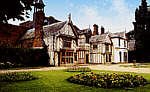
Wythenshawe Hall was built by the Tatton family who lived their
between 1540 and 1926, when Robert Greville Tatton sold the
hall and park to Lord Simon of Wythenshawe, who immediately
donated them to the City of Manchester. Several rooms are open
to the public, including the Dining Room and the Drawing Room,
the latter being the oldest surviving part of the original 1540
house. It has wall paintings celebrating marriages between the
Tatton and Booth (of Dunham Massey) Families in the late 16th
century. (See Dunham Massey).
The Hall also contains many fine paintings and drawings, now
administered by the City Art Galleries, as well as hosting frequent
and regular visiting exhibitions.
A new display records the history of the house and family through
memorabilia, documents and paintings. Recently, the external
timbers have been restored and the black and white paint removed
to show the facade in its near-original condition. To the rear
are beautifully maintained Victorian gardens. Facing the Hall
stands a monument to Oliver Cromwell whose troops occupied the
Hall in 1644.
FACILITIES
Self-service drinks and snacks are available in the Horticultural
Centre within the Park. A small range of items inspired by Wythenshawe
Hall is on sale at the Hall reception desk. The Hall welcomes
disabled visitors wheelchair access is only posssible on the
ground floor. There is parking immediately outside the Hall.
The nearest accessible toilets are situated in the courtyard
of the Park offices 200 yards from the Hall. Guide dogs and
hearing dogs are welcome. Photography is not permitted within
the Hall. Regretfully there are no baby changing facilities.The
Hall is available for corporate entertaining, receptions and
meetings - contact telephone: 0161-234 3039.
OPENING
Open from end of March to the end of September from Thursday-Sunday
and Bank Holidays, 10.00am to 5.00pm. The Park is open to the
public all year round. Please note that times may change - check
before setting off.
ADMISSION
Free.
LOCATION
& DIRECTIONS
Located in the centre of Wythenshawe Park, 5 miles south of
Manchester city centre. Accessible by car from the M56 Motorway
- take the B5167 Wythenshawe Road (junction 3) to Wythenshawe
Park. From the A5103, take the B5166 exit to Northern Moor/Sale
Moor, and bear first left onto the B5167. The park main entrance
is on the left.
There is free parking outside the Hall.
Access by Bus on services 101,104, 105 from Manchester city
centre.
|

Books
about Wythenshawe Hall
|
Hall I' Th' Wood
Green
Way, off Crompton Way, Bolton BL1 8UA.
Telephone: 01204-332370

This small but fine Tudor manor house, one-time dwelling place
of Samuel Crompton, the
inventor of the spinning mule, has recently undergone significant
restoration. It is located in the northern suburbs of Bolton,
just off Crompton Way, the town's main northerly by-pass road,
and is well signposted. It has been preserved as a museum to the
memory of Crompton, thanks largely to Lord Leverhulme, another
Bolton man who made his fortune in soap manufacture and founded
the town of Port Sunlight in Birkenhead.
Leverhulme purchased the house and rescued it from complete dereliction
in 1899, after which he presented it to the Borough of Bolton.
He continued to by 16 and 17th century furnishings for the house
right up to the time of his death in 1925.
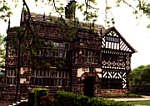
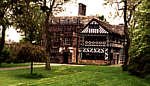
The house is an odd mixture - to the right, the original building,
a black and white half-timbered structure standing on sandstone
footings, built by Lawrence Brownlow in 1483, and on the left
a stone wing built by a later resident, Alexander Norris in 1648.
Norris had demolished the west side in order to do this. There
are 10 rooms to view, including the dairy, which houses a collection
of old household and kitchen implements. Upstairs is the Crompton
Room, where he built his prototype spinning mule, while his family
lived downstairs.
Also exhibited are copies of Crompton's letters pertaining to
his battle to obtain a parliamentary grant for his invention,
a spinning wheel which he used for spinning flax yarn, his favourite
armchair, his grandfather clock, a trunk in which he kept his
papers, and an organ which he built.
Other Crompton relics are to be found in adjacent rooms, including
his violin. Unfortunately, the house is difficult for disabled
visitors, and only the ground floor is feasible for wheelchairs.
Opening:
Open from the beginning of April until the end of
September from Wednesday to Sunday 11.00 - 5.00pm and from October
to the end of March on Saturday and Sunday 11.00-5.00pm.
Entrance costs £2 for adults, £1 for children and
concessions and family tickets are £5.
Please
note that times may change - check before setting off.
|
Books about
Hall I' Th' Wood
|
|