|
Virtual
Hosting by

TheServerBank
Drawings
by John Moss
|
 |
 |
Manchester
Celebrities
Industry, Commerce & Business Entrepreneurs
(4 of
6)
|
Eddie
Shah
Newspaper Publisher & Journalist
Eddie Shah
sprang into public consciousness in 1983 as a result of an industrial
dispute at his Messenger Newspapers group plant at Warrington.
Shah intended to launch a brand new concept in newspapers -
"Today", the first ever national daily newspaper to be printed
in colour. Hitherto, Shah had been an obscure publisher based
in Manchester.
This new concept required a revolutionary approach, which the
print industry, hide-bound with old traditions, was loathe to
accommodate. Shah decided to print without the unions and employed
"unqualified" printers, prompting violent "strike busting" protests
and street fighting. His own house was fire-bombed on several
occasions.
The new national tabloid newspaper was to use computer-driven
technology instead of hot metal type, which had been used since
the time of Gutenberg in the 15th century. Computerised reporting
meant that later deadlines were possible and as a result news
could be "fresher" and more up-to-date. Further, the new technology
meant there would be no need for antiquated, labour-intensive
machinery or many of the very costly staffing levels which had
been kept in place by Fleet Street's powerful print unions and
many of their outdated practices. Shah's innovation was revolutionary
and world breaking news.
The design of the newspaper was overtly based on USA Today,
an American colour broadsheet newspaper which had been launched
a few years earlier. Computerised typesetting, or "desk top publishing"
as it came to be known, meant that the idea of producing a newspaper
from scratch without any of the traditional methods was practical
and simple, though it took some getting used to by older more
traditional journalists. Many failed to make the change and were
sacked. Few had sat in front of a computer screen before and there
were many teething troubles.
The first much-heralded edition failed to materialise on time,
printing machines were new and unknown and their operators were
inexperienced.
Early editions were often badly printed or poorly registered and
became known in the trade as "Shah-Vision". In time however, the
technology was mastered, though advertisers failed to bring in
much needed revenues. It has been said that Shah failed to read
the market well enough to ascertain whether it was capable of
supporting yet another daily newspaper. In the event the business
failed, was taken over in1987 News International, and, later absorbed
by Rupert Murdoch's News International empire within two years.
"Today" ceased publication in 1995, though its legacy lives
on to this day, as we take for granted that our newspapers will
be produced on computer screens and that they will be printed
in colour. Shah also went on to publish another newspaper,
"The Post", which also failed.
Back
to Top
|
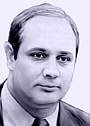
Eddie Shah
|
|
|
Samuel
Oldknow
Cotton Manufacturer
(1756-1828)
Samuel Oldknow was born in Nottingham in 1756. He served an apprenticeship
in his uncle's draper's shop before moving to live and work in
Manchester where he became a cotton manufacturer.
In 1779 he purchased several of Samuel
Crompton's spinning mules, and was to specialise in the weaving
of fine muslin, and by the turn of the century probably the country's,
if not the world's, largest manufacturer of muslin. These sold
well in locally and in London so that in 1785 he was encouraged
to open business premises employing over 300 weavers in Stockport.
By 1790 he had built a new mill in the town which was driven by
a Boulton & Watt steam engine. In 1793 he opened another mill
in Marple on the outskirts of Stockport.
Oldknow went on to operate his mills in the area for a further
40 years. Some time around 1798 and he formed a partnership with
Richard Arkwright, after which Oldknow concentrated on running
the mill at Marple.
His works were to change the face of Marple beyond all recognition
and it was he who was largely responsible for the industrialisation
of the area. Apart from the mill, he built roads, bridges, coal
mines and housing for his workers.
He was also instrumental in the construction of the Peak
Forest Canal, and as a mark of respect for his good local
works, a monument was erected to him in the local church which
he had built. In 1784, with a loan from Arkwright of £3,000 he
purchased a house, warehouse and land on Upper Hillgate in Stockport.
The house, built around 1740, still stands as offices today.
In 1824 Samuel Oldknow was appointed High Sheriff of Derbyshire.
On his death in 1828, at the age of 72, he was considerably in
debt to the Arkwright family and his estates became their property
in settlement. He died, revered and much loved - over 3,000 people
attended his funeral.
Back
to Top
|
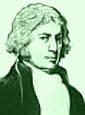
Samuel Oldknow
of Mellor |
Samuel
Brooks
Manchester Banker
(1792-1864)
Samuel Brooks made his name and fortune as an important Manchester
banker. By 1846, he already owned more than 600 acres of land
in Sale, almost a third of the town's area. An astute businessman,
he ploughed a great deal of money into the purchase of land for
suburban residential development which he sold on at considerable
profit to emerging Manchester industrialists, of whom there were
many in mid-nineteenth century Manchester.
In 1859 he agreed a deal with the Manchester South Junction &
Altrincham Railway Company for land to build a new railway station
to serve the wealthy residential area of Brooklands Road. Brooks's
name still survives as the name on the station, which today is
the Brooklands Metrolink Station on Marsland Road.
Back
to Top
|
|
Joseph
& Edward Holt
Manchester Brewers
Joseph Holt
was a weaver's son born in 1849 in Unsworth (a district in Bury
Metropolitan Borough). Unsworth was one of the many small textile
towns and villages that surrounded 19th century Manchester and
were an integral part of its cotton industry.
As a young man Holt was carter at Harrison's Strangeways Brewery.
He went on in 1849 to marry Catherine Parry, a schoolteacher from
Wales. It was her astute business sense that persuaded Holt to
mortgage his property in order to set up a small brewery in central
Manchester. In 1855 the brewery was moved to the Ducie Bridge
Brewery, by which time Holt was wealthy enough to be able to make
loans at beneficial interest rates to help local publicans to
set up in business in return for exclusive rights for the sale
of his beers on their premises. In 1860 he bought land in Empire
Street and built a brand new brewery.
By 1882 he had established a chain of 20 houses and was able to
hand most of the day-to-day running over to his son Edward, who
in his turn went on to further expand and develop the brewery
business. By 1901 Edward had installed an automatic bottling production
line.
Edward went on to become a successful local entrepreneur and became
involved in local politics. He was instrumental in establishing
Manchester's water supply directly from the Lake District, and
in 1908 he was elected Lord Mayor of Manchester. Despite the anger
that his election engendered in the growing northern temperance
movement; Edward went on to be re-elected for a further two years.
The Holt family are probably best known in the region, apart from
their fine beers, for their support and sponsorship of Christie
Hospital in Withington (of which the Holt Radium Institute still
records their family name). Christies has an international reputation
as a leader in the fight against cancer and for research into
its cure.
The Joseph Holt's Derby Brewery has remained in the family for
over four generations and the company now own 127 pubs, mainly
in and around North Manchester.
Back
to Top
|
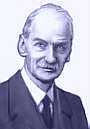
Edward Holt |
Nicholas
Kilvert
Kilvert's Lard
(1822-1883)
Nicholas Kilvert (Senior) was born in Over in Cheshire in 1822,
the eldest son of Thomas Kilvert, and was the founder of N Kilvert
& Sons in Trafford Park, manufacturers of Kilvert's Lard,
the world-famous brand of cooking fat. Kilvert lived at Ashton
Lodge in Ashton on Mersey.
The origins of the family business had, in fact, begun earlier
when Nicholas' father, Thomas Kilvert, (1799-1871), is recorded
as having moved with his wife Sarah (Vernon) to Manchester in
1821 to set up a pork butcher shop at 13 New Market, Salford,
and another later in Chorlton. He lived at White Cross Bank in
Chapel Street, Salford.
One of Nicholas Senior's four sons, another Nicholas, (1859-1922),
lived in Brooklands in south Manchester and became Managing Director
of the company on the death of his father. This Nicholas went
on to become a Manchester City Councillor for a time.
When he died, his younger son, Harry Vernon Kilvert, (born 1862)
took up residence at Ashton Lodge. He too became MD of the company
on the death of his brother Nicholas (junior). Harry Vernon was
an important figure in local politics and was chair of Altrincham
Conservative Association. He was Knighted by Queen Victoria for
sevices to Business and the Community, and his wife, Annie, had
a scout troup named in her honour - "The Lady Kilvert Own
Scout Group".
We
are indebted to Peter Kilvert for supplying much of this information.
|
|
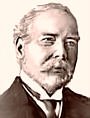
Sir
William Mather MP, LLD, MInstCE
Ironworks Manufacturing
(1838-1920)
Industrialist, entrepreneur, humanitarian and politician, William
Mather was a resident of Woodhill House in Prestwich, and celebrated
head of the Mather & Platt Salford Ironworks Engineering Company.
He attended both Manchester and Bristol Universities and went
on to become Liberal Member of Parliament for Salford for 1885-86,
for Gorton 1889-98 and for Rossendale 1900-1904. He was knighted
in 1902.
Mather was an influential man who regularly entertained contemporary
celebrities at his residence at Woohill House, including inventor
Thomas Edison and Prime Minister Sir Henry Campbell-Bannerman.
He became a respected Industrial Relations consultant and acted
as arbitrator in many industrial disputes, notably in the national
engineers strike of 1897-1898.. He surrounded himself with men
capable of furthering his ideals in the efficient running of industry
and improvement of working conditions for the common man. During
his lifetime Mather would be responsible for many innovations
in work management. As an enlightened man with a far-reaching
vision he had a revolutionary humanitarian attitude towards business
and industrial relations. Mather's philosophy placed the welfare
of people alongside that of profit and in 1893 at his Salford
Iron Works he took the unprecedented and controversial step of
introducing an eight hour working day.
In 1845, the Mather family formed a partnership with John Platt
at Salford Iron Works to serve the expanding business of textile
finishing machines.
By 1883 William Mather had purchased the patent rights to the
Grinnell Sprinkler Aystem for the rest of the world, excluding
America. His company, Mather and Platt, became the leaders in
the British sprinkler industry.
After Sir William's death, in 1920, he and his wife were buried
at St Mary's Church in Prestwich, now within the Borough of Bury.
|
Sir William Mather |
|