|
|
Manchester
Fire & Railway Stations in Northwest England
 

Papillon
Graphics' Virtual Encyclopaedia of Greater Manchester
Including
Bolton, Bury, Manchester, Oldham, Rochdale, Salford, Stockport, Tameside,
Trafford & Wigan |
|
NAVIGATION









































Virtual
Hosting by

TheServerBank
Photos
by John Moss
|
 |
 |
Manchester
Buildings
The Architectural Heritage of Manchester
|
London
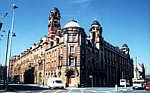
Road Fire Station, Manchester
London
Road, Central Manchester.
Designed
and built by Woodhouse, Willoughby & Langham from 1904-1906
this fine Grade II listed building was headquarters of the Manchester
City Fire Brigade for the first half of the 20th century. It also
housed a police station and a coroner's court, the latter still
being in operation.
This
exuberant buff, terracotta and red brick building occupies a triangular
plot and is located opposite Piccadilly Railway Station. The central
courtyard includes a series of balconies, whose tenements were
once home to 40 firemen, and a training tower. By any measure
it was a well equipped and sumptuous complex, with its own library,
stables, bank and gymnasium.
A
fine baroque building, which presently is under utilised and awaiting
a major cleaning and refurbishment. It was in continued occupation
until the late 1980s, but its future is presently unknown, despite
several plans to convert the building to another function, including
one abortive plan to make it into a hotel.
Back
to Top
|

|
|
|
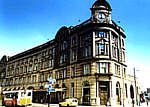
Victoria
Rail Station, Manchester
Station
Approach, (off Corporation Street),
Manchester City Centre.
Originally
a small single storey single platform building designed by George
Stephenson and completed in 1844 on Hunts Bank to serve the Manchester
& Leeds trans-Pennine railway. By this time there were six railway
connecting Manchester to the cities of London, Liverpool, Leeds,
Sheffield, Bury and Bolton - Victoria Station had come to dominate
the Long Millgate area and was one of the biggest passenger stations
in Britain. It was enlarged by William Dawes, who is responsible
for most of the remaining facade, in 1909.
The
present Edwardian building has a 160 yard facade, which still carries
an iron and glass canopy bearing the names of the original destinations
which it served. These canopies served as covered waiting porch
for taxi cabs until they were severely damaged in the 1996 IRA bomb
blast - they have now been completely restored to their former glory.
The cast iron train sheds behind the facade run back for some 700
yards. Initially the station was approached by a wooden footbridge
over the River Irk which has subsequently disappeared beneath culverting
alongside the Cathedral, where it makes
its way unobtrusively into the River Irwell.
Nowadays,
largely serving destinations north and east of Manchester, it is
the main terminus for the adjacent Manchester Evening News Arena,
which was effectively joined onto the original station between 1992
and 1996 to designs by Ellerbe Beckett. Here it forms a major interface
where the Metrolink train joins the streets of Manchester as an
urban tramway. Also a major rail-bus interchange, the station is
linked directly to Piccadilly Station by Metrolink.
Back
to Top
|

|
Liverpool
Road Station, Manchester
Liverpool
Road Station ranks as one of, if not the most important railway
stations in Britain. Manchester can be said to have been the place
where the Railway Age began. It was the service established between
Liverpool and Manchester which first demonstrated the feasibility
of rail as a viable public transport system. Opened to the public
in 1830, it marked the terminus of the newly created line which
ran from Liverpool to Manchester, and it is now part of the Museum
of Science and Industry.
The
station building and the warehouse opposite date from the earliest
days of railway history. It was to this station that the Rainhill
Trials to choose a locomotive to pull passenger coaches between
Liverpool and Manchester arrived. George Stephenson's ubiquitous
"Rocket" being the winner. The rail link, together with the canal
system, was instrumental in the growth of Manchester's industrial
base in the 19th century.
Back
to Top
|
 |
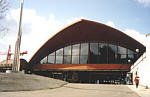
Oxford
Road Station, Mancheester
Designed
by British Rail Regional Architect, W R Headley in 1960 and now
a Grade II Listed building of architectural merit. A striking
and somewhat surprising frontage cunningly devised to fit on an
otherwise awkward triangular site, the structure is described
as 3 conoid (cone-shaped) shells made of wood, glued and nailed
together. This wooden building was actually based on concrete
forms. Restored in 1998. The present building replaced an earlier
Victorian station which had been built by the Manchester South
Junction & Altrincham Railway Company in 1849 on a viaduct
running across Oxford Road over an area known then as "Little
Ireland".
Back
to Top
|

|
Central
Station (G-MEX)
The
Greater Manchester Exhibition Centre
Manchester
M2 3GX. Tel: 0161-834 2700
GMEX
- Greater Manchester Exhibition Centre
Aerial Photograph
Image Courtesy of www.webbaviation.co.uk
© 2005
CLICK ON IMAGE TO ENLARGE
Resurrected
after lying derelict for many years, the old Central Station which
originally connected by rail the City of Manchester to Liverpool
was closed in the late 1960s. In its new form - the Greater Manchester
Exhibition Centre (GMEX) was opened by Her Majesty Queen Elizabeth
in 1986, having cost more than £20 million in converting it to
one of England's finest exhibition centres.
At
over 10,000 square metres it is also one of the country's largest,
the whole space being open without interior supporting pillars,
its vast vaulted roof held up by sheer engineering ingenuity and
simple geometry.
The hall can seat over 9000 people. There are an additional 2,250
square metres of surrounding land adjacent to the main hall for
temporary buildings and exhibitions, with onsite parking for over
1,500 cars. Regular exhibitions are held there - everything from
Aquatic to Computer Fairs, Caravans and Home Exhibitions.
It
also frequently hosts musical and performance events, having already
added Luciano Pavarotti, Simply Red and a Torville & Dean Ice
Spectacular to its repertoire. The conversion of the old Central
Station into its present form is typical of the kind of urban
renewal and inner city transformations which the City of Manchester
Council and the Central Manchester Development Corporation have
undertaken over the past decade, much to their credit and to the
approval of the citizens of Manchester.
This
is a major stopping off point for Metrolink Trams, not only for
GMEX itself, but for Castlefield.
See
Also: Coming
of the Railways - Castlefield
Back
to Top
|
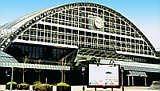
G-Mex as it is
today
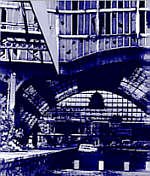
The Derelict
Central Station -
Photo of 1968 by the author

|
|
|
|