NAVIGATION









































Virtual
Hosting by

TheServerBank
|
 |
 |
Bird
Sanctuaries & Nature Reserves
In
the Northwest Region
|
|
These venues
are within a day's return trip by car from Manchester City Centre.
The Wildlife
Trust
Wherever you
live in the United Kingdom, you'll find a local Wildlife Trust
near you. Some local Trusts are now online.
The
Wildlife Trust National Office
The Green, Witham Park, Waterside South,
Lincoln LN5 7JR.
Tel (01522) 544400 Fax (01522) 511616
email - wildlifersnc@cix.compulink.co.uk
Registered Charity No. 207238
The
Trusts cover the following local areas :
- Cheshire
Tel: 01270-610180
Email: cheshirewt@cix.compulink.co.uk
- Cumbria
Tel: 015394-32476
Email: cumbriawt@cix.compulink.co.uk
- Derbyshire
Tel: 01332-756610
Email: derbywt@cix.compulink.co.uk
- Lancashire
Email: lancswt@cix.compulink.co.uk
- North
Wales
Tel: 01248-351541
Email: nwwt@cix.compulink.co.uk
- Staffordshire
Tel: 01889-508534
Email: staffswt@cix.compulink.co.uk
- Yorkshire
Tel: 01904-659570
Email: yorkshirewt@cix.co.uk
|
|
Hillside Ornamental
Fowl
Beech
Hill, Mobberley, Cheshire. Telephone: 01565-873282.
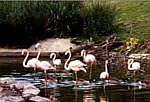
Flamingos,
pelicans, toucans, penguins and wallabies are found here. Parking
on site, picnic area, and refreshments available. Red Rocks Marsh
Our only coastal reserve. Situated on the north of the Wirral
coastline between West Kirby and Hoylake. Nominated as both the
'best' reserve and the 'best birdwatching' reserve this site on
the North Wirral coast . The reserve is 4 hectares and consists
of a reedbed, a salt-marsh, and both embryo and secondary dunes
and slacks. Access is via Stanley Road, Hoylake. Progress on foot
onto the foreshore and then left onto the reserve. Unfortunately,
the site is not accessible to wheelchair users.
Holcroft Moss
An area of
raised peat bog and scrub birch woodland lying next to the M62
motorway just outside of Glazebury in Warrington. The last remaining
area of this type of habitat within the county.
The Quinta
The Quinta
at Swettenham comprises over 36 acres of ancient woodland, grassland,
an arboretum and water features. Part of the property is designated
a Site of Special Scientific Interest (SSSI), whilst another part
is a Site of Biological Importance (SBI). The new woodland area
is grant-aided by the Forestry Authority, and the grassland is
covered by a Countryside Commission stewardship scheme. The reserve
also forms part of Cheshire County Council's Dane Valley Area
of Special County Value for Landscape (ASCV). Because of the mosaic
of habitats on the reserve, the opportunities for use as an educational
resource are vast. It is intended that, over the next few years,
interpretation displays will be installed on the site to add to
the experience of the visit.
Wildfowl &
Wetlands Trust Martin Mere
Tel:
01704- 895181
Martin Mere
is in Lancashire between Ormskirk and Southport, an excellent
place for seeing huge numbers of Pinkfoot Geese, Bewick and Whooper
Swans as well as large numbers of Duck. Renowned for its wide
selection of ducks, geese, swans and flamingos Martin Mere's facilities
include: childrens adventure playground, pond-dipping zone, exhibition/craft
gallery and superb bird watching facilities. There is an ongoing
programme of special events and activities. The site is open all
year round daily from 9.30am to 5.30pm (earlier in winter). Closed
25 December. Free parking for cars and coaches; restaurant; gift
shop; facilities for disabled people; wheelchair access.
Leighton Moss
Leighton
Moss, Silverdale, Carnforth, Lancashire. Tel: 01524 701601.
One of north-west
England's largest venues for birdwatching, with shallow meres,
reed-beds and woodland. Its varied wildlife includes such special
birds as breeding bitterns, bearded tits and marsh harriers, otters
and roe and red deer. As well as a centre with excellent information,
the reserve has seven birdwatching hides, four of which have wheelchair
access, and nature trails. Facilities include car parking, a picnic
area, shop, snacks and light refreshments facilities, cycle facilities,
visitor centre and organised teaching programmes. There are toilets
with facilities for disabled visitors. On offer is also binocular
hire. There is a charge for RSPB non-members. Opening times are
from 1000 am - 5.00 pm. Public transport: rail - Silverdale 200
yards. Members of the RSPB and its club for children, the YOC,
are admitted free to all RSPB reserves. You may join the Society
at reserves.
Mersey Estuary
The Mersey
Estuary has a similar range of species to the Dee, with especially
large numbers of Pintail, Teal, Wigeon, Shelduck, Dunlin and Redshank.
The Duck have decreased in recent years but good numbers still
occur. Unfortunately the best areas for the duck, Manisty Bay
and Stanlow Marshes, have no public access but you may be able
to visit by arrangement with the Merseyside Naturalists Association.
Areas where there is public access are Seaforth Nature Reserve
(North Liverpool), Otterspool Promenade, Hale Lighthouse and Eastham
Country Park. Seaforth Nature Reserve in particular is well worth
a visit. Although not a pretty place at the North end of Liverpool
docks this reserve is a magnet for birds, these include a good
selection of waders and gulls as well as a nesting colony of Common
Terns.
Frodsham
Marshes
Frodsham Marshes
are an exceptional area for birdwatching all year round. Species
include a large range of duck species, Hen Harriers, Marsh Harriers,
various waders including a good selection of rarities and in 1997
Spoonbills attempted to breed with up to six present during the
summer.
Woolston Eyes
Woolston Eyes
Reserve is an area of water, marsh and reed beds situated between
the Manchester Ship Canal and the River Mersey near Warrington.
Two hundred and twenty species have been recorded on the Reserve,
including thirteen species of raptor, more than thirty species
of wader, all five grebes, the three woodpeckers, and five species
of owl. In winter large numbers of wildfowl can be seen and in
the spring and summer several hundred warblers breed.
Conwy Estuary
The Conwy
Estuary has similar duck and waders to the Dee, albeit in smaller
numbers, but has the added bonus of some exceptional scenery.
There is an RSPB reserve here (just off the A55) which has a number
of freshwater lakes as well as good views over the estuary.
Back
to Top
|
|