|
Manchester
Airport in the Northwest of England
 

Papillon
Graphics' Virtual Encyclopaedia of Greater Manchester
Including
Bolton, Bury, Manchester, Oldham, Rochdale, Salford, Stockport, Tameside,
Trafford & Wigan |
NAVIGATION









































Virtual
Hosting by

TheServerBank
Photos
by John Moss
& Gary Burns




|
 |
 |
|




|
The Development
of Manchester Airport
Tour
Centre
Guided
tours of Manchester Airport for groups.
Email: tourcentre@tasmanchester.com
Aviation Society Spotter's Club
Membership Enquiries:
Email: a.birtles@btinternet.com
TAS Information Centre Office
Winged Words and Flight Check publications. Tel: 0161-489
2443
Email: admin@tasmanchester.com
Airport
Parking Manchester
See
Main Page - Airport
Parking
The
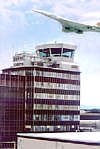
Original Ringway Airport
Manchester
has a long association with aircraft and flying. From the early
days of the Avro and the Lancaster bomber to the contemporary
supersonic elegance of British Airways Concorde.
It
was in 1934 that Manchester
City Council approved the building of Ringway Airport, which
was opened in 1938 with the completion of the original terminal
and the commencement of scheduled flights.
However,
the Second World War brought a swift halt to scheduled flights
in 1939, and for the duration it was the home base of 613 Squadron
RAF and the Parachute Training School.
Manchester
Airport PLC
Scheduled
air services recommenced in 1946 and in 1948, the airport saw
the first visit by a military jet aircraft. In the following years
the original runway was extended several times (in 1951 to 5900
feet, in 1959 to 7000 feet, in 1961 to 7500 feet, in 1965 to 7900
feet, in 1969 to 9200 feet, in 1982 to 10,000 feet.
In the meantime, the airport had seen the arrival of its first
"jumbo" aircraft in 1970, and of the first visit by "Concorde"
in 1976.
In 1975, the airport changed its name to "Manchester International
Airport" and in 1986 "Manchester Airport PLC" was incorporated,
at which time it changed its name to the present form : "Manchester
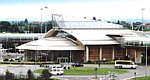
Airport". In 1992 the Railway Station and the new Terminal 2 were
opened.
Manchester
Airport News
Manchester
Airport news page - a daily updated airport news website: http://www.uk-airport-news.info/manchester-airport-news.ht


|
Manchester
Airport World Freight Centre
Nowadays,
over 20 million passengers pass through its booking hall. Originally
called "Ringway Airport", it is now the third biggest international
air terminal in Britain.
Rail
linked to the city centre, it takes only 15 minutes to reach,
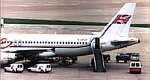
though it is 10 miles out. Air traffic controllers currently handle
94 airlines, with over 170 world-wide destinations.
In
1994, the airport handled over 73,000 metric tonnes of cargo and
freight. It has come a long way since the City
Council first decided to build a municipal "aerodrome" in
1929, and the first arrival of an "international" service landed
in 1938 in the form of a KLM DC-2 from Amsterdam.
Best Airport in the World
Manchester
Airport is unlike most other major UK airports in that it is not
run by the British Airports Authority (BAA), as most are, but
it is independently managed by Manchester Airport PLC, and owned
by all 10 Metropolitan Boroughs
which make up Greater Manchester.
It is most proud of its independent status, and this is reflected
in its mission to become "the Best World Airport".
The Future of Manchester Airport
Many
further developments are planned, including the provision of airline
offices, major terminal extension and refurbishments, a second
runway (currently under construction), a new public transport
interchange with the full integration of the City's Metrolink
tram/train service, the building of a new Inter-Continental 5
Star Hotel, various extensions to the Arrival Halls, and generally
increased capacities for expected passenger growth.
The
Airport anticipates more than 30 million passengers annually by
the end of the decade.
Manchester Airport Parking
See
- Main Entry
Manchester
Airport Taxis
See
Taxis - Main Entry


|
|
|
|
|