NAVIGATION









































Virtual
Hosting by

TheServerBank
Photos
by John Moss


|
 |
 |
Shopping in Manchester
|
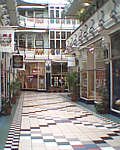
Barton Arcade
St
Ann's Square and Deansgate, Manchester

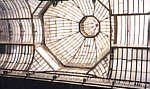
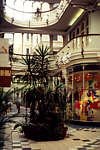
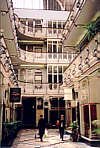
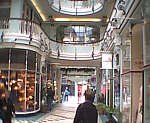
This fine
three storey cast iron and glass conservatory-like structure with
its cast iron roof was erected by Corbett, Raby and Sawyer in
1874, and after extensive restoration in the 1980s, has emerged
in recent years as a delight to see and visit. It is a Grade II
Listed Building of special architectural interest, and now houses
exclusive shops and upper storey offices.
The arcade
was the first building erected on the newly widened Deansgate.
Its cast iron and glass were produced at the Macfarlane Saracen
Glass Factory in Glasgow. Macfarlanes were the leading makers
of architectural cast iron decorative details. Walter Macfarlane,
the founder of the company was originally a silversmith.
Many of the
original shop fronts have long since disappeared as have the decorative
tiled floors, but its renaissance is a tribute to the conservator's
skill and sensitivity - it houses many elegant and high class
shops, although they seem to change hands all too frequently (too
high rates?). Well worth a walk through - even if you're not buying.
|
|

Barton
Arcade &
its Makers - the Macfarlane Company
We are indebted
to Stuart Durant for supplying information relating to
the Macfarlane Company. Mr Durant, a bookseller in Richmond on
Thames and one time Reader in Design History at Kingston University,
supplied details of an illustrated book of which he had recently
catalogued, on the Macfarlane Company's work, entitled "Examples
Book of Macfarlane's Castings".
The following
text is a largely verbatim account from Mr Durant's email to us
"Comparatively
little of Macfarlane's work survives, though much of it would
have been exported. Many of the designs seen here (ie. in the
book) are registered and can be precisely dated by the official
kite marks which accompany them.
The
earliest of the designs in the book were apparently registered
on 17th March 1862 and the latest on 14th May 1875. (A complete
list of dates of registration is loosely inserted). More than
half the designs date from 1875 and this appears to be the most
likely date of publication.
Although
no architects, or designers, are named the quality of Macfarlane's
design was exceptionally high, Lithographs show a large shopping
arcade, balconies, balusters, band stands, castings for bridges,
large conservatories for botanical gardens, clock towers, a
drinking fountain, a variety of complete façades, lamp standards,
pavilions, railway station waiting rooms and platform coverings,
shop fronts, tomb railings etc.
The
components of each structure are clearly indicated. These are
architecturally sophisticated and reveal that the principles
of system building and prefabrication have their origin in cast
iron. All the complete buildings illustrated here have registration
marks for 1875 and it is likely that Macfarlanes used this publication
to launch their cast iron buildings. The fact that this copy
was presented to W J Rennison, a Stockport architect, indicates
that Macfarlane's clients were often likely to have been architects.
Cast
iron architecture is taken a great deal further here than it
was by Paxton at the Great Exhibition (Hyde Park 1851) or even
by Viollet-le-Duc in Entretiens (1863-72).
A
number of Macfarlane¹s arcades were actually built - the largest,
Barton Arcade in Manchester - completed in 1900 - is shown in
this book, The Arcade in Johannesburg - circa 1900 - and the
Alexander Arcade in Swansea of circa 1890 also appear. (See
: Johann Friedrich Geist: "Arcades - The History of a Building
Type", 1983, pp - 284-5, 351-6, 553-4).
The
design for the Barton Arcade was registered on 28th April 1875
and no designer is mentioned - I conclude that it was very likely
to have been "bought off the peg" and probably modified to fit
the site by an architect. Geist - cited above - says the design
was inspired by the Galleria Vittorio Emanuele (1868) in Milan.
I doubt, however, if this is the case."
Footnote
"I wonder how many people in Manchester know that they have
an architectural treasure of international importance. It should
be listed Grade One of course. Regards - Stuart Durant. "
<
Return to Shopping Menu
|
|